The Loewenhielm Family
– 4 min read


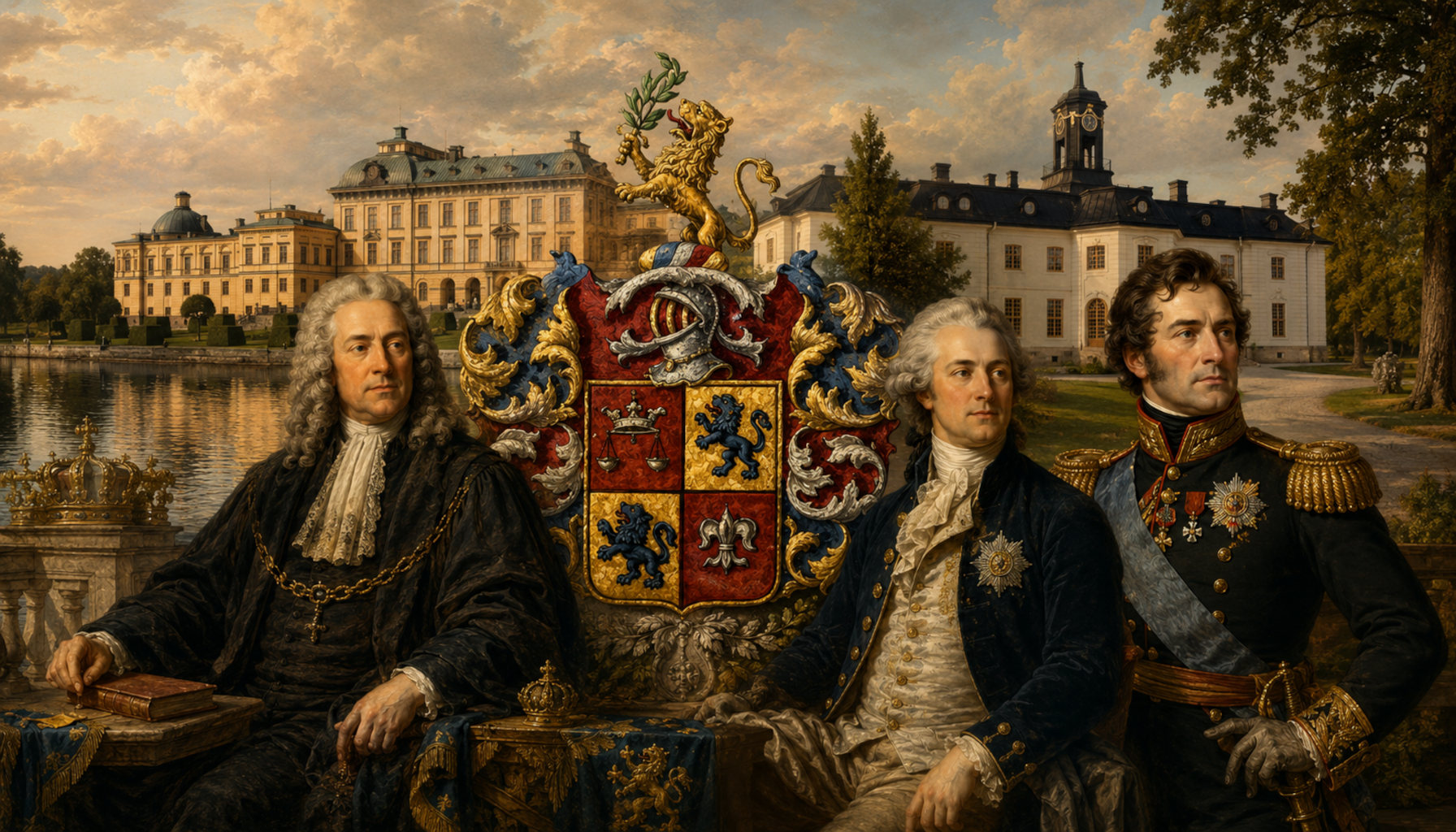
The Lowenhielm family was a Swedish noble family of the service aristocracy, registered at Riddarhuset as noble family no. 1791, ennobled on 12 May 1725 and introduced in 1726. Their roots lay not in some misty warrior legend but in the educated clerical and legal world of western Sweden, especially Varmland, and their primary linked Y-DNA haplogroup is I1a1b1b1c. That matters because the family's story is very much a Scandinavian one: a line rising through study, office, royal loyalty, and careful placement in the machinery of the Swedish state.
The founder of the noble line was Gudmund Norberg, later Gudmund Lowenhielm, born in 1656 at Gillberga parsonage in Varmland. He belongs to that fascinating generation in Swedish history when the crown increasingly depended on trained men of law and administration, and when families of learning could climb into hereditary nobility by service rather than by medieval sword alone. Gudmund studied at Karlstad and Uppsala, then built a formidable career as advocate, military auditor, vice district judge, district judge in Bohuslan, mayor of Stromstad, assessor in Gota Court of Appeal, lawman in Kristinehamn, and later court councillor. From the same broader kin network came the noble family Nordenborg, the noble and baronial Nordenfalk families, and later the comital branch of Lowenhielm itself. In other words, this was a family that grew out of paperwork, education, and royal administration, and ended up in palaces, embassies, and the upper reaches of Swedish public life.
Read more about the Bure Family
The family background is richer than a bare list of titles suggests. The Lowenhielms were anchored in a Sweden that was still adjusting to the long aftershocks of great-power expansion, war, and centralization in the late 17th and early 18th centuries. In that world, parsonages, schools, law courts, and provincial offices were ladders of advancement. Estates and associations linked the family to places such as Strom in Kila parish in Varmland, as well as Agnhammar, Hammarsten, Bjorno, Skaggebol, and other properties and offices across western Sweden. Their rise tells us something important about Swedish history: nobility was not only inherited from deep medieval antiquity, it could also be manufactured, quite consciously, by the crown out of useful, educated, loyal servants.
Several descendants carried the family into the highest circles of 18th- and 19th-century Sweden. Carl Gustaf Lowenhielm, born in 1701, became president of Svea Court of Appeal, council president, royal councillor, baron, and count. Gustaf Carl Fredrik Lowenhielm moved in a more courtly and diplomatic world as director of the Royal Theatre, general commander, minister in Vienna, and one of the lords of the realm. Carl Axel Lowenhielm, of the comital branch, served as general major, governor of Drottningholm and Svartsjo palaces, and a member of the Swedish government from 1822 to 1839. So the family's arc runs from a Varmland parsonage to court rooms, ministries, theatres, embassies, and royal residences: a remarkably Swedish path into aristocratic refinement.
The clearest geographical anchor for the family is Gillberga in Varmland, where Gudmund Norberg was born at the parsonage, together with the nearby landscape of Kila parish and Strom. This is not just a pin on a map. It is the sort of provincial Swedish setting that produced generations of clergy, educated sons, and local officials in the early modern period. Varmland, with its inland routes, parish structure, and links westward and southward, was fully part of the kingdom's administrative fabric while still retaining the feel of a rooted local world. A parsonage in this context was not merely a house for a clergyman. It was often a small intellectual center, a place where books, schooling, Latin, account-keeping, and ambition lived side by side with farming and parish duties. That helps explain how a man like Gudmund could emerge from it and move steadily upward through the legal and governmental hierarchy. The wider area tied to the family can still be visited today, including parish landscapes and historic districts associated with their early roots, and for anyone interested in heritage it offers exactly the right sort of setting: not grand ruins, perhaps, but the lived geography from which Swedish service nobility actually came.
Explore the Lagerbielke Family
The primary haplogroup linked here, I1a1b1b1c, sits within a broader Scandinavian and northern European Y-DNA story. We should be careful: ancient samples with related or linked I1 lineages are not proof of direct descent from the Lowenhielm family. But they do help sketch the deeper backdrop of the paternal world from which such a family ultimately emerged. Related or linked examples appear across a striking range of times and places, including Neolithic Sweden at Albacksbacken Maglarp (CGG105926), Gothic-associated Poland at Moroczyn Wielbark (PL070), Migration Period Hungary at Rakoczifalva (RKF183), Longobard-era Pannonia at Savaria Szeleste Barbaricum (SZL026), Merovingian Bavaria at Altheim (Alh_141), Vendel Age Saaremaa at Salme I (VK507), Viking Age Sweden at Uppland Alsike (als007), the Stora Kronan shipwreck from the Battle of Oland (kro016), Viking contexts in Denmark at Asnaes (CGG107443) and Rantzausminde on Funen (VK315), Saxon Lower Saxony at Dunum (DUN005), and even early medieval Britain in Mercia at Wolverton (I16509) and Dumnonia in Cornwall at Widemouth Bay (I16383). There are also related appearances in Dark Ages Italy at Torino Lavazza (To_Lav_T2US16), post-Roman Pannonia at Balatonszemes (Bal_111, Bal_111m, Bal_111x), Iron Age Netherlands at Valkenburg Marktveld (CGG107762), and Viking Age Staraya Ladoga (VK221). The lesson is not that one can draw a neat straight line from any one burial to the Lowenhielms, but that this haplogroup cluster belonged to a mobile northern European world stretching from Scandinavia into the Migration Period, the Viking sphere, and the kingdoms that followed.
Read more about the Gyllenstierna Family
If you have Swedish roots, noble family traditions, or simply an interest in how lines like the Lowenhielms rose from parish learning to aristocratic prominence, uploading your DNA can add another layer to the story. You may find matches to the family, to related Scandinavian noble lines, or to the ancient DNA samples linked with haplogroup I1a1b1b1c and its wider historical world.

Comments