The Lagerbielke Family
– 3 min read


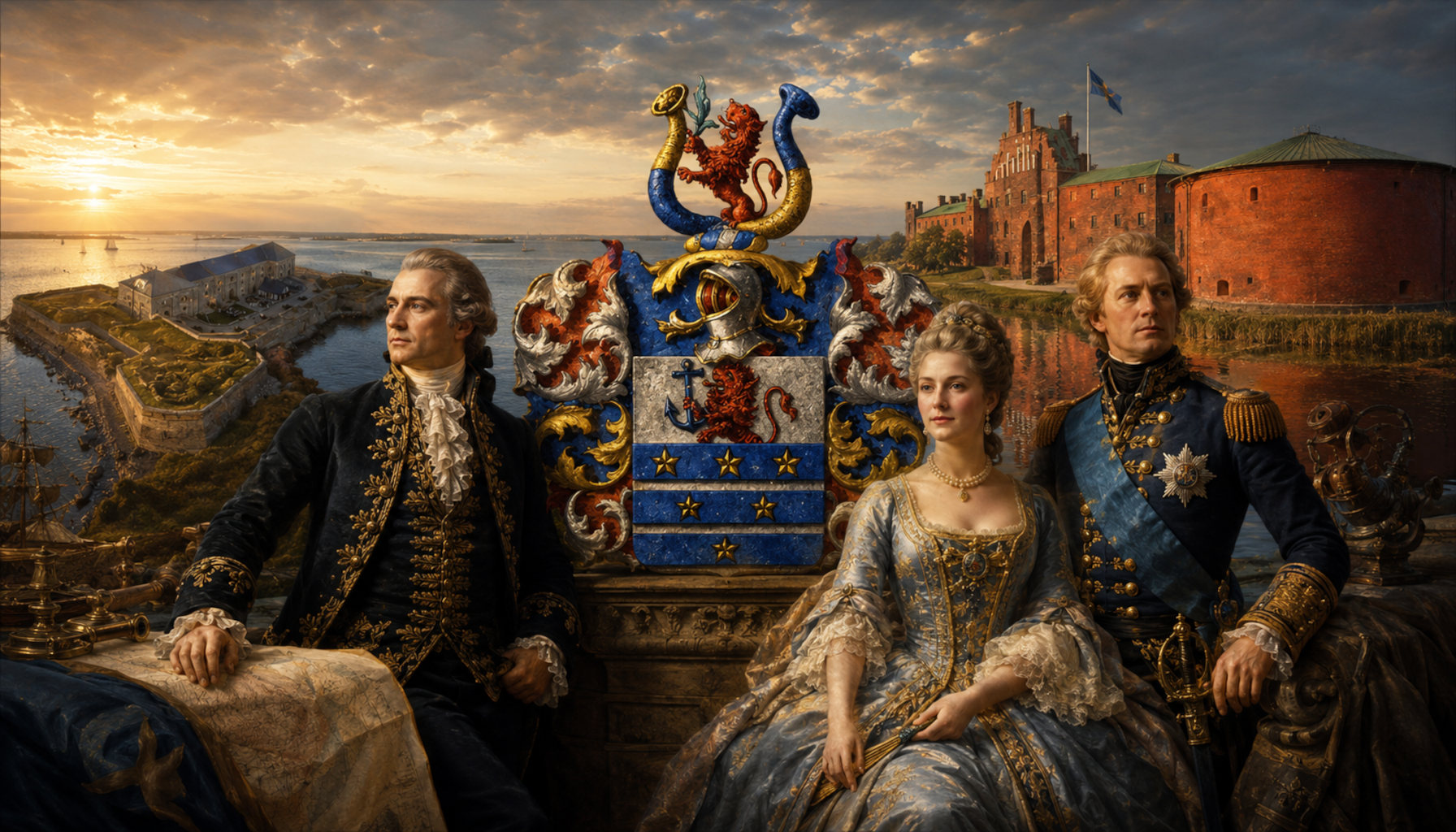
The Lagerbielke family was a Swedish noble family registered at Riddarhuset as noble family no. 1378, with the primary family haplogroup tagged here as J2a1a1a2b2a1. They emerged from a strikingly practical rather than anciently aristocratic background: a family rooted in trade, surgery, administration, and naval service, rising through the machinery of the Swedish state in the great age of Baltic power. Ennobled on 10 September 1698 and introduced in 1701, with a later adoption and ennoblement in 1715, the family shared origin with the noble family Stiernblad and later branched into the baronial and comital house Lagerbjelke.
The older story begins with Benedictus Fistulator, a barber-surgeon and field surgeon who likely came from Scotland, or perhaps from the Schottland suburb of Danzig, before settling in Gothenburg. That matters, because 17th century Gothenburg was one of those bustling northern port cities where commerce, war, medicine, shipping, and migration all collided. Benedictus became not just a surgeon but a merchant and city councillor, and his descendants show exactly how Sweden's expanding crown could turn urban skill into noble status. The central founder of the noble line was Johan Eugenius Fistulator, later Lagerbielke, born in Gothenburg in 1667. His career carried him into customs and admiralty administration at Karlskrona and Blekinge, where he served as customs officer, inspector of the sea customs, over-commissioner at the admiralty, and later admiralty councillor. Around him, the family became deeply tied to Sweden's maritime world: Frans Fistulator, later Lagerbielke, served in the admiralty and became an admiralty captain, while later descendants were linked to Drottningskar sea fortress, Kungsholm fortress, Karlskrona, and the fleet. Among the better-known later figures were Baron Axel Lagerbielke (1703-1782), Count Johan Gustaf Lagerbjelke (1745-1812), and Count Gustaf Lagerbjelke (1817-1895). The women of the family, including Anna Christina, Hedvig Eleonora, Sofia Lovisa, and Sofia Juliana Lagerbielke, also helped knit this house into Sweden's wider noble and naval networks through marriage.
Read more about the Stierna Family
A useful location anchor for the family's later world is Alvsjo gard, south of central Stockholm in today's Alvsjo. The estate is one of the oldest known farms in the area, with medieval roots and a long history as a manor environment tied to the agricultural landscape that once fed and supplied the capital. Over time it passed through different owners and became part of a larger story of landed estates on the edge of Stockholm, where noble, official, and wealthy urban families often invested their status in country property. The main building standing today is later in date than the medieval farm itself, and the site reflects that familiar Scandinavian layering of history: old village land, manor ambitions, changing architecture, and eventually incorporation into the expanding modern city. Alvsjo gard is also associated with preserved green surroundings and a visible historic setting, so it is a place that can still reasonably be visited today as part of the public landscape, even if what you encounter is the accumulated result of several centuries rather than one untouched noble residence frozen in time.
Explore the Royal House of Bernadotte
From a DNA perspective, the Lagerbielke family's tagged paternal line J2a1a1a2b2a1 belongs to a much wider and older story than Sweden alone. We should be careful here: related or linked haplogroup matches are not proof of direct descent from any ancient individual. What they do show is that this lineage appears across an astonishing geographic and historical range. Linked examples include the Medieval Hungarian Bathory male nobility sample Pericei PER04A, Neolithic Anatolia at Arslantepe ART011, post-Roman Hungary at Szeleste Savaria Pannonia Prima SZL009, Piast-era Poland at Milicz PCA0548, and Kingdom of Poland Lublin Zamosc PDH003. The same broader lineage also appears in samples from Carthaginian Kerkouane in Tunisia and Pantelleria I22232, Late Bronze Age Canaanite Megiddo I4519, Iron Age Armenia at Bragdzor I16536 and I16546, Early Bronze Age southeast Anatolia at Tatika I4478, Byzantine Roman Mugla in Anatolia I20320, Late Medieval Ashkenazi Erfurt I13870 and I13864, medieval and later Armenia R11542 and R11713, Makurian Nubia at Kulubnarti I6255, I17475, and I6325, Amorite Alalakh ALA004, post-Roman Sardinia I12220, Greco-era Empuries I8208, Roman Granada I4054, Tivoli Palace Late Renaissance R969, and even a Crusader-period Armenian or Lebanon-linked knight SI-44. In other words, this is the sort of haplogroup trail that reminds us how lineages travel through ports, armies, courts, merchant worlds, and imperial frontiers long before they surface in a Swedish noble pedigree.
Explore the Princely House of Bathory
If the Lagerbielke story catches your imagination, it is worth seeing it as both family history and Baltic history at once: Gothenburg migration, Karlskrona naval administration, fortress command, and the crown's habit of turning useful service into hereditary rank. Upload your DNA to MyTrueAncestry to see whether you match the Lagerbielke family group or any of the related ancient J2a1a1a2b2a1-linked samples that echo across Anatolia, the Caucasus, the Mediterranean, and medieval Europe.

Comments