The Gyllenstierna Family

– 3 min read


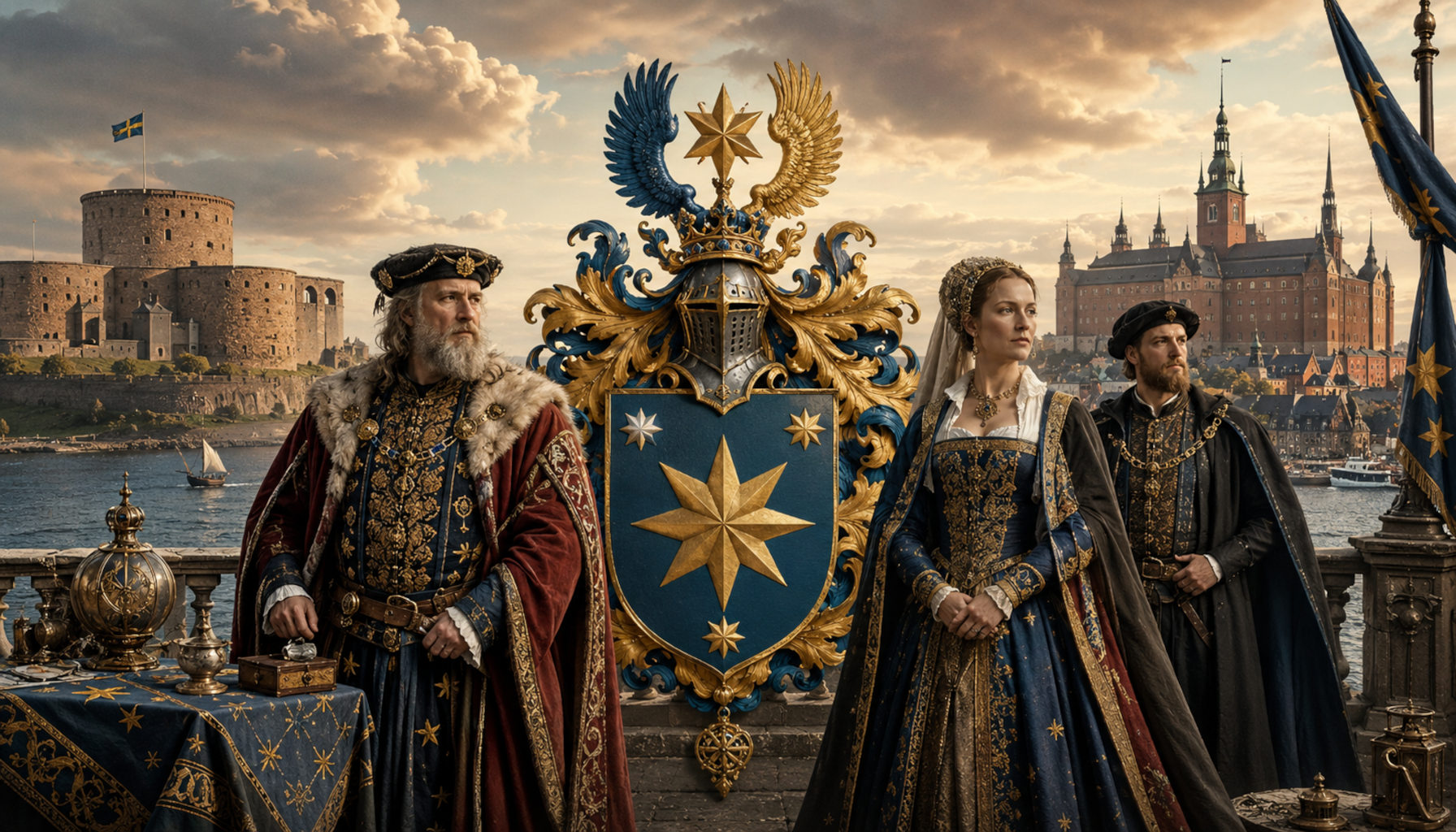
The Gyllenstierna af Lundholm family was one of the great aristocratic houses of Sweden, though its roots lay across the water in medieval Denmark. Registered at Riddarhuset as baronial family no. 3, it received baronial rank on 10 July 1569 and was introduced at the House of Nobility in 1625. The wider lineage began as the old Danish noble house Gyllenstjerne, a family shaped by the political world of castles, landholding, royal service, and the uneasy companionship of the Scandinavian kingdoms under and around the Kalmar Union. Its primary family haplogroup is linked here as R1b1a1b1a1a2b1a1, a paternal line with a deep European time depth. Tags: Haplogroup R1b1a1b1a1a2b1a1, Gyllenstierna af Lundholm, Swedish nobility, Danish nobility.
The family emerges in the record early, with figures such as Aagaard in 1310 and Niels Erikssen in 1350 standing among its older Danish ancestors. From that medieval Danish setting, the line entered Sweden in the 1400s with Erik Eriksson the Elder, knight, royal councillor, and one of the central architects of the Swedish branch. He held estates in both Denmark and Sweden, including Demstrup in Jutland, Krakerum in Monsteras parish, Fagelvik in Tryserum parish, and Stora Bjurum in Skaraborg County. In 1446 he acquired the Oland pledge fief with Borgholm Castle through his father-in-law, was knighted in 1449, became a royal councillor in 1450, and served King Karl Knutsson as court marshal. That is the sort of career that tells you exactly where a family stood: close to the king, close to the castles, and very close to danger. The Gyllenstierna name later became tied to high office, military command, diplomacy, and marriage alliances with houses such as Bonde, Bielke, Baner, Tott, Sture, and Tre Rosor. And of course, in the wider lineage, Christina Nilsdotter Gyllenstierna became one of the most famous noblewomen in Swedish history through her defense of Stockholm in 1520 during the struggle against Christian II.
Read more about the Hellenstierna Family
A key place anchor for this family story is Lindholmen Castle in Vastergotland, strongly associated with the Gyllenstierna sphere and with the political geography of late medieval Sweden. Lindholmen lies in the municipality of Orby, in present-day Marks Municipality, and was once a fortified manor or castle site of real strategic and aristocratic importance. In the later Middle Ages it was connected to some of the highest noble circles in the realm, including the Sture and Gyllenstierna networks. The site is especially remembered because Christina Gyllenstierna herself was born there, which gives it a special place in Swedish historical memory. Today what survives is not an intact fairytale castle, but visible remains and an evocative historic landscape, the sort of place where archaeology and memory do much of the talking. Yes, it can still be visited in the practical sense that the ruin site remains accessible as a historic place, and for anyone interested in Swedish noble history it is precisely the kind of location worth seeing: quiet now, but once close to the hard machinery of power.
On the DNA side, the haplogroup linked here with the family, R1b1a1b1a1a2b1a1, belongs to a wider paternal world seen across many ancient European contexts. It is important not to claim direct descent from named ancient individuals without specific evidence, but there are related or linked samples that help place this lineage in a broad historical frame. Among them are Bronze Age Unetice males from Leubingen Sommerda in Thuringia such as LEU025, LEU055, LEU056, LEU051, LEU060, LEU015, LEU012, LEU041, and LEU026; Bell Beaker and Copper Age individuals from Brandysek and other Czech sites such as I7249, I7278, I7271, and I7251; Celtic and Gallo-Celtic samples such as WBK13 from Durotriges England, 3429, 3431, and 3439 from Pont de Cornaux-Les-Sauges in Switzerland, and I13620 from Roquepertuse in France; and later historical examples stretching into Roman, post-Roman, and medieval Europe, including TAQ018 and related Tarquinii samples in Etruscan Italy, VK177 from the Viking Age St. Brice context at Oxford, PCA0391 and PCA0618 from Piast-connected medieval Poland, and ST1298 from medieval Sint-Truiden in Belgium. What this suggests, in broad terms, is that the family's linked paternal line sits within a long, well-traveled European story rather than a narrow local one: Bronze Age central Europe, Iron Age Celtic horizons, Roman-period mobility, and medieval noble networks all form part of the backdrop.
Explore the Royal House of Bernadotte
If the Gyllenstierna af Lundholm family catches your interest, the next step is a very modern one: DNA. Upload your results to MyTrueAncestry and see whether you match the Gyllenstierna family profile or any of the related ancient DNA samples linked to haplogroup R1b1a1b1a1a2b1a1. It is a fascinating way to connect noble history, archaeology, and your own deep ancestry.
Comments