The House of Vals
– 3 min read


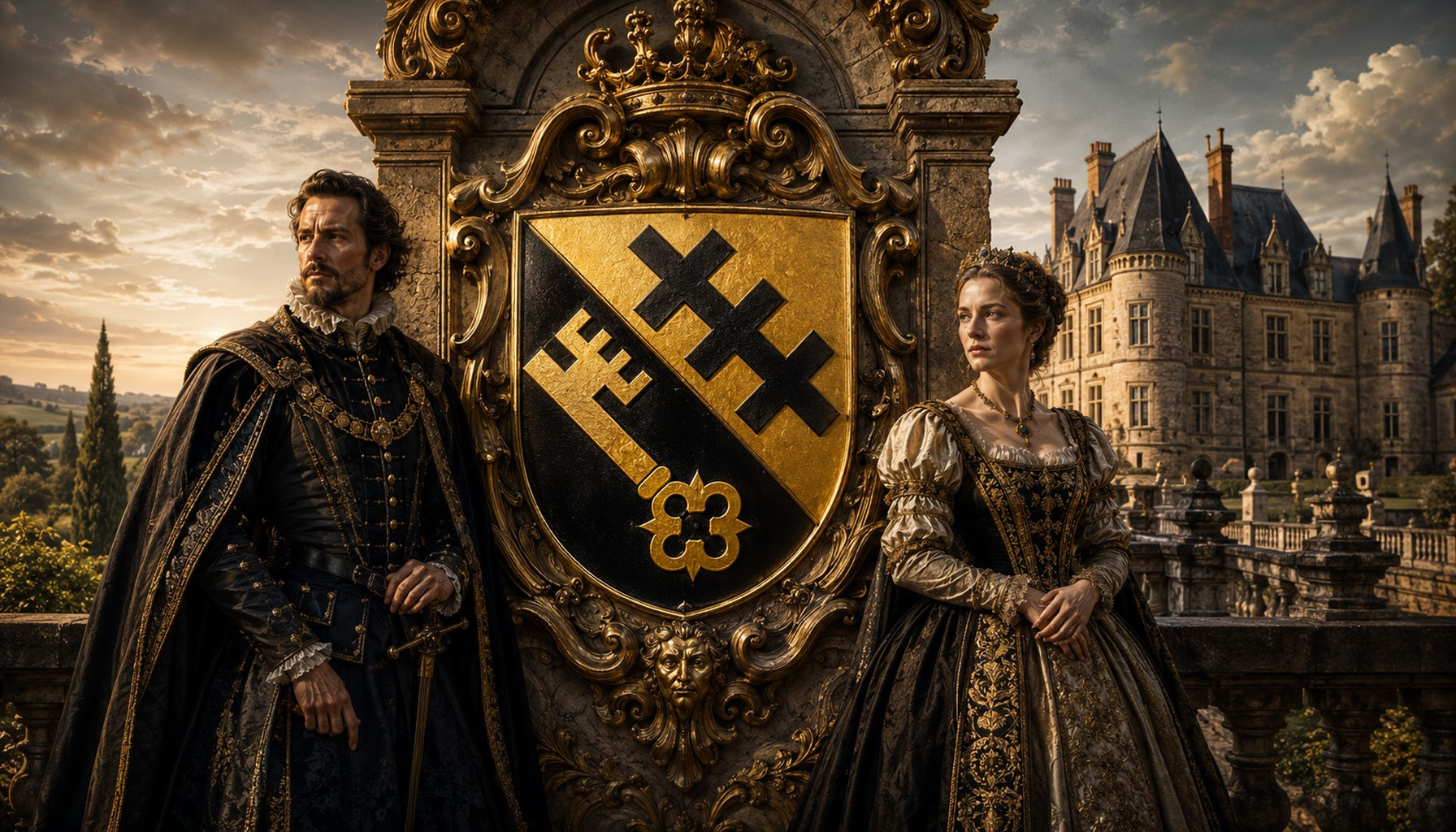
The House of Vals was a provincial noble family whose identity was rooted not in kingship, but in land, lordship, heraldry, and long family memory. The name itself strongly suggests a place-based origin, the sort of territorial naming pattern common across medieval Europe, where a family became known through the estate, valley, manor, or district from which it drew its authority. In that sense, House Vals fits a familiar and important historical pattern: a regional noble house shaped by local influence, military or administrative service, marriage alliances, and the careful handing on of arms and status from one generation to the next. In genetic tagging terms, the primary family haplogroup linked here is R1b1a1b1a1a2c1a2a2a1a.
Families of this kind mattered enormously in the making of medieval Europe. They were the people who held ground, witnessed charters, defended routes, managed tenants, and turned family reputation into durable inheritance. Rather than floating in the glamorous air of royal courts, they were anchored in the practical business of power on the ground. One named historical figure associated with this wider noble tradition is Hubert I de Vaux, Lord of Gilsland, recorded in 1164, a reminder that families in this orbit were already visible in the documentary world of the 12th century. The Vals story is best understood in that same framework: a noble lineage of regional standing, remembered through land, local authority, and heraldic continuity over generations.
Read more about The Vaux Family
A useful location anchor for the family memory is Loch Slin Castle in Ross-shire in the Scottish Highlands, near the village of Lochs. The ruined tower house stands on an island in Loch Slin and is traditionally associated with Highland lordship, changing possession, and the long afterlife of noble residences in the landscape. The castle as seen today is generally dated to the 16th century, though the site likely carried strategic value earlier, as so many island strongholds did. What survives is a compact but evocative reminder that noble identity was never just about a surname on parchment; it was also about a visible seat in the countryside, a defended residence, and a place where authority could be seen. Loch Slin Castle is ruinous rather than fully restored, but it remains a known historic site and can still be viewed and visited from the surrounding area, which makes it an especially good physical anchor for anyone tracing the heritage world around House Vals.
The haplogroup tag most closely associated here with House Vals is R1b1a1b1a1a2c1a2a2a1a, a branch within the wider R1b line that appears again and again across western and parts of central Europe in ancient DNA work. That does not prove direct descent from any excavated individual, and it is important not to pretend otherwise. What it does offer is a network of related or linked ancient samples that help place the family in a much deeper human story. Among those linked examples are multiple Celtic Durotriges burials from Duropolis at Winterborne Kingston in England, including WBK12, WBK20, WBK29, WBK41, WBK05, WBK30, WBK43, WBK06, WBK08, WBK18, and WBK191; Celtic Briton East Kent England sample I13730; Iron Age Worlebury Somerset I11991; Iron Age Roundhouse Bu Orkney I2982; Iron Age Hillfort Battlesbury Bowl I21309; Post Roman Worth Matravers Dorset I11580; Bell Beaker Upavon I4950; Bronze Age Amesbury Down I2417; Bronze Age Trumpington Meadows I3256; Bronze Age Bedfordshire I7576 and I7577; Bronze Age Boatbridge Quarry South Lanarkshire I5473; Early Bronze Age England Thames I5377; and Rathlin2B from Copper Age Ireland. Further linked cases spread across Europe and beyond, including Imperial Roman Zadar in Croatia I26776, Late Roman Conimbriga Portugal R10488, Late Roman Klosterneuburg Lower Austria R10656, Merovingian Alt-Inden IND013, Early Medieval Sint-Truiden ST2025, Medieval Sint-Truiden ST1308, Bronze Age Orkney KD061, Bronze Age Calabria GMO015, Gallic France CGG023699, Medieval Faroe Islands VK27, and even Iron Age Mongolian Steppes RISE603. Taken together, these linked samples suggest not a single family line one can draw with a neat red pencil, but a broad and very old paternal landscape connected with Atlantic Europe, Celtic-speaking zones, Bronze Age mobility, and the long reshaping of populations from prehistory into the medieval world.
Explore ancient DNA and Celtic origins
If the House of Vals is part of your family story, the most exciting next step is to test the paper trail against the deeper genetic one. Upload your DNA to MyTrueAncestry to see whether you match the Vals family profile or any of the related ancient DNA samples linked to haplogroup R1b1a1b1a1a2c1a2a2a1a. It is a splendid way to connect surname history, medieval heritage, and the much longer archaeology of your ancestry.






Comments