The House of Berkeley

– 3 min read


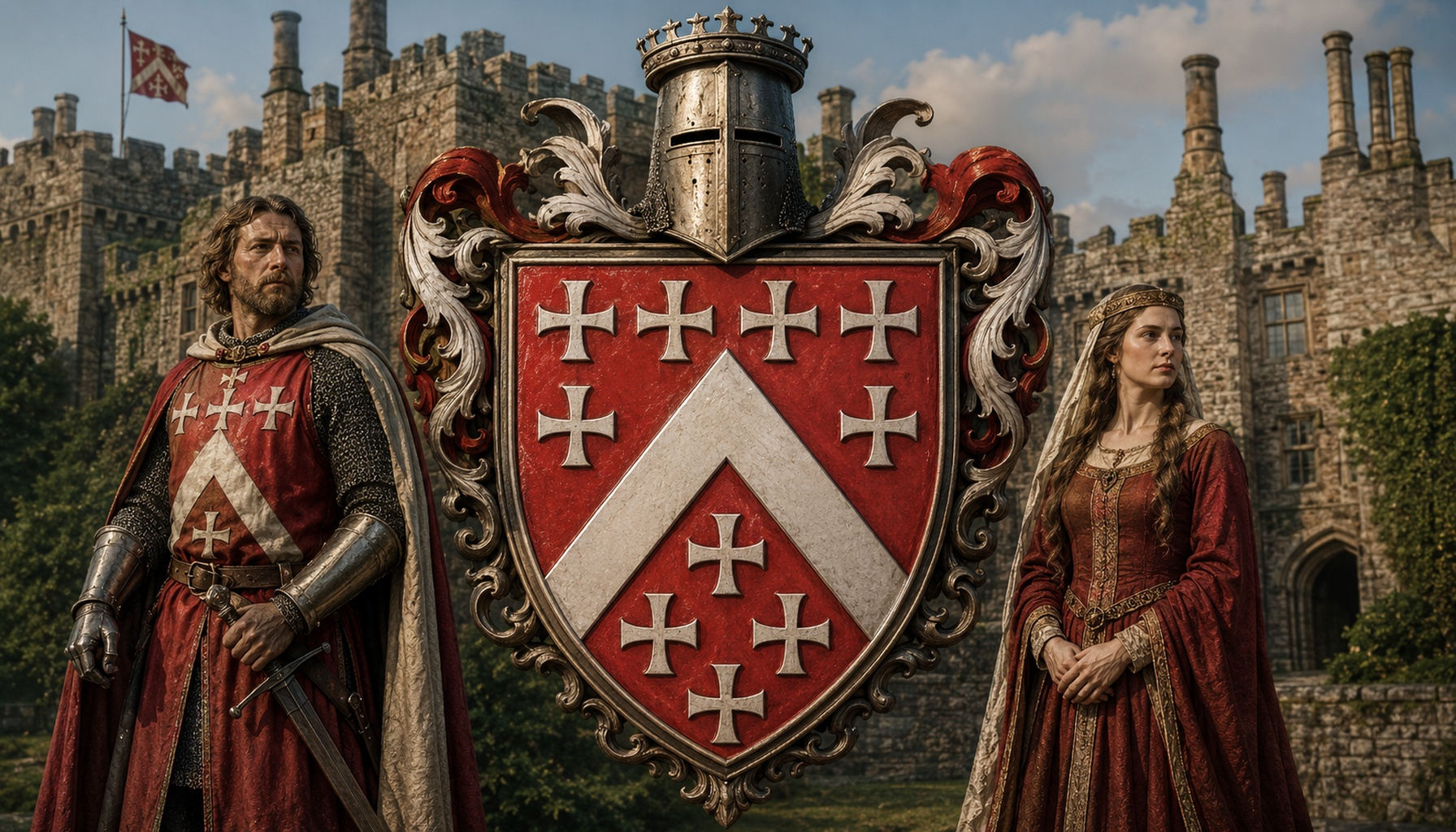
The Berkeley family was one of the great long-lived noble houses of England, rooted above all in Gloucestershire and inseparable from Berkeley Castle. Their name comes from the place itself, Berkeley in the Severn valley, and their story is a classic example of how an English aristocratic house could turn land, lordship, marriage, service, and memory into something remarkably durable. In haplogroup terms, the primary family line here is tagged as E1b1b1b1a1c12, a lineage that adds an intriguing genetic note to a family better known from charters, heraldry, parliament, and stone walls.
Historically, the Berkeleys belong to that very English pattern in which a family becomes almost part of the landscape. After the Norman Conquest, power was tied to control of estates, castles, feudal rights, and local influence, and the Berkeleys managed to hold onto all of these across centuries of upheaval. Their continuity is the impressive thing. Medieval barons come and go, titles rise and fall, lawsuits proliferate, branches split, yet the Berkeley identity persists. Figures such as Thomas de Berkeley, 1st Baron Berkeley, William de Berkeley, 1st Marquess of Berkeley, and George Berkeley, 1st Earl of Berkeley, show the family moving through the long sweep from baronial England to the later aristocratic world, always adapting without quite ceasing to be themselves.
Read more about the House of Beauchamp
Berkeley Castle is the great anchor of the family story, and not merely as a picturesque backdrop. It is one of the oldest continuously inhabited castles in England, standing at Berkeley in Gloucestershire, with origins in the Norman period after an earlier motte-and-bailey foundation. Much of the stone castle dates from the 12th century, and over time it became both fortress and family seat, a place where authority was displayed, defended, and inherited. It is also bound up with some of the darker and more famous episodes of English history, not least the imprisonment and probable murder of Edward II in 1327. Yet what is most striking is not just the drama, but the continuity: this is still, in historical terms, the Berkeley home. And yes, Berkeley Castle can still be visited today, which gives it that rare quality of being not just a monument to the past, but a living thread connecting medieval lordship to the modern landscape.
From the ancient DNA angle, the Berkeley haplogroup tag E1b1b1b1a1c12 links the family, not by proven direct descent but by related paternal signature, to a fascinating spread of historical samples across medieval and late antique Europe. These include Medieval Sicily Segesta Muslim Grave samples SGBN1 and SGBN3, the Late Roman frontier sample STRAZ_I_37 from Straubing Azlburg in Germany, Medieval Kingdom of Portugal Santarem Rua dos Barcos sample LP117_10, Kingdom of Portugal Aveiro Travanca sample LP116_10, the Carthago-Iberian-Maghrebi Cordoba Caliphate sample I7500, and Hispano-Roman and Medieval Taifa of Valencia samples I12644 and I12649. What this shows is not a neat family tree pointing straight at the Berkeleys, but something more interesting in its own way: a wider web of related lineages appearing in frontier zones, Islamic Iberia, Portugal, and Sicily, reminding us how old haplogroups travel through very different worlds before turning up in later noble contexts.
Explore Medieval Sicily's multi-faith genetic history
If the House of Berkeley is part of your family story, or simply part of the world you are curious about, this is where history and DNA become wonderfully complementary. You can upload your DNA to MyTrueAncestry and see whether you match the Berkeley family profile or any related ancient DNA samples linked with E1b1b1b1a1c12. That is the real pleasure of it: not treating the past as a museum label, but asking whether some small piece of it might be walking around in you.






Comments