The Bagge Family of Stradsett Hall: From King's Lynn Merchants to Norfolk Baronets and Ancient Noble Lineages
– 15 min read


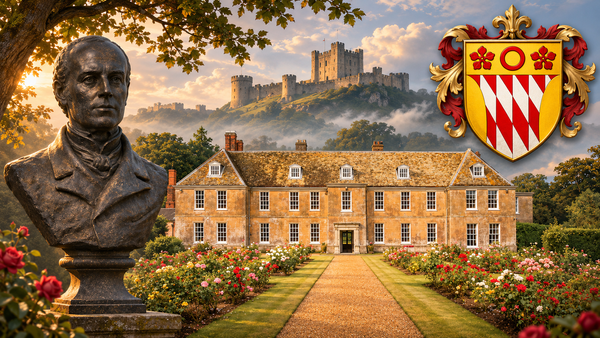
In the peaceful Norfolk village of Stradsett, surrounded by historic parkland and centuries-old trees, stands St Mary's Church, a place where generations of one of West Norfolk's most influential families have been remembered. Among its monuments is the memorial of Sir William Henry Ernest Bagge, second Baronet of Stradsett Hall, whose remarkably short period as head of the family brought an unexpected turning point in the inheritance of a great Victorian estate.
Born into wealth and privilege in 1840, William Henry Ernest Bagge inherited a family history that reached across centuries of English commerce, landed society and aristocratic marriage. His paternal ancestors had helped transform the port of King's Lynn into a prosperous commercial centre, while the family's marriages connected them with established Norfolk landowners and the wider world of Britain's hereditary elite.
The Bagge story is particularly fascinating because it represents two pathways into the English ruling class. One was founded on trade, enterprise and commercial ambition. The other developed through marriages, property inheritance and alliances with families whose histories extended into the medieval period.
Together, these traditions produced a dynasty whose influence was felt in the streets of King's Lynn, the political institutions of Norfolk and the great country estate of Stradsett Hall. The story begins long before the creation of the Bagge baronetcy in 1867.
Early family histories describe the Bagges as having Scandinavian origins, sometimes tracing their name to Sweden or the historic province of Halland, a region that belonged to Denmark before passing to Sweden in the seventeenth century.
The surname is certainly found in Scandinavian historical records, and these traditions formed part of the family's later understanding of its ancestry. However, surviving evidence does not establish a continuous documented descent from the medieval Swedish Bagge families to the Norfolk household.
The English Bagges themselves can be traced in Norfolk records long before their rise to commercial prominence. By the fifteenth century, members of the family were associated with Shipdham, a village in central Norfolk, where they held land and gradually established themselves within the local community. Over successive generations, different branches acquired property at Cockley Cley, Islington and other settlements across western Norfolk.
Their rise was not initially the story of conquering knights or great medieval barons. Rather, it was the story of a provincial family steadily building wealth through property, enterprise and the opportunities available within an increasingly commercial society.
By the late seventeenth century, members of the family had begun establishing themselves in King's Lynn, one of England's most important historic ports. Situated near the mouth of the River Great Ouse, King's Lynn had long served as a gateway between the agricultural wealth of eastern England and the trading networks of the North Sea.
During the medieval period, the town maintained commercial relationships with merchants from northern Europe, including those associated with the Hanseatic League. Its waterways connected the port with inland markets, while its harbour supported the movement of grain, timber, coal, salt and other valuable commodities. The town's commercial importance created opportunities for ambitious merchant families willing to invest in ships, warehouses, breweries and financial enterprises.
Among these entrepreneurs was John Bagge, who became established as a merchant in King's Lynn during the later seventeenth century. He acquired premises in King Street, where the family developed a brewery that would remain closely associated with the Bagge name for generations.
Brewing was a substantial commercial enterprise in early modern England. Ale and beer supplied households, inns and taverns, while successful brewers controlled extensive networks of customers and licensed premises. For the Bagges, brewing became the foundation of a wider commercial empire.
The family invested in merchant shipping, property, inns and other businesses, building connections with trading communities across the North Sea and Baltic regions. Their activities reflected the changing economy of eighteenth-century Britain, when merchants operating from provincial ports could accumulate wealth sufficient to rival that of established country gentlemen.
The Bagge family became particularly influential in the civic administration of King's Lynn. Several members served as aldermen and mayors, helping govern the town while also directing their commercial enterprises. Over approximately two centuries, members of the family occupied the mayoralty repeatedly, demonstrating the extraordinary continuity of their influence within the borough.
Their prominence was not always welcomed by the traditional aristocracy. During the eighteenth century, established landowning families sometimes looked down on successful merchants whose fortunes had been made through trade rather than inherited estates. Yet commercial wealth was increasingly capable of overcoming such distinctions. As families acquired land, arranged advantageous marriages and educated their children for professional and public careers, the boundary between merchant wealth and hereditary gentility became less rigid. The Bagges became an important example of this transformation.
During the eighteenth century, the family expanded its shipping interests, acquiring shares in vessels involved in coastal commerce and overseas trade. Some family members also invested in the Greenland whaling industry, a demanding and often dangerous enterprise that attracted merchants seeking substantial returns. Whaling voyages required considerable capital, reliable crews and the ability to withstand the loss of ships or cargoes. Such investments reveal the scale of the financial ambitions of the King's Lynn merchants.
The family also developed interests in banking and finance, using the commercial relationships established through brewing and shipping to support a wider network of business activities. By the beginning of the nineteenth century, the Bagges belonged to the most prosperous and influential commercial families in western Norfolk.
Yet their greatest social transformation came through the acquisition of landed estates. The key connection was the marriage of Thomas Bagge, a successful King's Lynn merchant, to Pleasance Case, daughter and co-heiress of Philip Case. The Case family possessed significant property interests, including the historic Stradsett estate. Through Pleasance's inheritance, Stradsett entered the Bagge family's possession during the closing years of the eighteenth century.
This was a decisive moment. The family was no longer defined solely by its commercial interests in King's Lynn. It now possessed the kind of landed estate that could support a lasting position within the Norfolk gentry.
Stradsett itself had a history extending far beyond the Bagge family. The village and its surrounding agricultural landscape had developed over centuries, while the estate contained an earlier Elizabethan manor house, medieval earthworks and the remnants of an older moated site. These features connected the property to the changing patterns of settlement and landownership that shaped Norfolk from the medieval period onward.
The acquisition of Stradsett therefore gave the Bagges more than an impressive country residence. It established their place within a landscape associated with generations of earlier landowning families.
Thomas Bagge died in 1807, leaving the estate to his son, Thomas Philip Bagge, born in 1771. Thomas Philip became responsible for one of the most important transformations in Stradsett's history. He wished to create a country residence and landscaped park worthy of the family's growing wealth and social standing.
In 1808, he consulted the celebrated landscape designer Humphry Repton, whose work had helped transform the gardens and parklands of numerous aristocratic residences. However, the principal landscaping commission was ultimately awarded to John Claudius Loudon, a young Scottish landscape designer who would later become an important figure in nineteenth-century horticulture and landscape architecture.
Beginning in 1810, Loudon developed an ambitious scheme for Stradsett. The project included the creation of a landscaped park, lake, pleasure grounds and kitchen gardens, transforming an agricultural landscape into a setting designed to express the wealth and refinement of its owners. The work continued until 1813 and cost a substantial sum, reportedly exceeding seven thousand pounds.
Although Thomas Philip had considered replacing the older mansion, financial disagreements and the growing cost of the project led to a different solution. Instead of demolishing the existing house, the family substantially remodelled it, completing extensive alterations in 1819. The result was a residence that combined an earlier historic core with the architectural tastes of the Georgian and Regency periods.
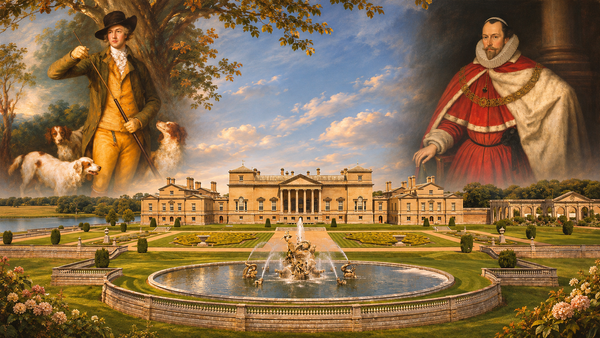
Today, Stradsett Hall preserves important elements of this transformation, while the surrounding parkland retains the broad influence of Loudon's early nineteenth-century design. The estate represents an unusually clear example of commercial wealth being converted into the architectural and social identity of the landed gentry.
Explore the House of Stradling
Thomas Philip Bagge also strengthened the family's standing through marriage. In 1808, he married Grace Salisbury, daughter of Richard Salisbury of Castle Park in Lancashire. The Salisbury, or Salusbury, name was associated with several established landed families, and the marriage introduced another important set of genealogical connections into the Bagge household.
Through the Case and Salisbury families, the Bagges were increasingly integrated into the world of inherited property, heraldry and county society. These relationships were commemorated in the monuments at St Mary's Church, where family heraldry preserved the memory of marriages that had brought together different estates and lines of descent. Such memorials are particularly valuable to historians and genealogists because they record the alliances that families considered central to their identity.
Thomas Philip and Grace had several children, including twin sons born in 1810. One of these sons, William Bagge, would become the first Baronet of Stradsett Hall and the father of the man whose memorial stands at the centre of this story.
William Bagge was born on 17 June 1810 and inherited the Stradsett estate following his father's death in 1827. Educated at Charterhouse and Balliol College, Oxford, he entered public life during a period of major political and economic change. The nineteenth century saw Britain transformed by industrialisation, parliamentary reform, expanding imperial trade and the growing influence of wealthy provincial families.
For a landowner of William's position, service in Parliament offered an opportunity to extend the family's influence beyond Norfolk. He was elected Conservative Member of Parliament for West Norfolk in 1837, beginning a political career that would last, with an interruption, for more than three decades. His parliamentary service placed him within the political world of Victorian Britain, where debates over agriculture, taxation, electoral reform and the relationship between landowners and government shaped national affairs.
Alongside his political responsibilities, William remained closely associated with the county's landed society. He served in local administration and maintained the family's position as owners of Stradsett Hall.
His marriage was particularly significant. On 11 July 1833, William married Frances Preston, daughter of Sir Thomas Preston, first Baronet of Beeston St Lawrence. The Preston family was another established Norfolk household, associated with landownership and the wider network of county families.
Yet this marriage also contained a remarkable genealogical connection. Frances Preston's mother was Jane Bagge, a daughter of the earlier King's Lynn merchant Thomas Bagge and a sister of Thomas Philip Bagge. As a result, William Bagge and Frances Preston were first cousins, a relationship that illustrates how nineteenth-century landed families often maintained property and social connections through marriages within established kinship networks.
The Preston name itself had entered the family through inheritance and marriage, with Frances's father originally belonging to the Hulton family. These connections brought together the Bagge, Case, Preston and Hulton households, linking the commercial history of King's Lynn with the wider landed society of Norfolk.
The family also belonged to a county where the histories of the Le Strange, Styleman, Astley, Howard, Bigod and de Warenne families remained deeply embedded in genealogical traditions. The Le Strange family of Hunstanton, for example, possessed roots in the medieval Anglo-Norman aristocracy and maintained important estates in northwestern Norfolk for centuries. The Astley family of Melton Constable similarly belonged to a long-established network of landowners whose history extended into the medieval period.
Such families formed part of the broader social and genealogical world in which the Bagges operated. Claims of specific descent from Norman knights or medieval barons, however, require carefully documented links through successive generations. The presence of a surname or an association with a particular locality does not independently establish a continuous family pedigree.
The Bagge family's importance lies in the combination of its demonstrable history of commercial advancement and its later integration into the landed society of Norfolk.
The marriage between William Bagge and Frances Preston produced several children, including their eldest surviving son, William Henry Ernest Bagge. Born at Stradsett Hall on 9 August 1840, William Henry Ernest entered the world as the heir to a family whose fortunes had been transformed over the preceding two centuries.
His early life would have been shaped by the privileges and responsibilities associated with a wealthy Victorian household. The surrounding estate, with its parkland, lake, gardens and agricultural property, provided the setting for a childhood very different from that of the merchants and rural tenants from whom earlier generations had risen. Yet the expectations placed upon an eldest son could also be considerable. He was expected to preserve the family's position, understand the management of its estates and eventually assume the responsibilities associated with its title and public standing.
William Henry Ernest received an education suitable for a gentleman of his background. Biographical records associate his education with Sandhurst and Gonville and Caius College, Cambridge, where he matriculated in 1860. The combination of military education and university study reflected the preparation expected of men who might enter the armed forces, public administration or the management of major landed estates.
Unlike his father, William Henry Ernest did not establish a lengthy parliamentary career. His adult life appears to have been directed more towards private responsibilities and the social concerns of his age. A contemporary obituary remembered his interest in the moral and social improvement of the population, suggesting an involvement with the reforming and charitable concerns that occupied many members of Victorian society.
The nineteenth century was an age of religious reform movements, educational initiatives and changing attitudes towards poverty and public welfare. For wealthy landowning families, participation in charitable institutions and local improvement schemes formed an important part of the ideal of public service. The precise extent of William's personal involvement in these activities is less fully documented than the parliamentary career of his father. Nevertheless, his recorded interests suggest that he wished to contribute to society beyond the management of inherited property.
On 26 October 1865, William Henry Ernest married Alice Giles, daughter of Alfred Giles, a member of Parliament associated with Cosford House in Surrey. The marriage connected the Bagges with another prosperous family whose influence extended through property and public life. It also continued the tradition through which the family's relationships developed across different regions of England.
Despite the expectations that surrounded the marriage, the couple had no children. This would eventually become a decisive fact in the history of the Bagge baronetcy.
In 1867, William Henry Ernest's father received a hereditary honour that marked the family's arrival among the titled families of Britain. On 13 April, William Bagge was created first Baronet of Stradsett Hall. A baronetcy was a hereditary title normally passing through the male line, ranking below a barony in the peerage but carrying considerable social prestige.
For a family whose recent history had been rooted in commerce, the creation of the baronetcy represented an important milestone. The descendants of King's Lynn brewers, merchants and shipowners had entered the ranks of Britain's hereditary titled families. The family's motto, Spes est in Deo, meaning Hope is in God, expressed an enduring religious ideal associated with its heraldic identity.
The achievement also reflected a broader social transformation taking place across nineteenth-century Britain. Families whose wealth had originated in banking, trade, manufacturing or professional service increasingly entered the traditional institutions of the landed elite. For the Bagges, commercial success had provided the resources, landholding had provided the social position, and public service had helped secure recognition from the Crown.
Yet William Henry Ernest's time as heir to the title was unusually long compared with his eventual tenure as baronet. His father continued to serve in Parliament and retained control of Stradsett until his death on 12 February 1880. Only then did William Henry Ernest succeed as second Baronet of Stradsett Hall.
At nearly forty years of age, he inherited the title and the responsibilities associated with the estate. It should have marked the beginning of a new chapter in the family's history. Instead, his tenure proved tragically brief.
On 23 October 1881, Sir William Henry Ernest Bagge died at Heather Side, Woking, Surrey, at the age of just forty-one. He had held the baronetcy for approximately twenty months. His death ended the direct male succession through the eldest son of the first Baronet and forced the family to look to another branch for the inheritance.
St Mary's Church at Stradsett preserves his memory through a memorial recording his birth and death. Within the church are also monuments to earlier members of the family, creating a remarkable physical record of the generations who transformed Stradsett into one of Norfolk's established country estates.
The church itself is an important medieval building. Its origins extend to the thirteenth century, and its surviving structure includes a tower, nave and chancel whose architectural details reflect successive centuries of alteration. Inside, historic stained glass and family memorials connect the religious history of the parish with the households that once governed the surrounding land.
Among its most significant monuments is the memorial to Thomas Philip Bagge, whose early nineteenth-century landscape improvements established much of the setting familiar to visitors today. The church's heraldic displays commemorate the marriages of the Bagge, Case and Salisbury families, preserving genealogical evidence in carved stone and coloured arms.
The memorial of William Henry Ernest belongs to this wider tradition of aristocratic remembrance. Unlike the magnificent houses and parks built by previous generations, such monuments preserve the memory of individual lives, sometimes revealing stories of ambition, inheritance and sudden loss.
For William Henry Ernest, the story was particularly poignant. His father had spent decades establishing the family's public influence, yet the son who inherited the title survived him by less than two years. Because William Henry Ernest left no children, the baronetcy passed to his younger brother, Alfred Thomas Bagge.
Born on 5 July 1843, Alfred had followed a very different career from that of his father and elder brother. He entered the Royal Navy in 1857, beginning a life of military service during a period when Britain's naval power extended across the globe. His service included participation in the conflict in China commonly known as the Second Opium War, fought between 1856 and 1860. This controversial war formed part of the expansion of European imperial influence in East Asia, involving military operations by Britain and France against the Qing dynasty.
Alfred's naval career eventually saw him rise through the ranks to commander and, subsequently, captain. By the time he succeeded his brother as third Baronet in 1881, he had acquired considerable experience in a profession very different from the commercial enterprises that had established the family's original fortune.
The succession brought the title into the branch of the family through which it would continue. Alfred had married Millicent Case Morris in 1872, and their descendants would carry forward the Bagge name through further generations. The baronetcy eventually passed to Alfred William Francis Bagge, fourth Baronet, followed by John Picton Bagge and later members of the family. Through this line, the hereditary title and the association with Stradsett Hall survived into the modern era.
The story of Stradsett therefore offers a remarkable contrast between continuity and change. The family had begun its rise through the commercial opportunities of Norfolk, accumulated wealth through brewing and shipping, established a landed estate through marriage and inheritance, and eventually achieved hereditary rank through political service.
Yet the history of that inheritance was never a simple sequence of fathers passing estates directly to sons. The marriages of the Case, Salisbury and Preston families had helped establish and strengthen the estate. The absence of children from William Henry Ernest's marriage redirected the baronetcy to his younger brother. In later generations, inheritance and marriage continued to reshape the family's responsibilities and relationships.
The Bagge story also raises important questions about the deeper ancestry of Britain's landowning families. Historical genealogy reveals how individuals and households were connected through marriage records, wills, estate documents, parish registers and heraldic monuments. Such evidence can establish family relationships extending across several centuries and, in some cases, connect later households with medieval noble lineages.
The wider genealogical traditions of Norfolk include families such as the Le Stranges, Howards, Astleys, Bigods and de Warennes, whose histories reflect the development of the Anglo-Norman aristocracy following the conquest of England in 1066. These families held important estates, participated in royal government, and established networks of inheritance and patronage that shaped the county for generations.
Ancient DNA studies of Britain and northern Europe have revealed patterns of migration and ancestry associated with prehistoric populations, the Roman period, early medieval migrations and the Viking Age. The population history of East Anglia is particularly interesting because of its long-standing connections with the North Sea world. From the arrival of early medieval settlers to the commercial networks linking Norfolk with Scandinavia and continental Europe, the region developed through centuries of cultural and population interaction.
Ancient DNA comparisons can help illuminate these broader historical processes, although a similarity to an ancient archaeological individual does not by itself prove descent from a particular named noble family.
Read more about the Howard Family
The surviving monuments, estates and records of Stradsett are therefore valuable for two different reasons. They preserve the history of an individual family whose remarkable economic and social rise can be reconstructed through documentary evidence. They also provide a setting in which to explore the wider ancestry of the people who inhabited Norfolk across many centuries.
In an on-location film at St Mary's Church, Simon Howard stands beside the memorial of Sir William Henry Ernest Bagge
In an on-location film at St Mary's Church, Simon Howard recounts the family's journey from commercial enterprise to hereditary nobility. The setting is especially evocative. Only a short distance from Stradsett Hall, the church preserves the names and memories of generations whose lives were shaped by trade, inheritance, marriage and public service.
The surrounding parkland reflects the ambitions of Thomas Philip Bagge, while the family monuments reveal the human stories behind the estate's architectural splendour. Standing beside the memorial of the second Baronet, the fragility of hereditary succession becomes particularly clear. William Henry Ernest had been born into the expectation that he would one day inherit the family's title and lands. After decades of preparation, he finally succeeded his father in 1880, only to die the following year. His unexpected death redirected the family inheritance and ensured that the future of Stradsett would be shaped by the descendants of his younger brother.
The Bagge family's wider legacy, however, endured. Its commercial enterprises helped shape the development of King's Lynn, its public figures participated in the political life of Victorian Britain, and its estates preserve important features of Norfolk's architectural and landscape history.
Today, Stradsett Hall and St Mary's Church remain reminders of the extraordinary changes experienced by families who moved between commerce, landed wealth and hereditary privilege. The Bagge story is ultimately one of aspiration, achievement and continuity across generations. It demonstrates how economic opportunity could transform the status of a family, how marriage and inheritance could establish enduring social connections, and how the fortunes of even the most prosperous households could be redirected by the unexpected death of an heir.
Through genealogy, archaeology and ancient DNA, we can explore the wider historical worlds in which such families lived. For those with ancestral connections to Norfolk, King's Lynn, medieval England or the broader populations of northern Europe, MyTrueAncestry offers the opportunity to upload existing raw DNA data and compare it with ancient archaeological samples. These comparisons can reveal patterns of genetic similarity and help investigate the deeper population history behind individual family traditions.
The memorial of Sir William Henry Ernest Bagge at Stradsett reminds us that a family's history is never confined to a single generation. Behind one name carved in stone lies a network of merchants, landowners, political figures, naval officers and families whose connections extended across centuries. More than a century after his death, the story of William Henry Ernest Bagge continues to illuminate the remarkable journey of a Norfolk family from the trading streets of King's Lynn to the hereditary baronets of Stradsett Hall.
Upload your DNA to MyTrueAncestry to see whether you match the Bagge family's wider regional and historical background, or related ancient DNA samples from Norfolk, East Anglia and the broader North Sea world.
Comments