Ancient Bactrian Burials and Vedic Funeral Traditions
– 4 min read

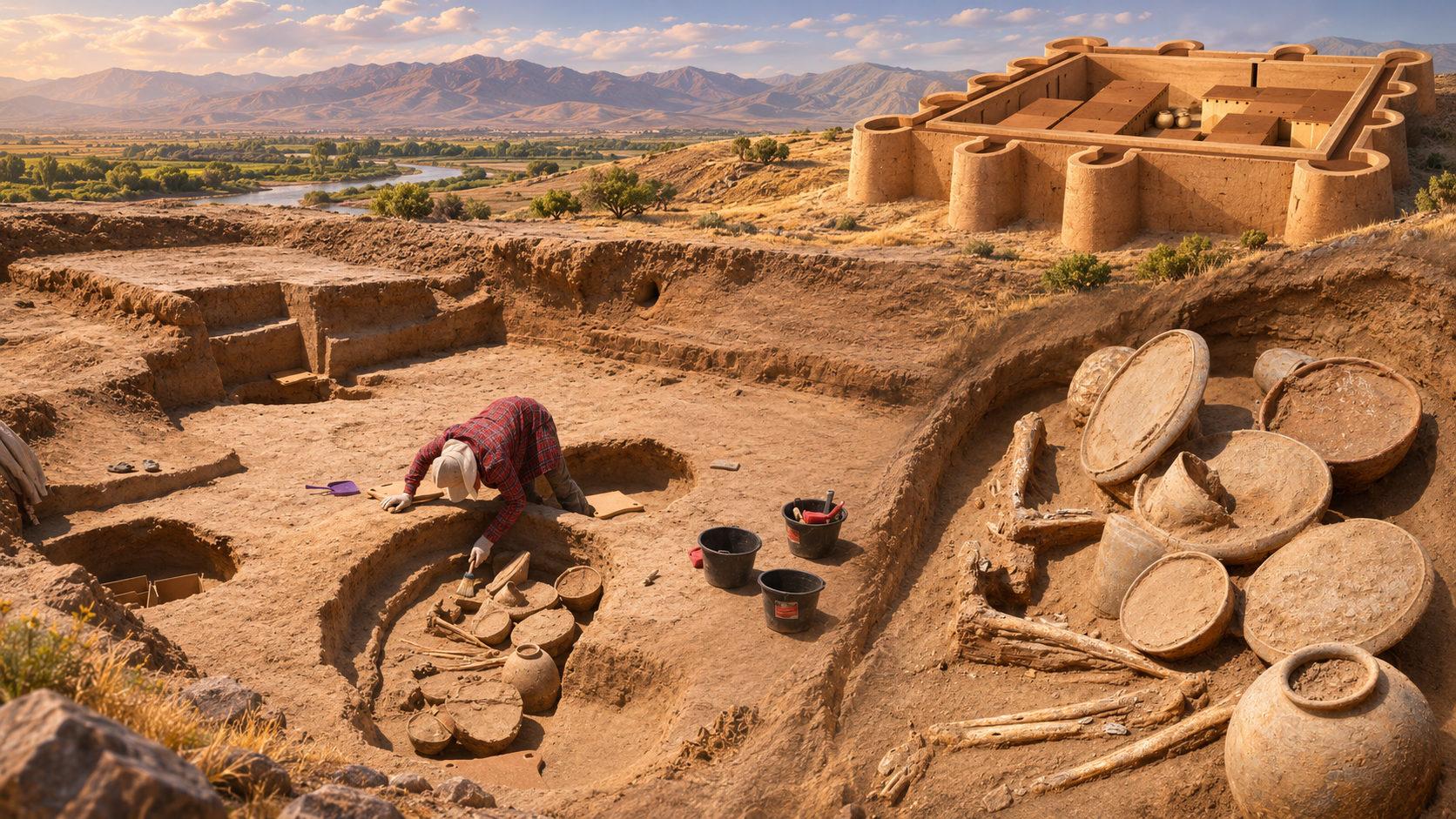
On the right bank of the Bostonsoy, the funerary landscape of Northern Bactria still feels charged with memory. The cemetery linked with Boston VI and Jarquton reveals how Bronze Age communities arranged death in relation to city, river, and ritual ground. The dead were placed on rises and mounds rather than flat ground — high places that made the necropolis visible and meaningful, standing just outside daily life but never fully apart from it.
Boston VI served as the cemetery for the urbanising community of Jarquton, a settlement with temples, craft production, and long-distance cultural ties. Its graves preserve beliefs, loyalties, and hopes carried into death. The necropolis belonged to several chronological stages, making it a record not only of death but of historical movement. Burial habits shifted, pottery styles changed, and ritual traces varied across sectors.
Peripheral spaces near the old riverbed were used for ceremonies connected with burial, with clay and sand supplying material for terracotta ritual objects. Signs of purification rites and reverence for sun and fire suggest that the dead were not simply buried, but transformed through staged ceremony before a watching community.
Among the most arresting discoveries at Boston and Jarquton is the treatment of human remains. Many bodies underwent cremation, with burned bones carefully gathered, sorted, and placed in graves or stone containers. Some burials show remains divided into three parts — a formalised ritual reflecting beliefs about the human body that required sacred reordering. Fire acted as a bridge: the person was imagined to continue elsewhere while the body became sacred residue.
Stone boxes containing cremated bones are especially powerful finds, suggesting deliberate collection and curation. Clay animal figurines and ceramic grave goods accompanied the dead — offerings carrying symbolic force linked to protection, identity, or household continuity. The surrounding landscape was part of the rite, not merely its backdrop. Through these gestures, ancient people in Northern Bactria become recognisable across time: they feared loss, sought order in grief, and used fire to turn death into meaning.
Jarquton stands as one of the great early urban centres of the region, combining ritual authority, craft skill, defence, and political leadership. Its temple occupied the highest local ground — architecture as power — within a broader world that required canal construction, water management, and organised labour.
The most vivid discovery is the burial on Hill 5 of a man in his fifties accompanied by more than fifty objects. Described as the city's god — a ruler endowed with sacred status — he was identified as a master metallurgist and jewellery maker. Control of metal in ancient societies was close to magic, and his grave announces that he mattered in life and was expected to matter in memory.
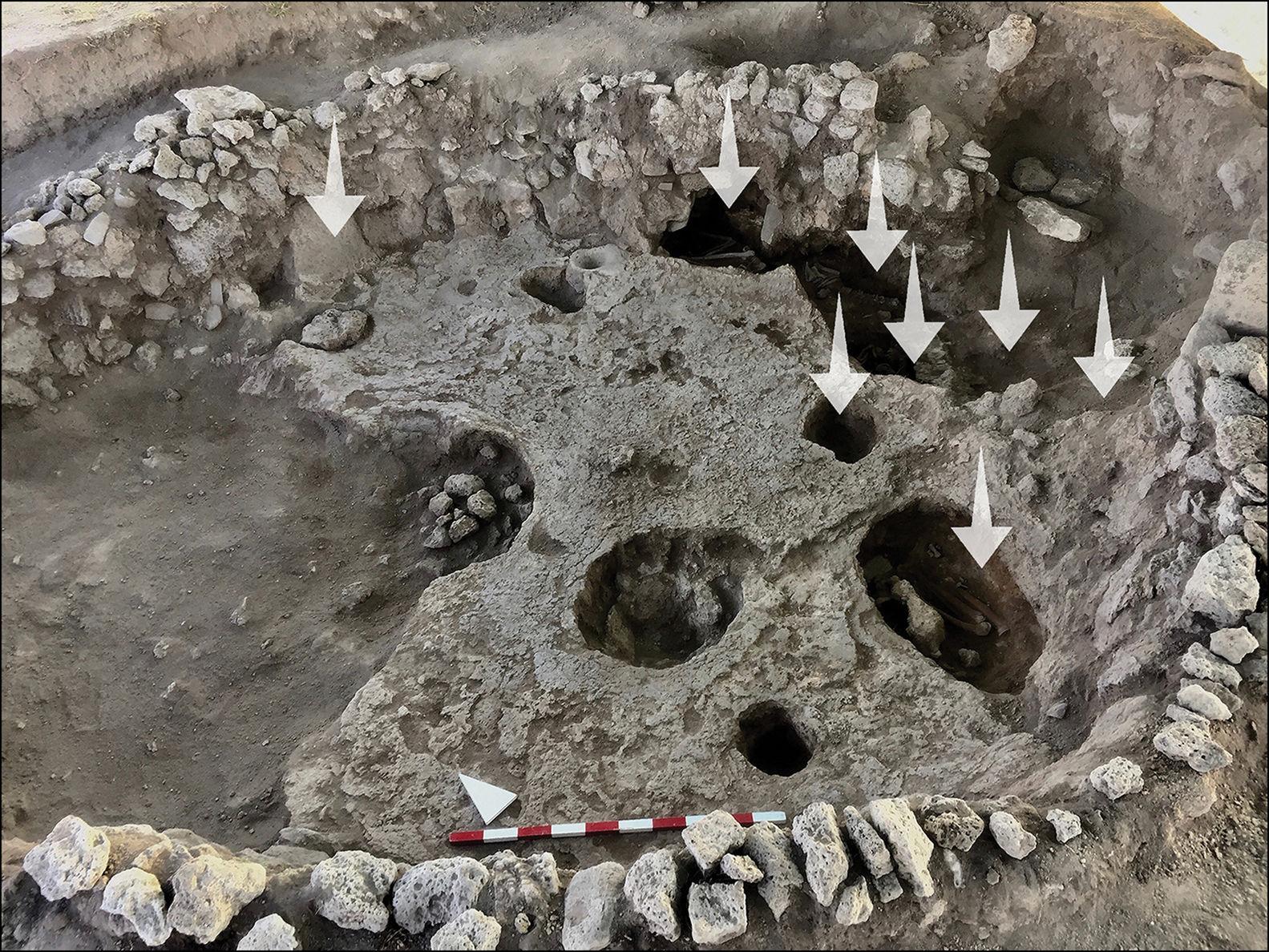
Hill 5 itself had three construction periods and contained a four-room house, making the burial site already heavy with social meaning. During the Kozali period it became a zone of active interaction with incoming pastoral traditions, suggesting that this ruler may have belonged to a local lineage negotiating alliances with steppe newcomers. His tomb folds the ambitions of an early city around a single, recognisable human being.
Northern Bactria was not a closed world. Gradual arrivals from steppe pastoral communities left traces in pottery, burial forms, and occupation layers. Stone box graves containing cremated remains — typical of steppe traditions — appear in the Kozali period near Jarquton-5, alongside steppe pottery fragments. Andronovo cultural pottery was also found in the Boston VI cemetery. A shard is not just a broken pot; it can be a migrant's memory or the residue of shared households.
The Kozali period marks when pastoral culture became strongly integrated into local life, particularly in the fourteenth and fifteenth centuries BCE. Local elite families and incoming steppe leaders may have formed kinship, military, and religious alliances, making grave goods and burial forms political evidence as much as markers of personal identity.
Among the most moving discoveries are seven burials placed in the rooms of Hill 5, including graves of children aged ten to thirteen. Their careful placement in a meaningful household space reminds us that great historical transformations were lived through by families. A child buried on a culturally contested hill strips away historical abstraction and returns us to something deeply human.
Clay models of wheels and horse-drawn chariots from the Boston VI cemetery join funerary archaeology to technological history. People did not merely use wheeled vehicles — they thought with them. Ancient communities distinguished carefully between war chariots and cargo carts, reflecting genuine expertise born of experience.
The horse transformed the scale of movement: distances shrank, raids became easier, and elite display grew grander. Finds from Jarquton fit into the broader steppe world where wheeled transport carried deep cultural significance, though local adaptation always reshaped imported technology. Clay wheel models in funerary contexts suggest that the wheel also gathered symbolic and perhaps cultic meaning — any object that dramatically expands human power tends to attract spiritual prestige.
A humble clay wheel can reconstruct an entire world: trained animals, cart builders, warriors, and trade routes linking settlement to cemetery. Through it, Bronze Age Northern Bactria appears dynamic and connected. The dead were buried with symbols of this mobile age around them, as if even in death they remained part of a world that had learned to travel farther and faster than before.


These cemeteries and ritual spaces illuminate a world where urban authority, household grief, steppe mobility, and ceremonial fire all met in the treatment of the dead. Boston VI and Jarquton preserve not only burial customs, but the social tensions and accommodations of a changing Bronze Age frontier.
Upload your DNA to MyTrueAncestry to explore whether you match ancient individuals from regions shaped by these early movements, exchanges, and burial traditions.
Comments