Piast Dynasty

– 2 min read


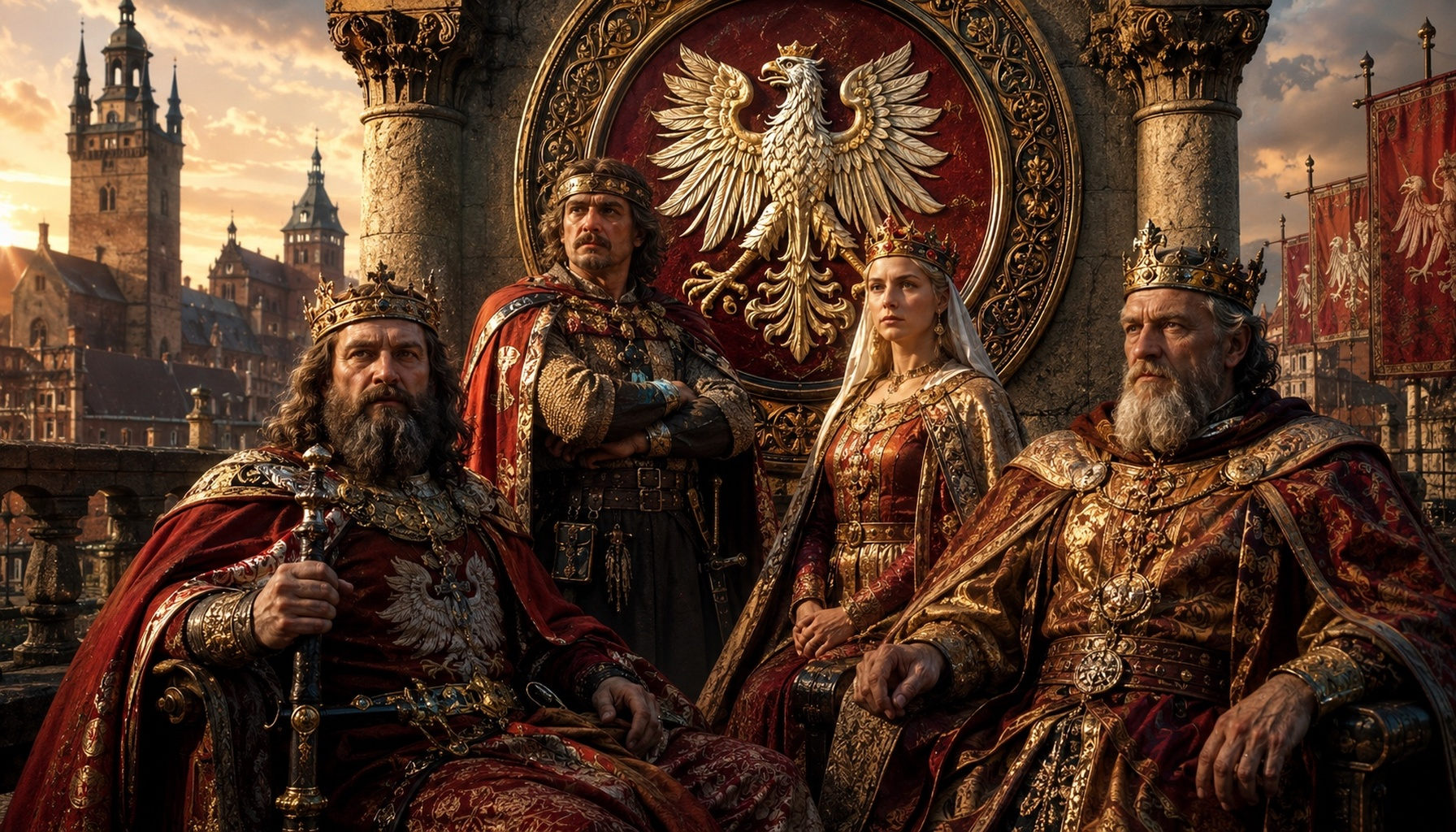
The Piast Dynasty was the first great ruling house of Poland, the line that carried the early Polish realm from tribal consolidation into a recognized Christian kingdom and then into a network of duchies and regional principalities that shaped Central Europe for centuries. Their story begins with Mieszko I in the 10th century and reaches through rulers such as Casimir I the Restorer and Władysław I Herman, a dynasty whose legacy still sits at the center of Polish historical memory.
In DNA terms, the Piast line in MyTrueAncestry is linked here to Y-DNA haplogroup R1b1a1b1a1a2b. That makes this post especially interesting because the dynasty is not just politically foundational, it is also tied to a clearly traced paternal signal in the local noble-family mapping. Figures linked in the source data include Mieszko I, Casimir I the Restorer, Władysław I Herman, Konrad I of Masovia, Bolesław III of Płock, and Janusz III, giving this house a long dynastic arc from early medieval state formation into the later regional Piast branches.
The strongest location anchor for the Piasts is Wawel Castle in Kraków, one of the most important royal sites in Poland. Rising above the Vistula on Wawel Hill, the castle complex became a symbolic heart of Polish kingship and still reads as a physical expression of Piast and later royal authority. It can absolutely still be visited today, and it remains one of the most historically resonant places in the country.
The deeper background is what makes the Piasts so compelling. This was not a minor noble family with a brief local story. The Piasts were the dynasty that anchored the emergence of the Polish state itself, helped define its Christian and political identity, and then spread into multiple branches whose rulers shaped Masovia, Silesia, and other regional power centers. Even when the main royal line fractured into cadet branches, the Piast name continued to matter across medieval Poland.
Ancient DNA adds another layer to that story. Related samples in the broader R1b-linked sphere include Iron Age and later elite burials such as BIY011 from the Sargat Horizon, I26735 from an elite Scordisci grave in Osijek, and Viking-era individuals like VK159 from Pskov. These are not direct Piast ancestors, but they are relevant comparanda that help place the dynasty’s linked paternal signature into a wider Eurasian ancient DNA landscape.
Upload your DNA to MyTrueAncestry to see whether your own results connect with the Piast Dynasty, its wider haplogroup story, or the ancient populations that help illuminate the world from which this foundational Polish royal line emerged.




Comments