Potato-Driven Evolution: Adaptive Expansion of Salivary Amylase Genes in Indigenous Andeans
– 6 min read


Starch, Mummies, and Mountain Kingdoms: AMY1 in the Ancient Andes
This comprehensive study takes readers high into the Andean plateau, to a world of terraced fields, burial towers, and lakeside villages, exploring how ancient peoples whose lives were built on potatoes and other starchy crops reshaped their own biology to cope with that diet. The focus centers on a gene called AMY1, which produces salivary amylase – the enzyme in saliva that begins breaking down starch the moment food enters the mouth. Unlike many genes, AMY1 can be present in different numbers of copies in different people, with some carrying only a few copies while others possess a dozen or more.
By around 12,000 years before present, small groups were already venturing onto the high Andean plateau, over 3,700 metres above sea level. Rock shelters like Cuncaicha in southern Peru preserve hearths, stone tools, and animal bones that speak of an early hunter-gatherer world. Through time, these highland camps transformed into more permanent settlements, with clearer signs of year-round occupation by about 9,500 years ago.
Around the shores of Lake Titicaca, one of the highest navigable lakes in the world, archaeology records a quiet but momentous change. Charred plant remains and microscopic plant particles from grinding stones, hearths, and storage pits reveal the local domestication of two starch-rich crops: potatoes and quinoa. Later, maize – originally domesticated far to the north in Mesoamerica – arrived in the Andean region around 4,000 years ago. For thousands of years, highland Andeans built their daily lives around local roots, tubers, and grains, especially potatoes.
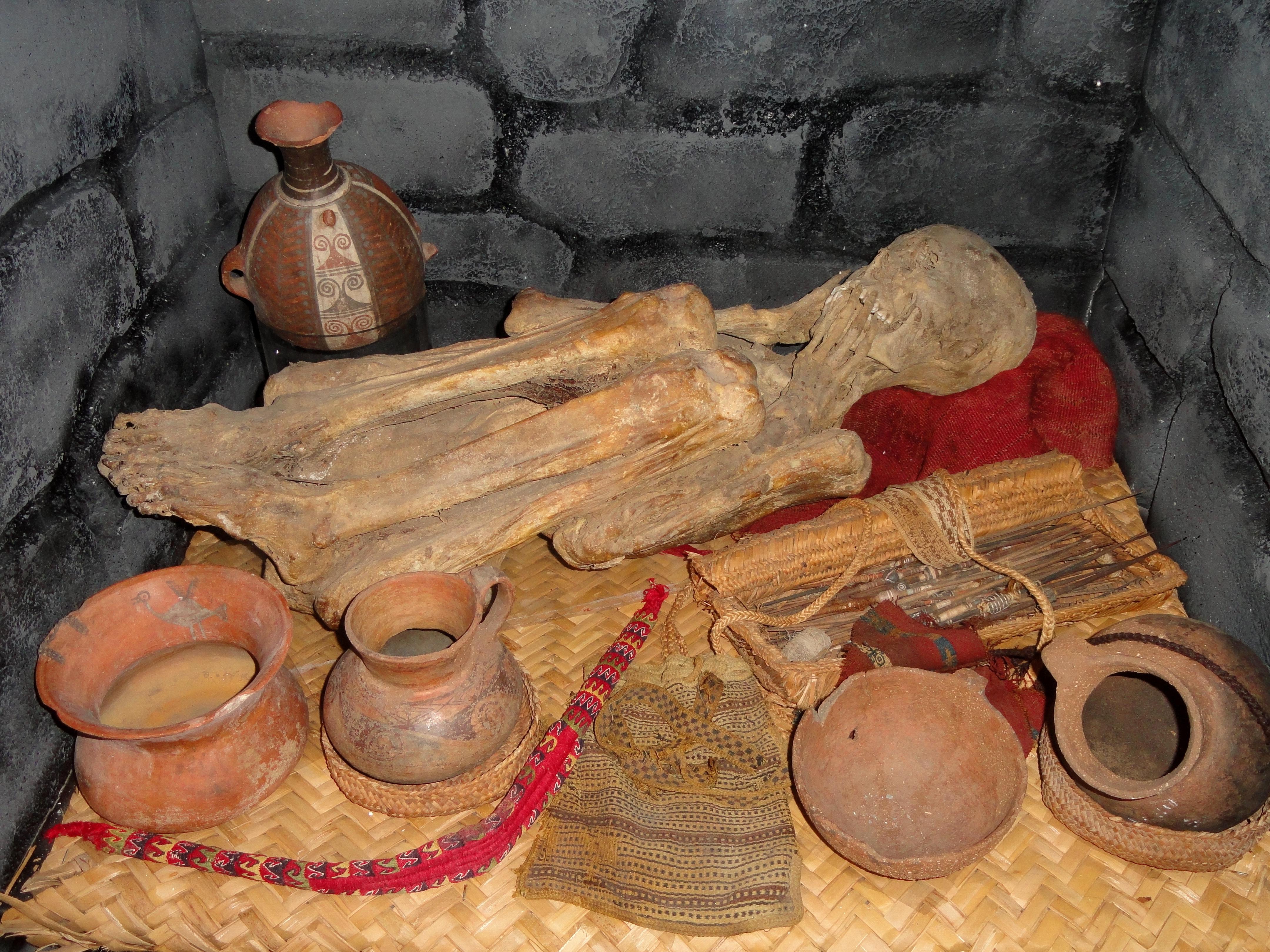
The archaeological record reveals not just what people planted, but what they valued. In funerary bundles and burial towers from later Andean cultures, excavators regularly find grinding stones, ceramic vessels for storing and serving starchy foods, dried potato products, and offerings of maize and quinoa seeds. These finds anchor the genetic evidence in real human practice, connecting AMY1 patterns seen in present-day Andean genomes to centuries of burials, houses, storage pits, and agricultural terraces marking a long-term, intensely starch-based highland cuisine.
Archaeological work at sites such as Jiskairumoke in the Titicaca Basin has recovered microscopic plant remains on grinding stones and cooking surfaces, pointing to potato use between 10,000 and 6,000 years before present. In these early villages, people ground, soaked, and dried tubers, slowly domesticating potato species that could thrive in cold, thin air and poor soils. Later, Andean communities developed ingenious techniques such as making chuño, a freeze-dried potato created by spreading potatoes on open ground in high, frosty fields, letting night freezes and daytime sunshine dehydrate them over days.
Researchers measured AMY1 gene copies in thousands of individuals from 85 populations worldwide, discovering that Indigenous Andean populations, especially Quechua-speaking groups with deep highland roots, have some of the highest known AMY1 copy numbers globally, often ten or more per person. This pattern is not random – the genetic signatures surrounding these high-copy versions suggest natural selection has favored them over thousands of years, in lockstep with a diet dominated by potatoes and other starchy crops.
To understand how such high AMY1 copy numbers arise, the study examined the gene's architectural complexity. Rather than a single AMY1 gene sitting tidily on the chromosome, the region contains repeated blocks where entire chunks containing amylase genes can be duplicated or deleted in single events. Using very long DNA reads from present-day Peruvian individuals, researchers traced these structural patterns back to recombination events that duplicate a standard unit of two AMY1 genes at a time.
The study identified a particular genetic marker, rs143597860, that tags haplotypes carrying at least five AMY1 copies per chromosome. This marker occurs at very high frequency in Indigenous Andean populations and much lower frequencies in closely related groups like the Maya. Statistical reconstructions suggest this marker's associated haplotype remained at low frequency until roughly 10,000 years ago, when its frequency in Andean lineages climbed steeply – exactly when archaeological evidence shows the commitment to potato-based agriculture.
The study's comparative approach reveals striking differences between Indigenous groups. The Maya, despite their long history with starchy maize and sophisticated urban centers, show much more modest amylase copy numbers – a median around six, consistent with many other American populations. Their genomes contain both high- and low-copy haplotypes, but the particular high-copy haplotype that surged in Andean highlanders never reached such dominance.
The Akimel O'odham (historically known as Pima), whose ancestral lands lie along the middle Gila River, present another fascinating case. Their ancestors engineered intricate irrigation canal systems, drawing river water onto carefully planned fields primarily devoted to maize cultivation. Genetically, the Akimel O'odham display some of the highest amylase copy numbers recorded worldwide, again around ten copies per person, suggesting that high starch intake based on different crops may have converged on similar genetic solutions.
The story extends beyond genetics to encompass health and microbiome implications. Studies show that people with many AMY1 copies tend to have different oral and gut bacterial communities, with more bacteria capable of processing the sugars that amylase creates from starch. In the ancient Andean context, extra AMY1 copies likely provided advantages: faster starch digestion meant more reliable energy extraction from each meal, and quicker conversion to simple sugars could have supported better nutrient absorption in harsh, high-altitude conditions.
However, in modern urban environments like Lima, the same high-starch genetics operates differently. Contemporary diets include refined flours, added sugars, and reduced physical activity levels. The combination of traditional high-starch foods with modern processed carbohydrates, working alongside AMY1-driven oral microbiomes, may contribute to dental health challenges and metabolic complications that weren't present in the original high-altitude agricultural context.
The amylase locus represents a genomic region of remarkable instability and evolutionary potential. The core building block consists of paired genes – one copy in standard orientation (AMY1A) and one nearby in reverse (AMY1B). When chromosomes pair during egg and sperm formation, these similar segments can misalign, leading to non-allelic homologous recombination where one chromosome gains extra amylase units while the other loses them.
Ultra-long DNA sequencing from Peruvian individuals revealed dozens of distinct structural arrangements, fourteen of which occur in Peruvians. Most remarkably, some individuals carry a distinctively Andean seven-copy haplotype that appears to have arisen locally through modifications of a nine-copy structure, then been further modified by continued recombination processes.
The genetic patterns only make complete sense when set against the rich archaeological record of the Americas. The timing of rising Andean amylase copies overlaps precisely with real archaeological phases showing potatoes and quinoa taking central dietary roles, while stone tools and settlement layouts hint at increasingly settled lives. In the Titicaca basin, hearths, storage pits, and botanical remains demonstrate the commitment to starch-based agriculture, while burial sites reveal individuals interred with grinding stones, ceramic vessels, and food offerings that speak to the ritual and practical importance of starchy crops.
The period during which high-copy amylase haplotypes surge in frequency corresponds exactly to archaeological evidence for: the gradual thickening of storage and processing features including pits, grinding slabs, and cooking hearths; the appearance of permanent stone architecture around highland lakes and valleys; and the development of specialized food processing techniques including freeze-drying and long-term storage methods.
This comprehensive analysis reveals how people living on the roof of South America reshaped their landscapes, their food systems, and over thousands of years, even their own DNA. The work transforms a technical question about gene copy number into a richly historical story connecting excavated terraces above Lake Titicaca, layers of ash and bone in shelters like Cuncaicha, pots decorated with tuber motifs, and dried potato cakes placed beside the dead with genetic patterns visible in the saliva of present-day Quechua speakers.
The AMY1 story represents more than genetic adaptation – it exemplifies the deep dialogue between fields, hearths, and genes that characterizes human agricultural evolution. As small communities on the Altiplano committed their harvests to frost-sensitive tubers and labor-intensive processing methods, their chromosomes were simultaneously lengthening DNA stretches to produce more salivary amylase. The result documents not just what ancient people ate, but how their bodies, their microbiomes, and their genetic inheritance were quietly adjusting to support a way of life built around the patient cultivation of starchy crops in one of Earth's most challenging environments.
The research ultimately demonstrates that genetic patterns preserve not just abstract evolutionary processes, but the lived experiences of named communities whose descendants continue to inhabit these landscapes. The high AMY1 copy numbers found in modern Quechua speakers represent a molecular archive of their ancestors' daily acts: planting tubers, drying chuño on open ground, grinding grain in courtyard kitchens, and building the terraced agricultural systems that still mark the Andean landscape today.






Comments