Clan Stirling

– 3 min read


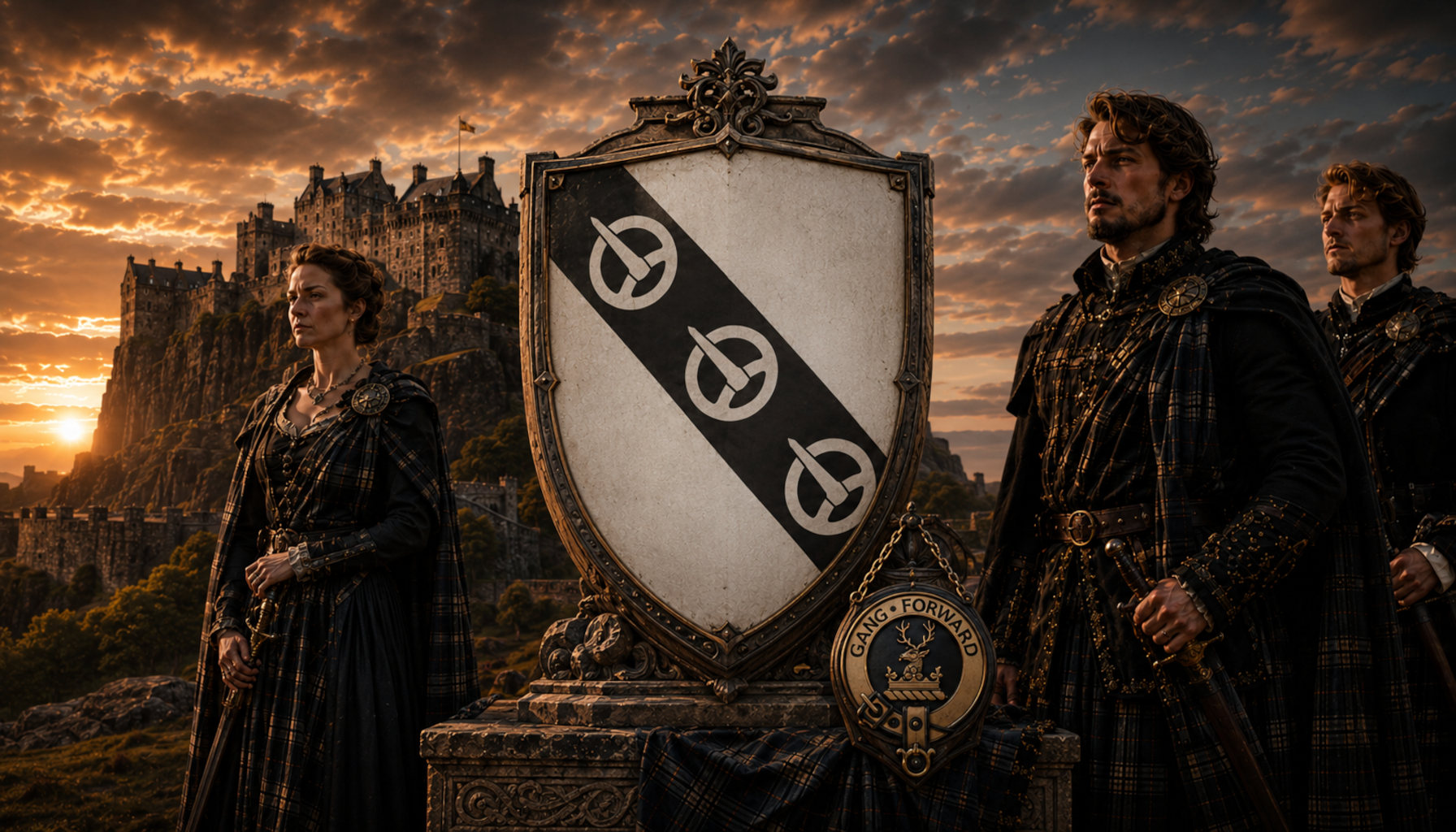
Clan Stirling was one of the classic landed families of Lowland Scotland, rooted in the strategic heart of the kingdom around the burgh and district of Stirling, and linked here with the primary family haplogroup I1a2a1a1a2a1. This was not a clan story built around one single crowned line, but a broad and durable network of lairds, estate-holders, royal servants, soldiers, and local power-brokers whose identity grew out of place, kinship, heraldry, and long memory. The surname itself points back to Stirling, that crucial hinge of Scotland where routes north and south converged and where so much of the country's history was fought over, negotiated, and remembered.
In the records, the family appears early and firmly. Thoraldus de Strivelyn is found in 1147, placing the name in the documentary landscape of the 12th century, when Scottish kings were consolidating burghs, lordship, and administration. Later figures such as Alexander de Strivelyn, Laird of Cadder, in 1304, and Sir John de Strivelyn in 1333 show the family already established among the landholding class during the bruising age of the Wars of Independence. Over time, branches such as the Stirlings of Cadder, Keir, Garden, and related lines developed their own estates and identities, while sharing a heraldic world marked by the hart's head and antique coronet of the crest badge, and arms that speak to a long lairdly and quasi-noble presence in Scottish public life.
One of the most telling anchors for the family is Cadder, in what is now East Dunbartonshire, just beyond Glasgow but historically part of that belt of territory where noble influence, church land, and strategic movement all overlapped. Cadder House, associated with the Stirlings of Cadder, stood in a place with much deeper roots than the later mansion itself. The district of Cadder is famous for its Roman frontier context, lying near the line of the Antonine Wall, and for the old parish church of St Cadoc, which preserves the sense that this was an inhabited and significant landscape for many centuries before and after the medieval Stirlings arrived. The present house is largely a later structure, but the site and estate carry the memory of the branch that made Cadder one of the notable Stirling seats. The wider area, including the ancient church and historic landscape, can still be visited, which gives the modern visitor something especially valuable: not simply a family name on paper, but a physical setting in which Lowland lordship once operated.
From a DNA perspective, Clan Stirling is tagged here with haplogroup I1a2a1a1a2a1, a paternal line within the wider I1 branch often associated with northern European and Germanic-speaking populations over the long term. That does not prove direct descent from any excavated ancient individual, and it is important not to overstate what genetics can say. But it does place the family beside a striking scatter of related or linked ancient samples across time and space: Nordic Bronze Age Denmark at Strandlunden II Gerlev (CGG106515), Iron Age Denmark at Sjaelland Holbaek Fjord Trundholm Mose (CGG106734), a Saxon settler from Hogebeintum in the Frisii Netherlands (CGG024694), Viking Age Denmark at Odense Norrebjerg (CGG105541), Anglo-Saxon Sedgeford in Norfolk (SED014), Viking Age Oland in Sweden (VK337 and VK357), Migration Period Hungary at Rakoczifalva (RKO002), Gothic-period Serbia at Timacum Kuline Ravna Village (I15549) and Timacum Slog Necropolis (I15545), Longobard-period Pannonia at Savaria Szeleste Barbaricum in Hungary (SZL028), a Gothic sample from Kecskemet-Mindszenti Transtisza in Hungary (A181016), Merovingian Frankish Buettelborn in Germany (Btb71), and medieval Sint-Truiden Groenmarkt in Belgium (ST2819). Taken together, these linked finds sketch not a single family tree but a much older northern and continental backdrop against which later Lowland Scottish lineages like the Stirlings emerged.
If you carry the Stirling name, have roots in the Scottish Lowlands, or simply want to know whether your DNA shows links to Clan Stirling or to related ancient I1a2a1a1a2a1-linked samples, you can upload your DNA to MyTrueAncestry and explore the evidence for yourself.



Comments