Clan Graham
– 3 min read


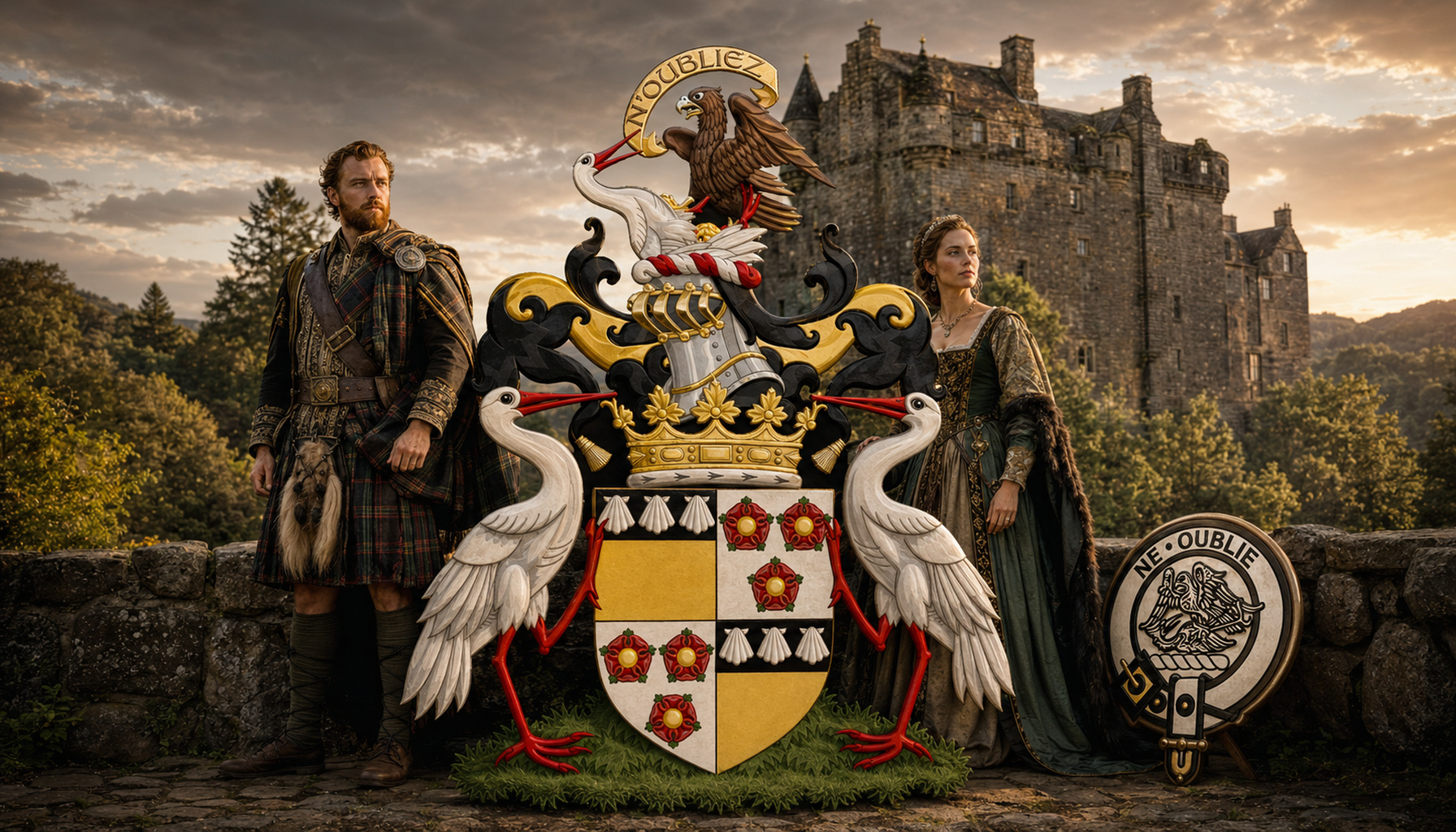
Clan Graham was one of the great noble families of Scotland: a house of border beginnings, castle lordship, royal service, and very sharp political instincts. Their story starts in the southern marches and Border country, then widens into Stirlingshire, Menteith, and Montrose, where the family built the sort of influence that turned landholders into magnates. In genetic-genealogy tagging, the primary family haplogroup linked with Graham research is I1a4a, a branch of Y-DNA more broadly associated with northern European paternal lineages.
The name itself is usually connected to the place-name Grantham in Lincolnshire, which fits the wider medieval pattern rather neatly: families moved, names travelled, and in the aftermath of the Norman and Anglo-Norman reshaping of Britain, new lordly houses took root in Scotland. By the 12th century the Grahams appear in Scottish records and, from there, they did what successful medieval families did best: acquired land, married well, backed the crown when it suited, fought when necessary, and produced an impressive run of churchmen, knights, councillors, earls, and dukes. Among the most famous are Sir John de Graham, companion of William Wallace; Patrick Graham, Archbishop of St Andrews; William Graham, 1st Earl of Montrose; and of course James Graham, 1st Marquess of Montrose, the dazzling and tragic royalist commander of the 1640s.
One of the best place-anchors for the Grahams is Mugdock Castle, just north of Glasgow, near Milngavie, in what is now Mugdock Country Park. This was long associated with the Grahams of Mugdock, a powerful branch from which the later Dukes of Montrose emerged. The castle began as a 14th-century tower house, later enlarged into a more substantial courtyard castle, and like so many Scottish strongholds it bears the marks of centuries of rebuilding, ambition, and damage. A later 16th-century range was added, and after military conflict in the 17th century parts of the old structure were ruined, leaving that wonderfully Scottish mixture of standing walls, altered masonry, and visible history in layers. In other words, it is not a neat postcard fantasy but a real aristocratic seat that changed with the fortunes of the family. Importantly for visitors today, Mugdock Castle still stands in ruined form and can be visited as part of the public country park, making it one of the most tangible surviving Graham landmarks.
For those looking at the deeper DNA horizon, I1a4a is not a "Graham-only" signature, and it would be wrong to claim direct descent from ancient or historic samples without documentary and genetic proof. But it is striking to see related or linked I1a4a finds appearing across a broad northern European and migration-era landscape. These include samples from the Nordic Bronze Age in Sweden and Denmark such as Falkoping 5 individuals NEO220, NEO223, and NEO227, Bybjerg NEO563, Stroby Ladeplads NEO93, Magleo NEO590, Toftum Mose NEO875, Sillvik NEO261, Vasagard NEO815, and Lollikehuse NEO857; the Battle Axe-linked Falkoping 5 sample NEO228; Iron Age and Gothic or Wielbark-linked individuals from Poland such as PL082, PCA0488, PCA0483, PCA0035, PCA0378, and PCA0498; Anglo-Saxon and medieval English examples like I0775, I20666, BUK015, BUK051, ELY004, ATP_PSN_20, ATP_PSN_53, ATP_PSN_115, ATP_PSN_120, ATP_PSN_344, ATP_PSN_351, ATP_PSN_511, ATP_PSN_519, and ATP_PSN_1238; and later historic-era links including Sir Ferdinando Wainman from Jamestown Colony of Virginia, sample I2096. Taken together, these do not prove a Graham pedigree reaching back to any one burial, but they do place the Graham-linked haplogroup in a long arc stretching from Bronze Age Scandinavia through Germanic, Anglo-Saxon, medieval British, and early colonial worlds.
If you are exploring Graham heritage, this is where history and DNA make a rather good partnership. The records show a major Scottish noble lineage; the haplogroup tag I1a4a adds a wider paternal context; and the ancient samples offer linked points across time rather than a fairy-tale straight line. Upload your DNA to MyTrueAncestry to see whether you match Clan Graham, or any of the related ancient DNA samples connected to this broader I1a4a story.
Comments