Clan Gordon
– 3 min read


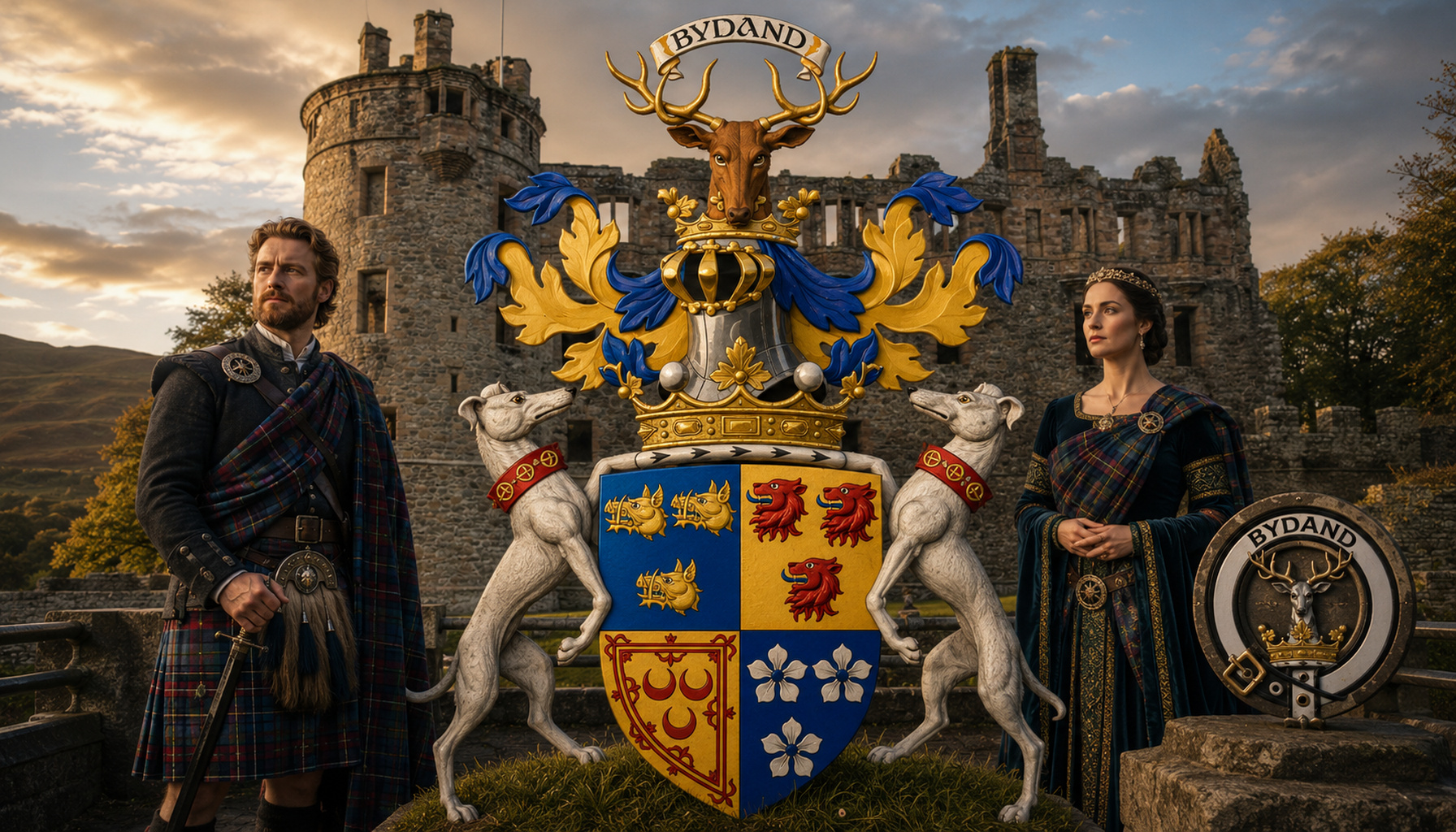
Clan Gordon was one of the great noble houses of Scotland, a family that rose from regional lordship into something much larger: a northern power with castles, titles, military followings, and a long reach into the politics of the kingdom. Traditionally linked first to the Borders and later to Aberdeenshire and the north-east, the Gordons became identified with aristocratic authority on a grand scale. In genetic tagging terms, the primary family haplogroup associated here is R1b1a1b1a1a1e1b.
The family name is usually connected with the lands of Gordon in Berwickshire, placing its earliest Scottish roots in the eastern Borders, in that complicated frontier zone where landholding, lordship, and armed service mattered enormously. From there the family expanded northward through marriage, royal favour, land grants, and political calculation. By the later Middle Ages and early modern period, the Gordons had become Lords of Badenoch, Earls of Huntly, later Marquesses of Huntly from 1599, and Dukes of Gordon from 1684 to 1836. Their story includes figures such as Alexander Seton in 1408, whose line helped shape the later rise of the house, Alexander Gordon, 1st Earl of Huntly, in 1470, the continuing Marquesses of Huntly, the Dukes of Gordon, the Earls of Aberdeen created in 1682, and the Marquesses of Aberdeen and Temair from 1916 to the present. This was a family repeatedly at the center of Scottish affairs: border warfare, Highland lordship, religious tension, royalist loyalty, and Jacobite memory all pass through the Gordon name.
Read more about Clan Mackenzie
Huntly Castle is the great stone emblem of Gordon power in the north-east, and it is hard to think of a better setting for their story. Standing near Huntly in Aberdeenshire, on the site of an earlier motte-and-bailey stronghold, the castle grew into a major residence of the Earls and later Marquesses of Huntly. What survives today is a striking and layered ruin, with medieval and later Renaissance elements that speak to changing tastes as much as to brute authority. The castle was burned, rebuilt, expanded, and caught up in the violent struggles of the 16th and 17th centuries, including the conflicts surrounding the Gordon earls and the Covenanters. Its impressive facade, heraldic stonework, and extensive remains still convey the confidence of a family that expected to rule a region, not merely inhabit it. Yes, it can still be visited today, and for anyone interested in Scottish noble history it offers exactly the sort of place where politics, architecture, and family ambition become vividly real.
From a DNA perspective, R1b1a1b1a1a1e1b is not something to imagine as belonging to the Gordons alone, but as a wider paternal branch appearing in a range of ancient and historical contexts across Europe. Related or linked samples include Bronze Age Unetice Thuringia at Leubingen Sommerda, Germany (LEU007), Late Neolithic Vlaardingen or Corded Ware Netherlands at Mienakker (I12902), Battle Axe Sweden L Beddinge 56 (RISE98), Celtic Iron Age Austria Hallstatt (CGG101214), Imperial Roman Viminacium, Serbia, Pecine Necropolis (I15527), Roman-period Germanic Warrior Mursa, Croatia, Third Century Crisis (OSIJ003), Saxon England North Yorkshire West Heslerton Vale of Pickering (I11583), Early Anglo-Saxon cemetery West Heslerton Yorkshire (I11584, I20652), Early Anglo-Saxon Buckland Dover England (BUK012, BUK060, BUK064, BUK070, BUK007), Anglo-Saxon Oakington England (OAI006, OAI013), Saxon and Migration Period sites in Lower Saxony and Saxony-Anhalt such as Dunum (DUN006, DUN009, DUN011), Bruecken (BRC006x), Hiddestorf (HID003, HID004), and Rathewitz (RTW012), Viking Age Sigtuna Sweden (urm160, urm160x), Danii tribe Denmark at Simonsborg, Sjaelland, Kalundborg (CGG106724), Post-Viking Age Hedeby (SWG001), Medieval and Carolingian Sint-Truiden in Belgium (ST0024, ST0323, ST0786, ST2969), Imperial Roman Isola Sacra (R11121), Etruscan Tarquinii (TAQ013), Early Medieval Hungary Holt-Tisza-part (I18184), Longobard-related Haeven samples (HVN003, HVN004), Bavarian Germanic samples at Straubing-Bajuwarenstrasse (STR393b, STR316b), Hun-period and Hungarian Conqueror era individuals including HUNper2, K3per1_GE, and K3per13_GE, and Germanic-linked AED92b. These are best understood as deep-time parallels within a broader paternal lineage network, not as proof of direct descent from any one ancient individual to the Gordon family.
Explore the Royal House of Stewart
If the Gordons are part of your family story, or if you simply want to see how your DNA connects with the great noble houses of Scotland and with ancient samples linked to haplogroup R1b1a1b1a1a1e1b, this is the moment to dig further. Upload your DNA to MyTrueAncestry and see whether you match Clan Gordon, their wider historical world, or related ancient DNA samples scattered across Bronze Age, Roman, Saxon, Viking, and medieval Europe.






Comments