Clan Drummond
– 3 min read


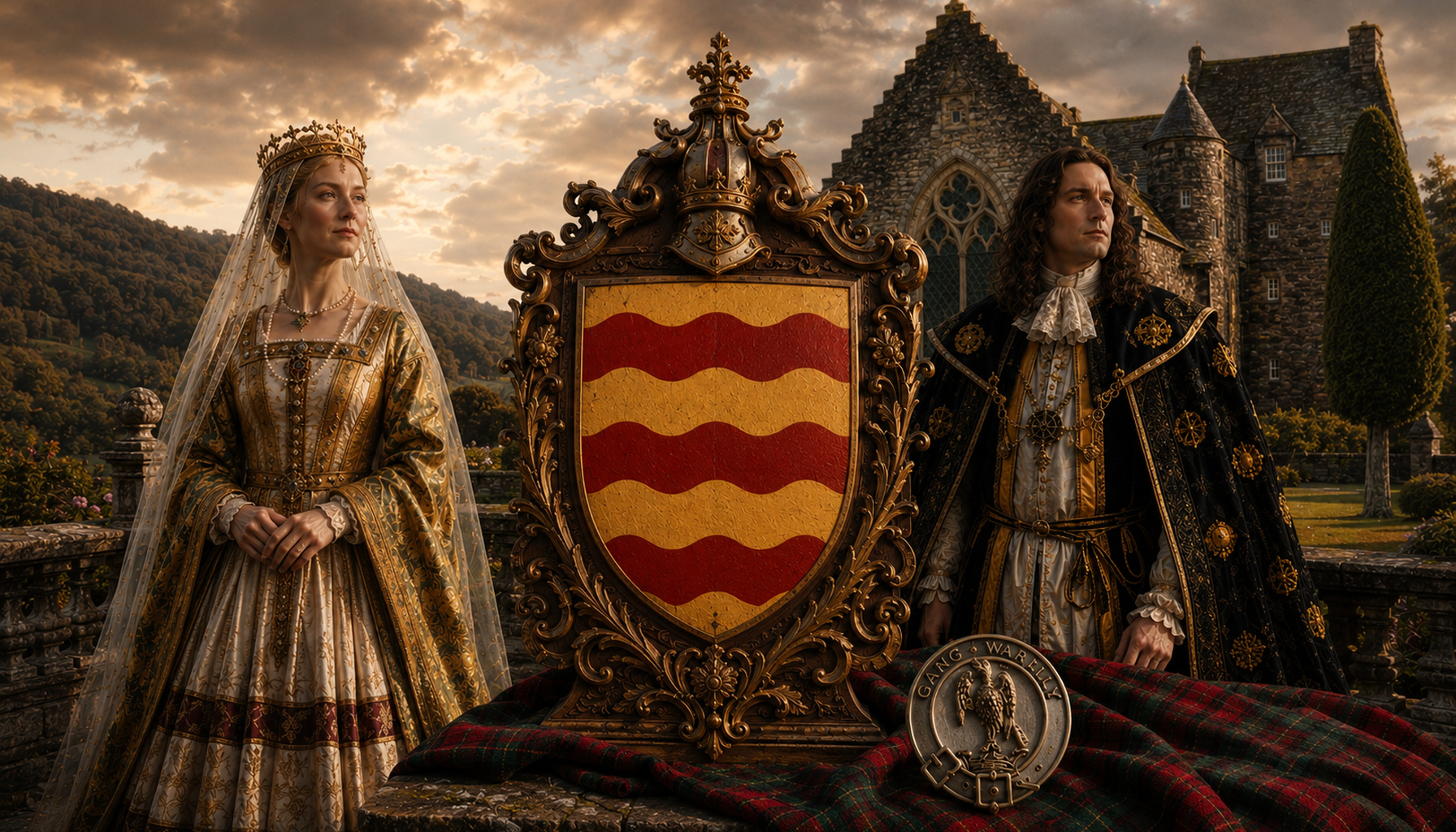
Clan Drummond was one of the great noble houses of Scotland, rooted above all in Perthshire and closely tied to Stobhall, Drummond Castle, and the political world of the Scottish crown. The family is traditionally linked to early medieval Scotland, and in genetic terms the primary family haplogroup associated here is R1b1a1b1a1a2c1a2a2a1e, a branch within the wider R1b lineage so often found across western Europe. In the long story of Scotland, the Drummonds were not simply local landowners with a handsome seat in the country. They became a family of consequence through landholding, careful marriage alliances, military service, and persistent loyalty to monarchy, especially in the shifting and often dangerous politics of late medieval and early modern Scotland.
The name itself is tied to place and landscape, which is very often how old Scottish power begins: not with an abstract pedigree, but with a stretch of ground, a defensible position, a cluster of loyalties, and a memory of possession. From that Perthshire base the Drummonds rose steadily. One of the family's most important figures was Annabella Drummond, who married Robert III of Scotland and became queen consort, binding the clan directly to the royal House of Stewart. That marriage gave the Drummonds a place not just near the throne, but inside the dynastic fabric of the kingdom. Later titles marked their continued standing, including Lord Drummond of Cargill from 1488, the Earls of Perth from 1605 to the present creation, and the Dukes of Perth from 1716 to 1800. Their history touches royal politics, court culture, Jacobite loyalty, and the ceremonial language of heraldry that mattered so much in aristocratic Scotland.
Read more about the Royal House of Stewart
Drummond Castle is the great location anchor of the family story, and it remains one of the most striking aristocratic sites in Scotland. Set near Crieff in Perthshire, the castle began as a tower house in the late 15th century, traditionally associated with Sir John Drummond, 1st Lord Drummond. What survives is not a single frozen medieval building but a layered noble residence, altered and enlarged over centuries, with later mansion elements joined to the older fortified core. In other words, it tells exactly the sort of truth castles often tell: families changed, tastes changed, danger changed, and architecture changed with them. Yet Drummond Castle is especially famous for its formal terraced gardens, among the most celebrated in Europe, laid out in their grand axial style and shaped into a display of power, order, and cultivated prestige. The place is not merely picturesque; it is a statement in stone and geometry about how the Drummonds wished to be seen. Happily for visitors, the gardens are still open to the public at set times, so this is one of those clan landmarks that can still be visited in a very immediate way.
For those interested in deeper ancestry, the haplogroup R1b1a1b1a1a2c1a2a2a1e links the Drummond story to a much older web of related ancient DNA samples across Britain and Europe. These do not prove direct descent from Clan Drummond, of course, but they offer a fascinating genetic backdrop. Related or linked examples include several Celtic Durotriges burials from Duropolis at Winterborne Kingston in England, such as WBK12, WBK20, WBK29, WBK41, WBK05, WBK30, WBK43, WBK06, WBK08, WBK18, and WBK191, alongside samples like Celtic Briton East Kent England I13730, Iron Age Worlebury Somerset England I11991, Iron Age Roundhouse Bu Orkney Scotland I2982, Iron Age Hillfort Battlesbury Bowl England I21309, Bronze Age Boatbridge Quarry South Lanarkshire Scotland I5473, Bell Beaker Wiltshire Upavon England I4950, Bronze Age Amesbury Down Wiltshire England I2417, Bronze Age Trumpington Meadows Cambridge England I3256, Bronze Age Bedfordshire samples I7576 and I7577, Early Bronze Age England Thames I5377, and Ireland Copper Age Rathlin2B. Beyond Britain and Ireland, linked examples also appear in Imperial Roman Era Zadar Croatia I26776, Early Medieval Belgium Sint-Truiden Groenmarkt ST2025, Medieval Belgium outsider Sint-Truiden Onze-Lieve-Vrouwekerk ST1308, Gallic France Parancot CGG023699, Post Roman Worth Matravers Dorset I11580, Merovingian Alt-Inden IND013, Late Roman Klosterneuburg R10656, Late Roman Conimbriga R10488, Bronze Age Orkney KD061, Bronze Age Calabria GMO015, and Medieval Faroe Islands Sandoy Church VK27. Taken together, they suggest a broad western European and especially Insular Celtic genetic horizon within which a later Perthshire noble house like the Drummonds would comfortably sit.
If you have Drummond ancestry, Perthshire roots, or simply a curiosity about how noble family history meets archaeology and DNA, this is exactly the kind of story worth testing for yourself. Upload your DNA to MyTrueAncestry and see whether you match Clan Drummond, the wider Stewart-connected world, or any of the related ancient DNA samples linked to haplogroup R1b1a1b1a1a2c1a2a2a1e.
Comments