House of Manfredi
– 3 min read


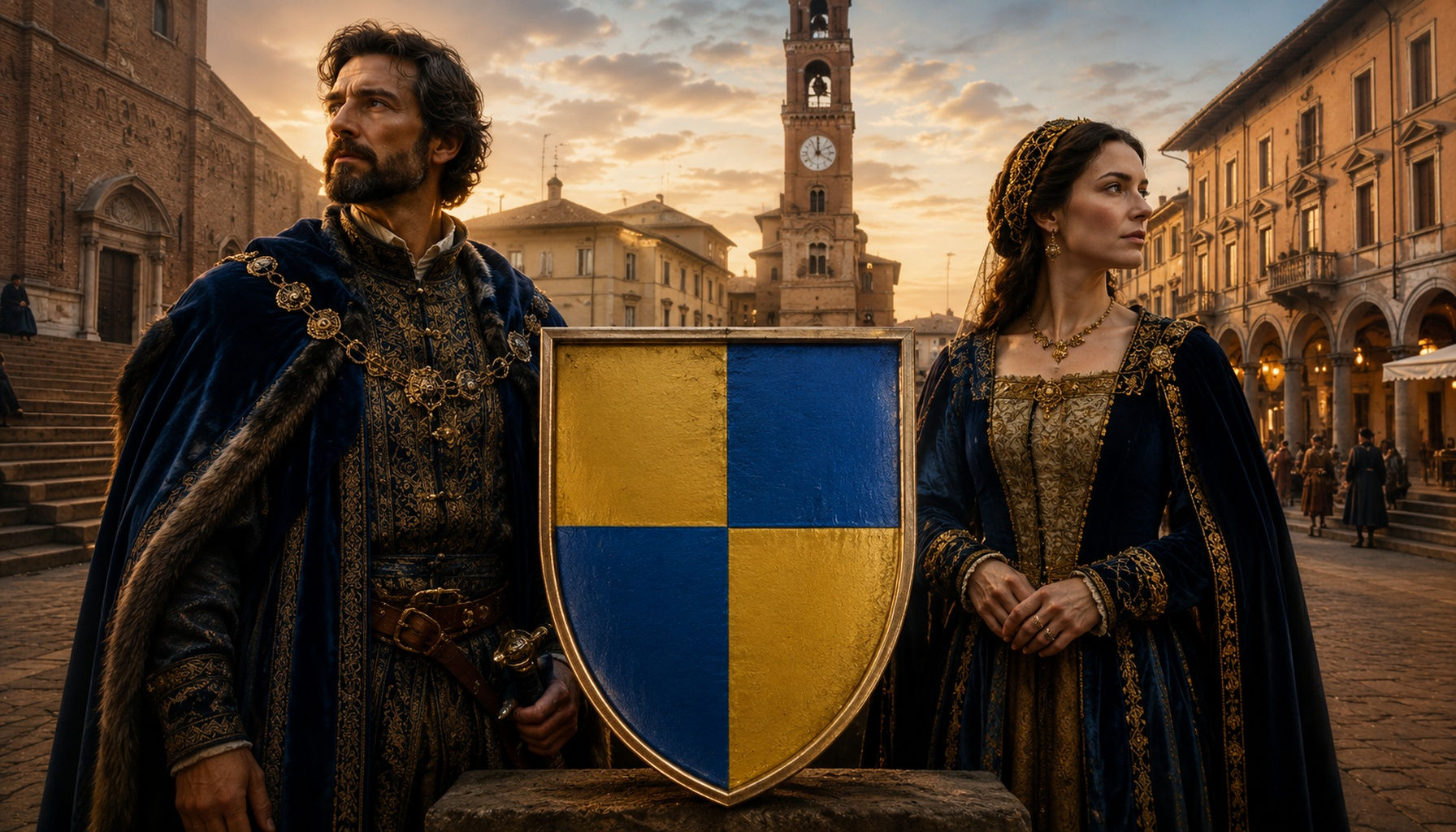
The House of Manfredi was an Italian noble family rooted above all in Faenza, in Romagna, and closely tied here to the haplogroup J2b2a1a1a1a1a1a. They belonged to that distinctive world of medieval and Renaissance Italy in which a family could begin as urban power brokers, gather offices, towers, armed followers, and loyal clients, and then turn civic influence into lordship. In other words, the Manfredi were not remote fairy-tale aristocrats. They were practical political operators in a landscape crowded with communes, bishops, papal legates, mercenary captains, ambitious neighbors, and rivals within their own walls.
Their rise makes best sense in the historical setting of Romagna, where the weakness of wider imperial and papal control often opened space for strong local dynasties. The Manfredi emerged from Faenza's political life and became signori, shaping government through force, negotiation, alliance, and patronage. Figures such as Astorgio Manfredi, noted in 1250, show the family already active in the turbulent communal age; Giovanni Manfredi, born in 1324 and dead in 1373, belongs to the period when family rule and military command were inseparable; and Astorre II Manfredi, 1412 to 1468, stands firmly in the Renaissance moment, when an Italian lord had to be part soldier, part diplomat, and part civic showman. Their story is a classic signorial one: urban rule, dynastic ambition, heraldic identity, and constant exposure to the dangerous weather of Italian politics.
The great location anchor for the family is the Rocca Manfrediana, associated with the Manfredi name in Faenza's historic landscape and memory. The fortress complex, as preserved and described in the historical record, reflects exactly what a signorial family needed: not just a residence, but a statement in brick and stone that authority had walls, towers, gatekeeping power, and a commanding presence over the town. Its fabric includes medieval and later phases, showing how these strongholds were adapted over time rather than built once and left untouched. Like so many Italian rocche, it was both military and political theatre, the architecture of control made visible. And yes, the site can still be visited, which matters because with families like the Manfredi the history is not merely in chronicles and coats of arms; it is still there in the urban landscape, where fortification, memory, and local identity continue to meet.
Read about the Royal House of Savoy
From the DNA side, the primary family haplogroup tag here is J2b2a1a1a1a1a1a, a lineage with a wide and interesting ancient footprint across parts of Europe and the Balkans. Related or linked ancient samples assigned to this branch or close context include multiple individuals from Migration Period and Avar-era Rakoczifalva in Hungary, such as RKF031, RKC026, RKF047, RKF029, RKC046, RKC047, RKC050, RKC011, and RKC038, alongside later and neighboring finds like Late Imperial Roman Croatia Gardun R3544, Late Imperial Roman Serbia Timacum Kuline Ravna Village I15548, Medieval Croatia Nustar I28397, Longobard Period Pannonia Savaria Szeleste Barbaricum Hungary SZL087, Post Roman Period Pannonia Arrabona Gyirmot Barbaricum Hungary GHD019, Merovingian Bavaria Alh_119, Illyrian Velika Gruda samples I13778, I14498, and I13169, and Iron Age Montenegro Doclea Bjelovine R3481. These do not prove direct descent from the Manfredi family, and it would be wrong to pretend they do. What they offer instead is a deeper genetic backdrop: a reminder that lineages later found among medieval and Renaissance elites often reach back through Roman, Balkan, post-Roman, and steppe-connected populations whose movements and entanglements shaped Europe long before the Manfredi took hold in Faenza.
Explore ancient DNA from Hungary's dynasties
If the House of Manfredi catches your imagination, the next step is to test the connection for yourself. Upload your DNA to MyTrueAncestry and see whether you match the Manfredi haplogroup profile J2b2a1a1a1a1a1a or any of the related ancient DNA samples linked to this wider historical world of Roman frontiers, Balkan lineages, and medieval elites.

Comments