Hochdorf Prince
– 5 min read


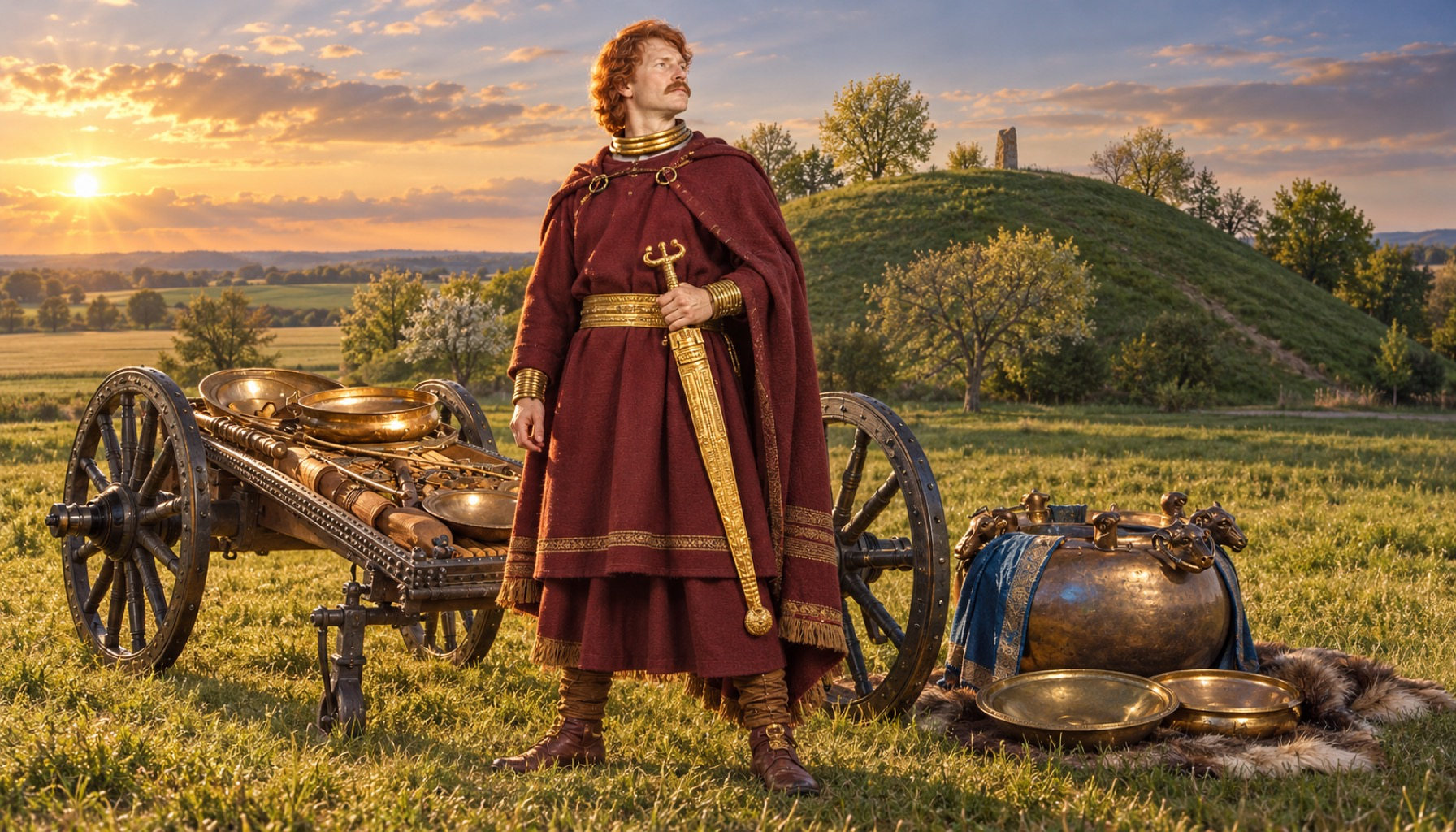
The Hochdorf Prince was buried near modern Eberdingen-Hochdorf in southwestern Germany around 530 BC, in the heart of the early Celtic world usually associated with the Hallstatt culture. He matters because his grave is not merely rich; it is one of those archaeological discoveries that makes one stop and stare. Here is a man laid out on an elaborate bronze couch, surrounded by gold ornaments, weapons, drinking gear, a four-wheeled wagon, and a vast imported bronze cauldron from the Mediterranean world. It is the sort of burial that tells us, in blunt material terms, that power in Iron Age Europe could be theatrical, hereditary, and astonishingly well connected.
That wider world was not an isolated barbarian fringe waiting for Greek and Roman history to notice it. Southwestern Germany in the sixth century BC sat within a network of elite centres, hilltop strongholds, exchange routes, and political households that linked temperate Europe to Alpine corridors and Mediterranean trade. The Hochdorf burial shows a ruler whose authority was expressed through feasting, display, mobility, and warfare. The grave goods are a political language in metal, gold, and imported prestige objects.
Explore Celtic origins through ancient DNA
We do not know the Hochdorf Prince's personal name, and that is worth saying plainly. He is a securely excavated individual, but not one known from written records. The label "prince" is therefore a modern shorthand for status, not a documented ancient title. Even so, the burial leaves little doubt that he belonged to the highest stratum of his society. He was a tall adult man buried with symbols of command and hospitality, two things that often go together in early aristocratic societies. A ruler feeds followers, stages alliances, and turns imported luxuries into local authority.
The great cauldron is especially telling. Mediterranean in origin and capable of holding hundreds of litres, it was no domestic pot. It speaks of banquets, ceremonial drinking, and a political culture in which generosity could be staged before an audience. The wagon, likewise, was not just transport but status made visible. Taken together, the objects in the mound show an elite who were not cut off from distant worlds but actively participating in long-distance exchange. The Hochdorf Prince stands, then, as a vivid witness to how early Celtic elites built power before Rome ever entered the story.
The ancient-DNA sample associated with this individual is Elite Prince Celtic Germany Eberdingen-Hochdorf Biegel, with an approximate date of 515 BC. In genetic publications the central burial is identified as HOC001. Because the remains come from the famous central interment within the Hochdorf mound, this is not a speculative identification but a strongly supported association between the excavated body and the historically important burial usually called the Hochdorf Prince.
Archaeologically, this matters because the grave was exceptionally well preserved and richly furnished. The man was placed on a bronze couch inside a chamber beneath the burial mound, and the arrangement of objects around him was highly deliberate. This was not a casual deposit of valuables but a carefully composed statement about rank and rulership. Ancient DNA adds another layer to that statement: researchers found that HOC001 was biologically related to another elite man buried at nearby Asperg-Grafenbühl. That finding, discussed in the 2024 study in Nature Human Behaviour, is historically important because it gives direct evidence that power among these early Celtic elites could run in families.
In other words, archaeologists had long suspected dynastic behaviour from the concentration of lavish burials in this region. Genetics now supports that suspicion with kinship evidence rather than impression alone.
Read more on ancient DNA and kinship
The Hochdorf Prince's Y-DNA haplogroup was R1b1a1b1a1, while his mtDNA haplogroup was J1b1a1. These two results describe different lines of ancestry. Y-DNA follows the direct paternal line, passed from father to son, while mtDNA follows the direct maternal line, passed from mother to children. Neither tells us everything about his ancestry, but each provides one narrow, useful thread through the much larger tapestry of his family history.
The paternal lineage R1b1a1b1a1 belongs to a broader Y-chromosome family widely documented in prehistoric and historic western Eurasia, including many Bronze Age and Iron Age individuals in Europe. That does not make it a "Celtic marker" in any simplistic sense, and it certainly does not prove ethnicity on its own. What it does do is place the Hochdorf Prince within a paternal lineage with deep roots in the wider population history of Europe.
His maternal lineage, J1b1a1, is much more specific in this case. The supplied ancient-DNA linkage for J1b1a1 points directly to HOC001 itself. That means the maternal line is presently informative mainly as part of his own genetic profile rather than as a broad cluster of named close comparanda in the material provided here.
A short look at related ancient DNA is revealing. The same broad paternal lineage, R1b1a1b1a1, appears in other ancient individuals from very different times and places, including the nearby elite Celtic burial at Asperg-Grafenbühl (APG001), another Hochdorf-associated sample (HOC001b and HOC001c), the elite Celtic burial from Magdalenenberg (MBG013), Iron Age and Roman-era individuals from Britain such as WBK17, WBK192, WBK10, NWC009, ARB003, DUX003, and DUX008, as well as later elite or warrior burials like COL_150 from Lombard Collegno. Going further back, related examples include Bronze Age individuals such as LEU064 from Leubingen and I5757 from Sion-Petit-Chasseur. The point is not that all these people formed one tribe, dynasty, or people in any cultural sense. Rather, it shows how one paternal lineage could persist across centuries while languages, identities, and political systems changed around it. In the Hochdorf Prince's case, the most historically useful comparison is the nearby elite APG001, because that is where lineage and social rank intersect most clearly.
The real excitement here is not that Hochdorf Prince had a named haplogroup. Many ancient individuals do. The excitement is that his DNA connects an extraordinary burial to a local network of similarly privileged burials and helps show that at least some early Celtic power was dynastic in biological as well as social terms. That is a rare thing in prehistoric Europe: not just a rich grave, but a rich grave tied by genetics to another rich grave nearby.
Still, the limits matter. DNA cannot tell us his personal name, the language he spoke at home, or the exact office he held. It cannot reduce a complicated Hallstatt ruler to a haplogroup label. What it can do is sharpen the picture drawn by archaeology. The Hochdorf Prince was not simply a wealthy individual in isolation. He appears to have belonged to a hereditary elite milieu, one plugged into long-distance exchange and local political succession. That is a far more interesting conclusion than any simplistic tale about origins.
Discover Celtic mobility and burial practices
MyTrueAncestry lets you compare your DNA with ancient populations and archaeological samples from worlds like that of the Hochdorf Prince, including Iron Age Celtic and wider European lineages. It cannot prove direct descent from this ruler, but it can help you explore whether your DNA shows connections to the ancient populations among whom he lived.

Comments