Haplogroup Q1b1a1a1k1

– 4 min read


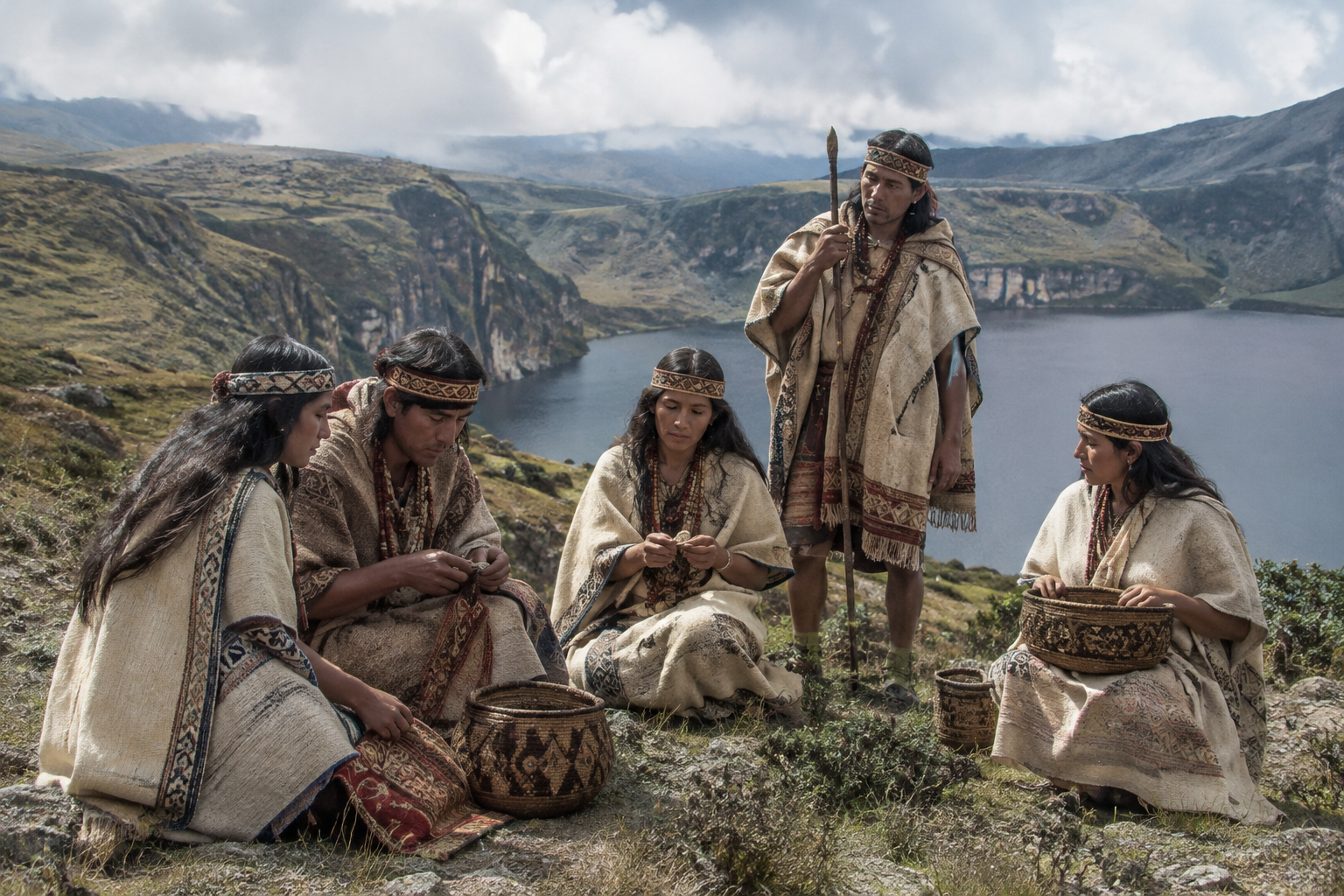
At Laguna de los Condores in the cloud forests of northern Peru, a remarkable cluster of late pre-Hispanic burials has given geneticists something unusually valuable: not just one ancient man tied to the Y-DNA haplogroup Q1b1a1a1k1, but several closely related sample designations from the same Chachapoyas context around AD 1455. The identifiers LDC020, LDC020c, LDC020e, LDC020g, and LDC020h all point back to that same archaeological setting, a mortuary landscape famous for preserving human remains in a high, cool environment.
That matters because Y-DNA follows a direct paternal line. It does not tell us everything about a person's ancestry, language, or identity, but it can preserve a very particular line of descent. In this case, Q1b1a1a1k1 appears not in some abstract map of the Americas, but in the lived world of the Chachapoyas, a society of the northeastern Andes whose dead were placed in dramatic cliffside and mausoleum settings long before Spanish rule remade the region.
Laguna de los Condores sits in Amazonas, in a zone where steep mountains, forested valleys, and difficult routes helped produce a distinct regional culture. The Chachapoyas are well known archaeologically for stone settlements, funerary constructions, and mortuary traditions that used caves, cliff ledges, and mausoleums. By the fifteenth century, when these individuals lived, the region had already been drawn into the expanding Inca sphere, but local communities remained very much in evidence.
The sample cluster centered on LDC020 is therefore historically suggestive. Rather than a lone genetic outlier, we are dealing with repeated sampling labels from one burial context in the late pre-Columbian Andes. That does not automatically prove a dynasty or even close kinship among everyone in the cemetery, but it does show that this paternal line belonged inside a real Chachapoyas population at a clearly defined time and place.
A major ancient DNA study of Indigenous populations in the Americas, published in Nature, has helped sharpen this broader picture of regional continuity and movement. For readers following paternal lines, the key point is that Q subclades in the Americas are best understood through local histories like this one, not through oversimplified stories of a single migration frozen in time.
The string of related identifiers, LDC020, LDC020c, LDC020e, LDC020g, and LDC020h, looks technical because it is. But archaeologically it tells a simple story: researchers were able to derive multiple records from material associated with the same individual or burial grouping at Laguna de los Condores. That kind of repetition can strengthen confidence that a paternal assignment is not hanging on one fragile read from one degraded fragment.
For the haplogroup article, that is especially important because Q1b1a1a1k1 is a very narrow label. It belongs within the much larger Y-DNA haplogroup Q, one of the principal paternal lineages associated with the peopling of the Indigenous Americas. Still, one should be careful. The long history of haplogroup Q across the Americas is not the same thing as the history of this exact terminal branch. What Laguna de los Condores gives us is hard evidence for the branch in one late pre-Hispanic Andean setting, not a licence to project every earlier movement of haplogroup Q onto Q1b1a1a1k1 itself.
There is sometimes a temptation to imagine the Andes as a series of neatly bounded peoples whose ancestry stayed perfectly local. Ancient DNA keeps spoiling that tidy picture, and that is a good thing. The late pre-Hispanic Andes were interconnected by exchange, imperial expansion, marriage networks, forced movements in some periods, and older regional continuities that long predated the Inca.
The Chachapoyas case belongs in that more interesting reality. A paternal lineage like Q1b1a1a1k1 could persist within a local population while the wider genetic ancestry of that population reflected many older layers of Andean history. In other words, one Y-line can remain stable through political change. The fifteenth century was not genetically blank; it was crowded with long memories.
That wider lesson fits well with other Andean case studies featured in the community, especially where ancient DNA has shown mobility without erasing local family structure.
Any discussion of this haplogroup has to begin with a plain fact: the parent haplogroup Q is central to the paternal history of Indigenous peoples across much of the Americas. But that broad statement can mislead if it is handled clumsily. Ancient and modern branches under Q diversified over long periods, in different regions, and under very different historical conditions.
So what can be said responsibly about Q1b1a1a1k1? First, it belongs to that unmistakably American paternal framework. Second, its appearance in Chachapoyas-associated burials around AD 1455 places it firmly in the late pre-contact Andes. Third, the Laguna de los Condores evidence suggests continuity of Indigenous paternal lines in a region often described through conquest narratives rather than through local descent.
That last point is worth lingering over. Spanish chronicles made the Chachapoyas visible to history in one way, but genetics and archaeology let them speak in another. A line like Q1b1a1a1k1 is not merely a marker on a tree; in this context it is part of the demographic texture of a mountain society living through the last generations before European invasion transformed Peru.
Some ancient DNA finds are famous because they are old. Others matter because they are precise. Laguna de los Condores belongs to the second category. A late date, a named archaeological culture, a specific Peruvian site, and multiple connected records make this a useful anchor point for anyone exploring a Native American paternal line within haplogroup Q.
It also reminds us that preservation shapes history. The cliffside mortuary traditions of northern Peru did not merely create striking archaeology; they helped preserve biological evidence that can still be read centuries later. Without such contexts, many paternal histories would remain frustratingly vague.
For readers interested in the bigger framework of how ancient genomes are clarifying the population history of Indigenous America, this broader overview is worth pairing with the Chachapoyas case.
The clearest ancient signal for Q1b1a1a1k1 here comes from the Chachapoyas-associated remains at Laguna de los Condores around AD 1455, especially the LDC020 sample cluster. That does not turn every bearer of the haplogroup into a Chachapoyas descendant, but it does place this paternal branch securely within the late pre-Hispanic Andes. For someone researching a direct paternal line, that is the real value of ancient DNA: not fantasy pedigrees, but a firmer map of where one lineage was genuinely living in the past.
Comments