Haplogroup N1a1a1a1a

– 5 min read


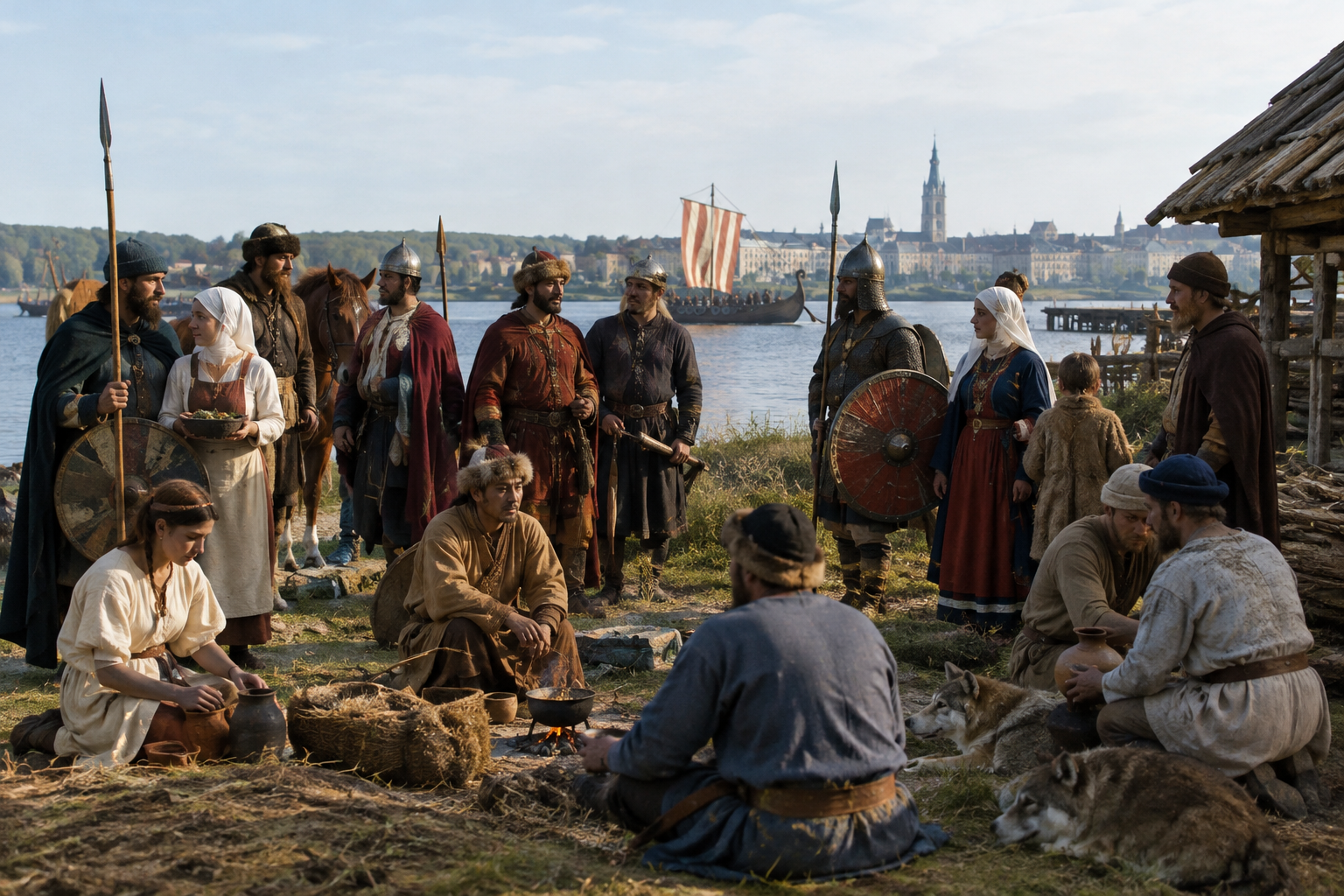
At Rikalanmaki in Salo, southwestern Finland, one medieval man has become a particularly revealing marker of northern paternal history. Sample SIK001, dated to about AD 1150 and described as Viking or Crusader Age, belongs to Y-DNA haplogroup N1a1a1a1a - a branch that turns up again and again in the eastern Baltic and the forest-steppe worlds beyond it.
That matters because N1a1a1a1a is not just a label on a tree of mutations. As a Y-chromosome lineage, it traces one direct male line only, but the archaeological spread of that line is striking: from Cis-Baikal in the Late Neolithic, to Iron Age Kazakhstan and Estonia, to Avar-period Hungary, medieval Finland, and a few later individuals further west. The pattern is not one of a single people marching across Eurasia. It is a record of recurring male-line continuity inside several different societies.
The strongest cluster in this set is in Finland, and that is the first thing worth noticing. Alongside SIK001 from Salo Halikko Rikalanmaki, the same haplogroup is reported in EU2002 from the rich male grave at Eura Vanha Kansakoulu, dated around AD 1100; PRK003 from Nokia Hakamaki in Upper Satakunta, around AD 1175; and RKA001 from Raisio Kansakoulunmaki, around AD 1190.
That is not a random scatter. It places N1a1a1a1a squarely in the male population of early and high medieval western Finland, especially in regions tied into Baltic trade, inland communications, and the changing political world of the 11th to 12th centuries. Research on early medieval Finland has increasingly shown that these communities cannot be reduced to a simple tale of isolation. They sat at a junction of Baltic, Scandinavian, and eastern connections, and paternal lineages such as N1a1a1a1a help show just how old some of those eastern-linked male lines were in the region.
One should be careful here. These Finnish men were not all the same in culture, status, or family background simply because they shared a Y-lineage. But taken together, they do suggest that N1a1a1a1a had become well established in parts of Finland by the medieval period, rather than arriving there as some brief or exotic intrusion.
The older samples push the story far to the east. The most ancient in this group is DA345 from Ust Ida in Cis-Baikal, dated to about 3504 BC. That single data point does not let us draw a straight line from Baikal to medieval Finland, but it does show that the broader paternal background associated with this branch reaches deep into northern Eurasia.
Later samples place the lineage in the steppe and forest-steppe interaction zone. SMV001 from Iron Age Shmakovo and KOK001 from Iron Age Kokonovka, both around 350 BC, point to its presence in Inner Eurasian populations before the Roman period. So does BIR005, a Scythian grave from Korgantas at Birlik in Pavlodar, Kazakhstan, dated to around 250 BC. Here the important point is not to claim that N1a1a1a1a was a "Scythian haplogroup" in any exclusive sense. Rather, it formed part of the paternal diversity inside steppe-connected societies that linked eastern and western Eurasia.
An ancient DNA study of Inner Eurasian populations has helped underline this broader setting, showing that steppe and forest-steppe communities were often genetically mixed and historically mobile rather than neatly bounded ethnic blocs. That wider background is relevant for understanding why a lineage like N1a1a1a1a can appear in very different cultural settings centuries apart here.
If Finland gives us the densest medieval cluster, 0LS10 from Iron Age Estonia offers an important bridge. This individual, from Hiiemgi in Laane-Viru County near Viru-Nigula and dated to about 670 BC, places N1a1a1a1a on the eastern Baltic shore well before the Viking Age.
That is archaeologically significant because Estonia and Finland were never sealed worlds. The Gulf of Finland connected them, even when language, local identity, and burial customs differed from place to place. A paternal line present in Iron Age Estonia and later in multiple medieval Finnish burials fits a long regional history of interaction across the northeastern Baltic, not a sudden medieval appearance.
It also serves as a useful warning against over-simplification. People sometimes imagine Y-DNA maps as if every lineage must belong to one named tribe or language community. But the Baltic evidence suggests something messier and more historical: continuity in some male lines, movement of others, and societies built from repeated contacts over many centuries.
Two particularly interesting appearances come from the Avar-period Carpathian Basin: A1808, a high-ranking elite military burial from Szalkszentmarton-Taborallas dated around AD 650, and A1820 from the Avar elite cemetery at Kunszallas-Fulopjakab, around AD 700. These are not ordinary finds in an article otherwise leaning toward the Baltic and northern Eurasia. They show that N1a1a1a1a also occurred among Avar elite contexts in early medieval Hungary.
That does not mean every bearer of this lineage was Avar, nor that the lineage itself can be equated with Avar political identity. But it does remind us that the early medieval Carpathian Basin drew in men with very different ancestral backgrounds. Elite burials there often reflect the connected world of the steppe, where military power, alliance, and migration could move paternal lines across large distances.
For readers interested in how genetics is reshaping our picture of such Hungarian contexts, MyTrueAncestry has also covered the broader genomic story of elite burials from the region.
Sample PCA0088 from Goth Maslomecz, dated to around AD 300, adds another twist. Maslomecz in present-day Poland is important precisely because it has produced evidence for a late antique community that was culturally Gothic yet genetically varied. In other words, the site is useful not because it confirms a pure ethnic package, but because it shows how misleading that expectation can be.
A recent archaeogenomic discussion of the Maslomecz material has emphasized this diversity here. The appearance of N1a1a1a1a in that setting fits the larger lesson: late antique frontier societies often brought together men from distinct paternal backgrounds under shared cultural labels.
After that, the lineage surfaces in still later western contexts that are individually intriguing but harder to weave into one simple migration story: KRA001c from medieval Krakauer Berg Peissen in Germany around AD 1140, kro006 from the Stora Kronan shipwreck off Oland in Sweden in AD 1676, and STR105a from St. Rombouts in Belgium around AD 1800. By this stage, we are looking less at frontier transfer and more at the fact that a once more easterly-associated male line had become part of wider northern and central European populations.
The distinctive feature of N1a1a1a1a is not a single kingdom, tribe, or heroic migration. It is its repeated appearance across northern Eurasia, the eastern Baltic, and steppe-connected societies, followed by a notably solid foothold in medieval Finland. For someone researching this paternal line today, that combination points less toward one dramatic ancestor than toward a deep history in the eastern half of Europe and beyond, with especially meaningful medieval echoes around Finland and the Baltic world.






Comments