Haplogroup Q1b

– 5 min read


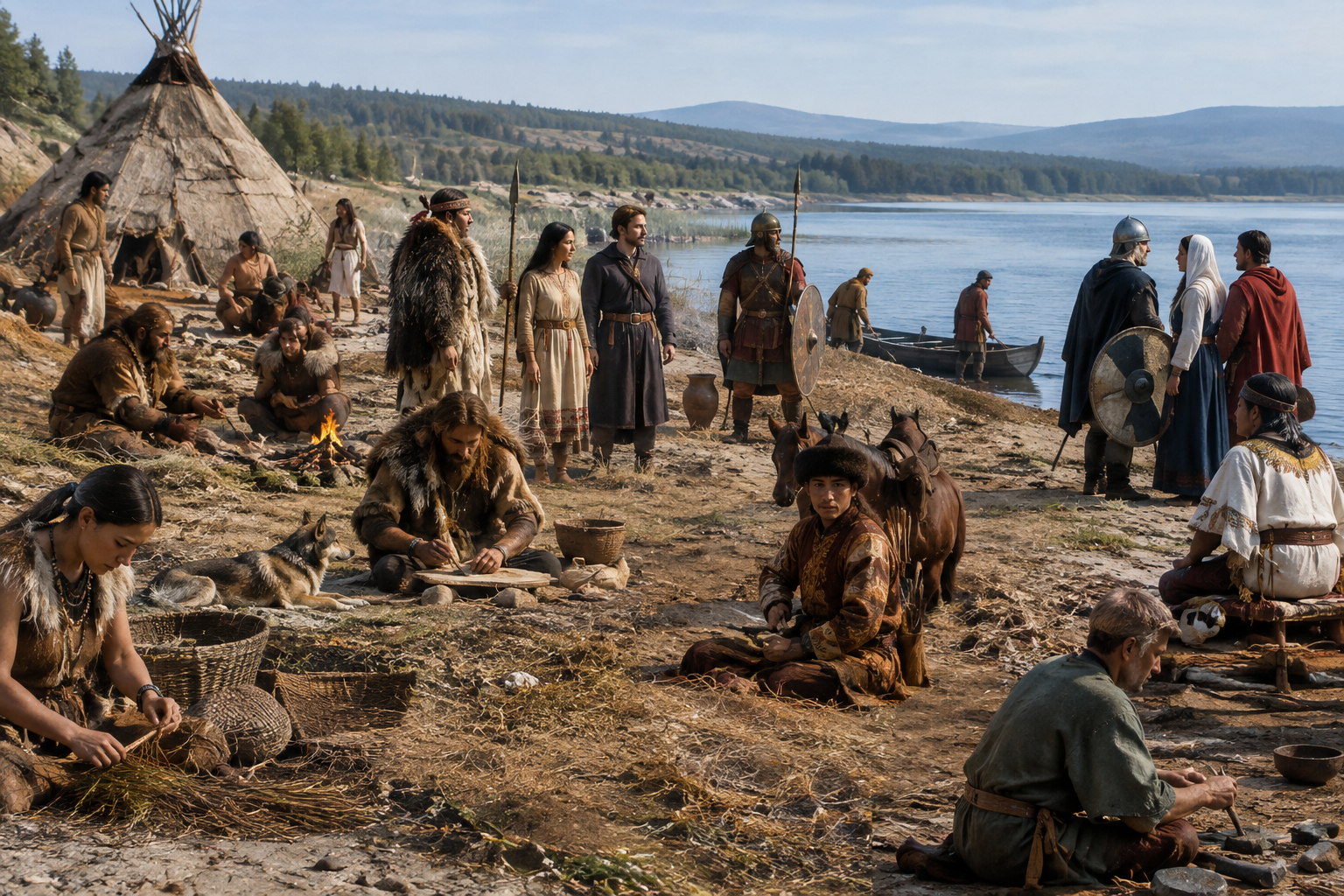
At Machu Picchu, two late individuals identified as MP55 and MP78a, dating to around AD 1500, carried the Y-DNA haplogroup Q1b. That is an arresting place to meet this lineage. The Inca citadel usually appears in popular imagination as a mountain stronghold of the imperial Andes, yet a paternal line linked here also turns up in much older burials far to the north across Siberia, the forest zone of Russia, and the Eurasian steppe.
That does not mean one simple unbroken tale from the Urals to Peru. It means something more interesting. Q1b belongs to the broader Y-chromosome haplogroup Q, a paternal lineage with a deep history in northern Eurasia and the Americas, and these ancient samples show how one branch could appear in very different societies over thousands of years. Y-DNA follows only a direct male line, not a person's whole ancestry, but even so, Q1b offers a striking archaeological map of mobility, persistence, and survival.
Some of the clearest early evidence in this set comes from Sakhtish II in Russia, where two Neolithic individuals, NEO181 and NEO185, are dated to around 3318 BC. This was not the open grassland world of later horse-riding nomads, but a forested landscape of rivers, lakes, and hunter-fisher communities. That matters, because it reminds us that paternal lines later associated in popular writing with "steppe" history often have deeper roots in very different ecological zones.
The Sakhtish material is especially useful because it places Q1b in a northern Eurasian setting long before the great historical confederations of the Iron Age. A reader looking at these two burials should not imagine a named tribe marching across a map. Better to think of small communities, local traditions, and male lines that could persist through generations even as language, subsistence, and wider contacts changed.
For more on this region and its ancient people, see the related MyTrueAncestry article below.
Sakhtysh forest hunter-gatherers
Other northern samples widen that same picture. NEO100 from the Ural River region, dated to about 7977 BC, is extraordinarily early. NEO72 from the forest steppes of Mergen, around 6406 BC, and the Vengerovo individuals NEO922 and NEO911, dated to roughly 5599 BC and 4830 BC, keep Q1b in view across a broad northern arc. Even without forcing them into a single cultural box, the pattern is plain enough: this branch was present in northern Eurasia very early, and in more than one local setting.
The eastern side of the story matters just as much. Three individuals from ancient Fofonovo in Buryatia, Russia - NEO199, NEO200, and NEO201 - are dated to around 5219 BC, while I20308 from Glazkovskaya at Sosnovy Mys 2 dates to about 2675 BC. These sites sit in the wider world of Siberia and the Baikal region, one of the great laboratories of ancient DNA because it preserves both long continuity and repeated contact between populations.
An ancient DNA study of the region, published in Science, has helped sharpen just how dynamic northern Eurasia was in prehistory. The value of the Q1b finds here is not that they solve every movement on their own, but that they show this paternal branch in eastern hunter-gatherer and early Holocene contexts that are central to the peopling history of North Asia.
That eastern distribution is worth pausing over. When a lineage appears in both the forested Russian interior and in Baikal-adjacent eastern contexts, the implication is not a neat "origin point" we can stamp on a map, but a broad zone of ancient northern Eurasian presence. Q1b, at least in this evidence, looks less like a local curiosity and more like part of a very old northern network.
A related article on prehistoric disease and Baikal-region populations gives useful background to this world:
Baikal hunter-gatherers and plague
By the Bronze Age and Iron Age, Q1b appears in settings that many readers will recognise more readily from history books. NEO77 from Okunevoa II in Russia, dated to around 2782 BC, NEO902 from Sjauke in Kazakhstan around 1854 BC, and ESZ014 from the Scythian grave at Eleke Sazy in East Kazakhstan around 550 BC place this lineage in the world of steppe and steppe-edge populations.
This is where one must be careful. A man buried in a Scythian context is not the same thing as a timeless "Scythian haplogroup," and a paternal line cannot stand in for an entire people. But these finds do show that Q1b was part of the male-line diversity present in the steppe zone across long stretches of time, from Bronze Age communities to the mounted societies of the first millennium BC.
Research on Iron Age steppe elites and related populations has increasingly shown that these societies were genetically varied rather than uniform. That makes ESZ014 particularly interesting. It is not valuable because it confirms a stereotype, but because it complicates one: steppe worlds were political and cultural formations drawing on multiple ancestries and lineages.
Readers interested in that wider context may want this related piece:
Scythian elites and ancient DNA
One of the most intriguing things about Q1b in this sample set is that it does not stay neatly in Siberia and Central Asia. NEO599, from Sjaelland Vanlose Mose Bog Skeleton in Denmark and dated to around 3191 BC, places the lineage in Neolithic Scandinavia. NEO516 from Igren in Ukraine, around 2114 BC, and MFC011 from post-Gothic period Arrabona-Menfocsanak Barbaricum in Hungary, around AD 550, show further western occurrences in very different periods.
Then there is VK260, a Viking invader from Ridgeway Hill in England, dated to around AD 998. Ridgeway Hill is one of those sites where archaeology and history converge with unusual force: a burial linked to a violent Viking Age episode, but one in which genetics can still surprise us. A paternal line like Q1b in this context is a useful warning against flattening Viking forces into a single Scandinavian male signature.
A genetic study examining broad patterns in ancient Y chromosomes across East Asia and adjoining regions, published in Nature, underscores an increasingly important lesson of archaeogenetics: paternal lineages can travel widely, persist in minority positions, and reappear in contexts where older models would not have expected them. The western Q1b finds do not make Denmark or England "Q1b regions." They show instead that long-range human history is full of lineages moving through networks of exchange, marriage, migration, and conquest.
For readers following the Scandinavian side of the story, this related post gives useful background:
Denmark's Mesolithic-Neolithic transition
The two Machu Picchu individuals bring the article back to where it began. MP55 and MP78a, dating to around AD 1500, place Q1b in the late pre-Columbian Andes under Inca rule. That is not an isolated curiosity. Within the broader haplogroup Q, paternal lines are deeply important in the population history of the Americas, and the Machu Picchu evidence reminds us that imperial Inca sites were inhabited by people carrying lineages with much older northern roots.
Still, caution is essential. We should not leap from "Q1b at Machu Picchu" to claims about a single founding family, a special royal house, or a direct line from one Eurasian grave to one Andean man. What the evidence does support is something subtler and stronger: this paternal branch belongs to the long human history that links North Asia and the Americas, while also appearing repeatedly in Eurasian settings that remained connected, fragmented, and reconnected over millennia.
A related MyTrueAncestry article on the deeper American context is well worth exploring:
Ancient genomes of the Americas
If your paternal line belongs to Q1b, the most responsible historical takeaway is not a single tribe, kingdom, or heroic migration. It is that your direct male line sits inside a very old northern Eurasian and American story, one that appears in Mesolithic and Neolithic Russia, in the Baikal world, among later steppe populations, and in the Andes on the eve of the Spanish conquest. Q1b is a reminder that paternal ancestry can preserve astonishing depth, while the people who carried it lived in societies as different as forest foragers, Bronze Age communities, Scythian-era groups, Viking raiders, and Inca subjects.






Comments