Haplogroup I1a

– 5 min read


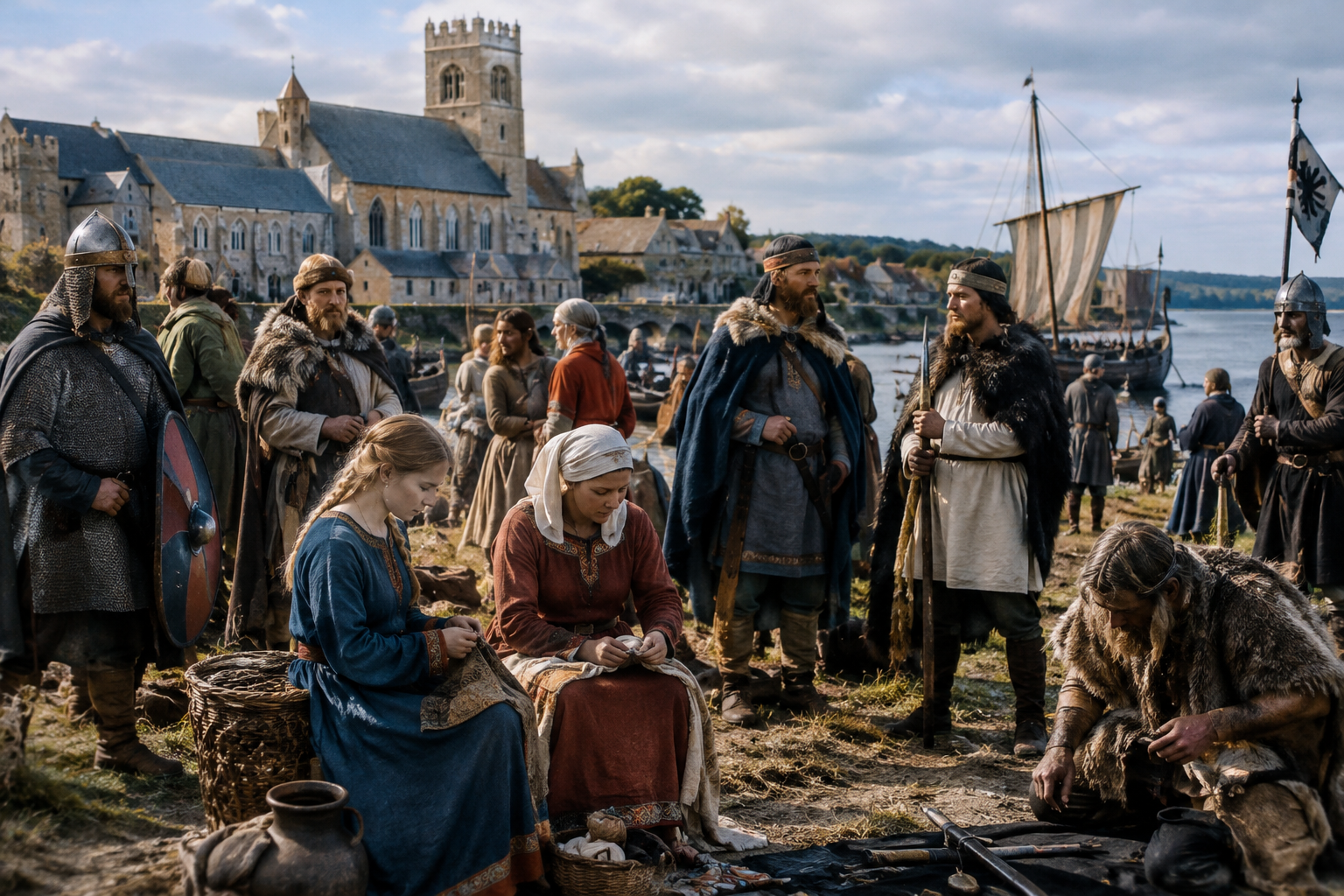
In Viking Age Oxford, among the men linked to the St. Brice's Day massacre of AD 1002, one individual stands out for anyone tracing the paternal line called I1a: sample VK144. He was not discovered in a saga, nor preserved as a king, but in a mass historical event recorded in both archaeology and text. That is often where Y-DNA becomes most interesting: not in legends, but in the collision between named history and excavated human remains.
I1a is a branch within the broader Y-chromosome haplogroup I1, a lineage strongly associated with northern Europe in ancient DNA research. Y-DNA follows one direct male line only - father to son to son - so it does not define a person's whole ancestry. But when the same paternal branch appears again and again in burials from Bronze Age Denmark, Iron Age Scandinavia, Migration Period Germany, and Viking Age contexts across the North Sea, it begins to outline a very specific historical pattern.
Sample VK144, identified from the Danish Viking group connected to St. John's College, Oxford, belongs to a moment of extraordinary tension in Anglo-Scandinavian history. These were men caught up in the massacre ordered under King Aethelred II, an episode that shows Scandinavians in England not as vague raiders on a map, but as real bodies in a real political crisis. For I1a, this matters because it places the lineage in a documented Viking Age movement across the North Sea.
The point is not that one Oxford individual can stand for all Vikings, still less for all carriers of I1a. Rather, he gives us a sharply focused example of the branch appearing in the very kind of mobile Scandinavian world with which I1 lineages are often associated. Another Viking Age Danish sample, VK316 from Hessum on Funen around AD 950, and VK367 from Bogovej on Langeland around AD 900, reinforce that Scandinavian background rather than leaving Oxford as an isolated outlier.
An ancient DNA study examining Viking Age populations across the wider region helped make this sort of comparison possible, showing just how varied and far-traveling Scandinavian-connected groups could be: https://www.nature.com/articles/s41586-023-06865-0#MOESM6.
If we move back well before the Viking Age, the distribution of I1a becomes even more revealing. Sample NEO590 from Magleo on Sjælland in Denmark, dated to about 1347 BC, places the branch in the Nordic Bronze Age. So does CGG106712 from Uglemose on Lolland, dated around 1675 BC. These are not medieval Scandinavians looking back to an ancestral homeland; they are part of the homeland itself, more than two millennia earlier.
That continuity across time is one of the most striking things about the evidence. We also have CGG106524 from Hestehavens mose in Jutland, dated around 237 BC, and CGG107392 from Asnæs, around AD 188, showing the branch in Iron Age Denmark as well. Add CGG106718 from Simonsborg in Kalundborg, associated with the Danii around AD 175, and the picture is not of a sudden Viking-age appearance, but of a lineage repeatedly present in southern Scandinavia across many centuries.
Sweden contributes to that pattern too. oll009 from the Battle Axe context at Ollsjö, dated about 1840 BC, is especially important because it hints at an even earlier northern setting for lineages associated with the wider I1 family. Much later, CGG024145 from Störlinge on Öland around AD 175 and kro008 from the Stora Kronan shipwreck of AD 1676 show that the paternal branch remained part of Scandinavian populations into the early modern period.
A broader genetic study of Denmark's deep population history helps frame why these repeated finds matter: ancient Scandinavia was not static, but some paternal lines clearly persisted and reappeared over very long periods in the region's archaeological record. See https://www.cell.com/cell/fulltext/S0092-8674(22)01468-4.
One should be careful here. I1a is not a synonym for "Viking," and it certainly does not prove a person's language or identity by itself. But sample VK409 from Staraya Ladoga around AD 1000 is a useful reminder that Scandinavian-linked paternal lines participated in the eastward world as well as the westward one.
Staraya Ladoga was one of the great nodal points of the early medieval Baltic and riverine trade networks, connected with routes that linked Scandinavia to the lands of the Rus'. A lineage like I1a appearing there fits neatly with what archaeology already tells us about movement, exchange, and settlement around the Baltic. It does not mean every man in Ladoga was Scandinavian; it means that this paternal line was part of that connected northern world.
The same caution applies to CGG106776 from Viking Age Bogovej, dated around AD 975. Taken alone, he is one burial. Taken with Funen, Langeland, Oxford, and Staraya Ladoga, he becomes part of a chain of evidence showing I1a in the maritime networks that tied together Denmark, England, and the eastern Baltic during the Viking Age.
Where the story becomes more historically textured is in the centuries between Rome and the Viking Age. Several samples associated with I1a turn up outside Scandinavia in Migration Period and early medieval settings. OBM052 from Obermöllern in Germany, dated around AD 500, and DRH024 from Deersheim in Saxony-Anhalt, also around AD 500, are associated with the Thuringii. Nearby in Bavaria, AED249 from about AD 485 comes from a Baiuvarii context.
None of this proves a simple one-way migration of a single "tribe." That would be much too tidy for the fifth and sixth centuries. But it does show I1a in the complicated post-Roman societies of central Europe, where local continuity, military mobility, intermarriage, and shifting political identities all overlapped. A paternal lineage that looks strongly northern in its deeper concentration was clearly not confined to Scandinavia itself.
Two further samples widen the map. A181017 from Kecskemét-Mindszenti in Transtisza, Hungary, dated around AD 450 and described as Gothic, places the branch in the Carpathian Basin during the age of Huns and Goths. VEM059 from Velim-Velistak in Croatia, around AD 775, shows the branch present in the early medieval Adriatic zone as well. These are precisely the centuries in which old Roman frontiers had broken down and new political worlds were being made out of movement and mixture.
By the eleventh century, I1a appears in a very different sort of context again: ATP_PSN_351 from St John's Hospital, Cambridge, dated around AD 1049. This is no Migration Period warrior horizon and no Viking massacre deposit. It belongs instead to medieval England, in a settled Christian landscape of hospitals, towns, and institutions.
That change of setting is historically important. A paternal branch that appears in Bronze Age Denmark, Iron Age Scandinavia, and Viking Age mobility does not vanish when the raids stop. It becomes part of ordinary medieval populations. In other words, the significance of I1a is not just that it turns up in dramatic northern episodes, but that it also survives into the everyday human fabric of later Europe.
That is why haplogroups are best understood not as badges, but as threads. Some threads pass through famous events like St. Brice's Day; others run quietly through cemeteries, villages, and hospitals. The same paternal line can belong to a Bronze Age man on Lolland, a Viking-linked burial in Oxford, and a medieval man in Cambridge.
For someone researching a modern I1a paternal line, the strongest supported impression is of a branch deeply at home in southern Scandinavia by the Bronze and Iron Ages, and later visible in the wider northern European worlds shaped by Migration Period movement and Viking Age expansion. The ancient samples do not give you a personal saga, but they do place your direct male line in one of the clearest long-term northern patterns yet visible in ancient DNA.






Comments