Haplogroup CT

– 6 min read


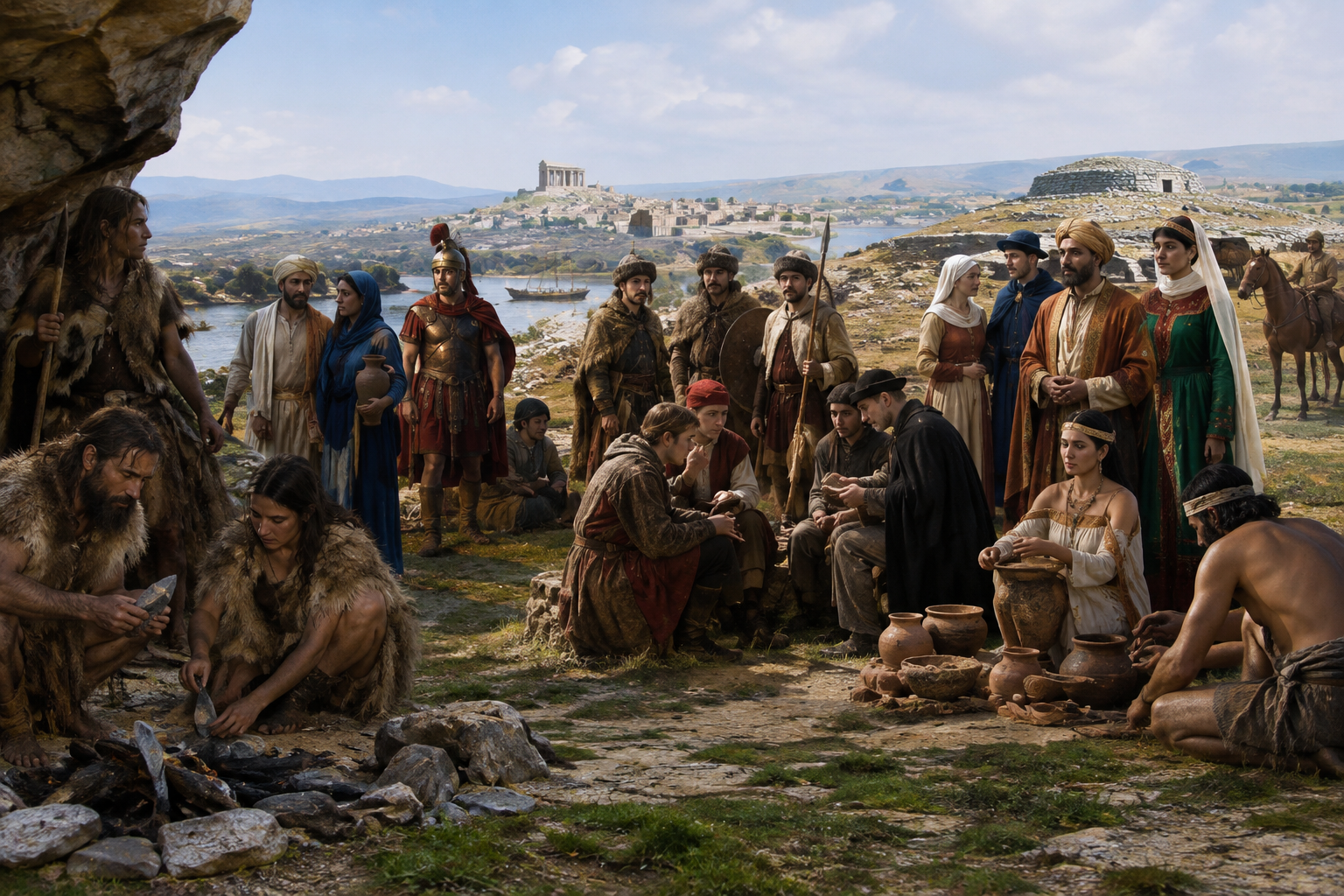
At Raqefet Cave in the Levant, two Natufian-era men - sample IDs I1685, dated around 9500 BC, and I1690, around 7950 BC - carry an arresting kind of significance. They belong to a world before pottery, before cities, and at the edge of the long transition from foraging to farming. In a lineage article about Y-DNA haplogroup CT, that matters because CT is not a small, recent family branch. It is one of the great trunk lineages in the human paternal tree, so deep and old that seeing it in ancient remains often tells us less about a narrow ethnic identity than about just how far back the paternal story runs.
That is the first thing worth saying clearly. Y-DNA follows one direct male line only - father to son to son - and CT sits very high in that tree. So when archaeological reports associate ancient men with CT at this broad level, we are usually looking at limited or cautious resolution, not a neat claim that all these people belonged to one close-knit paternal clan. Even so, the spread of these samples, from Natufian caves to Roman frontiers, from Bronze Age Bavaria to medieval Poland and Islamic Spain, is historically fascinating.
The Natufian samples from Raqefet Cave are the most compelling place to begin because they come from a formative moment in Southwest Asian prehistory. The Natufians are famous in archaeology as late Epipalaeolithic communities of the Levant, often discussed in connection with increasing settlement, intensive wild cereal use, and mortuary practices that foreshadow later Neolithic worlds. To find broad CT assignments in men from this setting underlines how deep the paternal framework is behind later Near Eastern and Eurasian populations.
Another early sample in the same broad region, I8554 from Amman Sahab in Jordan, dated around 7950 BC, adds weight to that picture. We should be careful here: CT is so ancient a category that it cannot by itself identify a "Natufian lineage" in any simple sense. But the appearance of CT-linked men in the early Holocene Levant fits what ancient DNA has repeatedly shown - that the Near East was not a historical sideshow, but one of the major theaters in the reshaping of human populations after the Ice Age. A landmark ancient DNA study of prehistoric populations in the region helped establish just how complex these early West Eurasian communities were, and how much later populations inherited from them through deep and regionally varied ancestry.
Levant burials and early villagers
Most haplogroup articles can follow a recognizable branch through time. CT is trickier, and in some ways more interesting, because it is an ancestral umbrella for an enormous share of later non-African and many African paternal lineages. In practice, when an ancient sample is reported simply as CT, that may mean the Y chromosome data were sufficient to place the individual on this major branch, but not securely enough to assign a finer downstream lineage.
That is why the sample list here looks so geographically scattered. We are not watching a single compact dynasty expand. We are watching the archaeological visibility of a very old paternal framework, glimpsed at different levels of resolution in very different societies. The value of these samples lies not in pretending they are all closely related, but in seeing how a broad paternal classification can recur in contexts shaped by utterly different languages, economies, and political worlds.
One of the sharpest reminders of that diversity comes from Copper Age central Europe. Sample I3592, from Alburg-Lerchenhaid near Straubing in Bavaria and dated around 2225 BC, places CT in a landscape already transformed by long-settled farming communities, metallurgy, and regional exchange. This is a very different world from Natufian Raqefet Cave. The same broad paternal label spans societies separated by thousands of years and radically different ways of life.
Far to the southwest, sample I8571 from Tumulo Morterem in Valencia, dated around 1400 BC, brings the story into Bronze Age Iberia. That matters because Iberia was by then no isolated edge of Europe. It was a contact zone of local traditions, maritime connections, and shifting ancestry patterns that had already absorbed major prehistoric population changes. A broad CT classification in such a context is not a sign of cultural sameness with the Levant or Bavaria; it is evidence that the paternal trunk itself is older than all those later cultural distinctions.
The same point is reinforced by NEO7 from Sigersdal Mose in Denmark, dated around 3290 BC. A bog skeleton in Neolithic Scandinavia sits in yet another archaeological universe, one tied to the complicated meeting of foragers and farmers in northern Europe. For readers interested in that setting, MyTrueAncestry has also explored Denmark's Mesolithic-Neolithic transition, where ancient DNA helps untangle just how dramatic that transformation was.
Several samples show CT appearing in places where movement and mixture were part of everyday history. I14636, from Kuriki Hoyuk in Batman, southeast Anatolia, dated around 550 BC in the Achaemenid period, comes from a region that sat between imperial systems and long-distance routes. I8038 from Mozia in western Sicily, around 400 BC, belongs to the Carthaginian world - a maritime network linking North Africa, Sicily, Iberia, and the wider Mediterranean.
Then there is I15511 from the Pirivoj necropolis at Viminacium in Serbia, dated around AD 225 in the Late Roman Empire. Viminacium was no sleepy provincial outpost; it was one of the great urban and military centers of the Danubian frontier. Ancient DNA work on the site and its surrounding region has shown the Roman Balkans to be a place of striking mobility, where people with varied ancestries could end up buried within the same imperial landscape in ways that fit the broader picture of Roman-era movement and mixing.
The same sort of historical texture appears in PCA0494 from Gdansk Wielbark, around AD 200, and I1680 from Angkor Borei Vat Komnou in Cambodia, dated AD 156. These sites are nowhere near each other and do not belong to a common historical tradition. Yet both remind us that a CT assignment can appear in communities shaped by exchange, migration, and local development far beyond the old habit of telling human prehistory as if everything important radiated out of one center.
Roman Hispania's genetic legacy
The later samples are especially useful because they show how little a broad Y-DNA label can tell us on its own about ethnicity or political identity. RKF022 and RKF233 from Rakoczifalva in Migration Period Hungary, both around AD 650, and KFJ002 from Avar-period Kunszallas Fulop Jakab, also around AD 650, come from a Carpathian Basin shaped by the collapse of Roman rule and the arrival of new power structures. In such contexts, ancient DNA is most valuable when paired with archaeology rather than used as a shortcut to naming peoples.
KIL017 from Kilteasheen in Roscommon, around AD 650, places CT in early medieval Ireland; Skoki_S49, Skoki_S52, Skoki_S54, and Skoki_S57 place it in the Kingdom of Poland around AD 1400; and I12650 from Carrer Sagunto in Valencia places it in Al-Andalus around AD 1200. That is a remarkable spread. It includes monastic or ecclesiastical Ireland, late medieval central Europe, and Islamic Iberia - societies with very different institutions and identities, but all capable of containing men whose paternal line was only resolvable, in current reporting, to the ancient umbrella of CT.
The Polish cluster is especially worth handling carefully. Four individuals from Skoki sharing the same broad haplogroup label may indicate recurring paternal backgrounds in that cemetery population, but it does not automatically make them close paternal kin. Medieval burial grounds can contain relatives, neighbors, newcomers, and unrelated locals together. The strength of the evidence is in the repeated appearance of the lineage category, not in claims the data do not make.
For someone researching haplogroup CT, the distinctive point is not that it ties you to one famous tribe, kingdom, or conquering people. Quite the opposite. CT is so foundational that it appears in archaeological settings ranging from Natufian Levantine burials to Roman Serbia, Bronze Age Iberia, medieval Poland, and Al-Andalus. Its historical interest lies in depth rather than narrowness.
In other words, CT points to a paternal line rooted very far back in the human tree, and the ancient men associated with it here show how that deep framework persisted through entirely different civilizations. The useful next step for family history is usually finer downstream testing: the closer one gets to later subclades, the more the story shifts from humanity's old trunk to particular branches, places, and historical populations.






Comments