Haplogroup J2b1

– 5 min read


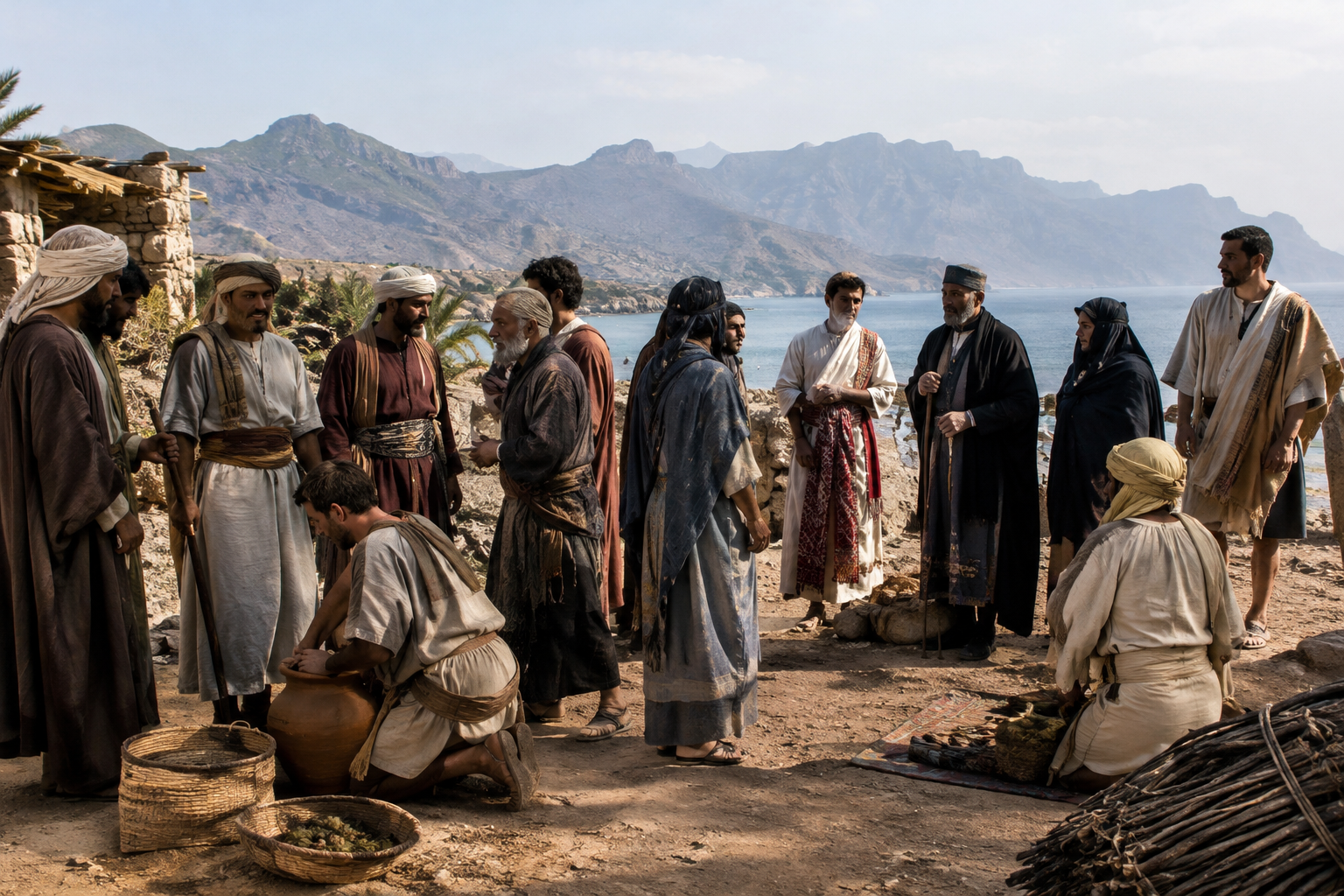
At Momi on Soqotra, off the southern coast of Yemen, the medieval cemetery of Zaflah has produced an unusually concentrated set of men associated with Y-DNA haplogroup J2b1: I20691, I20692, I20694, I20695, I20697, I20701, I20702, I20705, I20708, I20710, I21114, and I21116, dated broadly between the eighth and tenth centuries AD. That is a striking pattern. One ancient man with a given paternal line may be a curiosity; a cluster on an island cemetery begins to look like a local male lineage with real staying power.
That is a good place to start with J2b1, because it shows what Y-DNA can and cannot do. Y-DNA traces one direct paternal line only, not a whole identity, but when the same branch appears repeatedly at one site it can illuminate how communities endured, expanded, and connected with the wider world. In the case of J2b1, the supplied ancient evidence does not point to a single empire or a single people. Instead, it appears in a set of settings stretching from the Bronze Age southern Levant to Roman Italy, early medieval England, the Balkans, and the Arabian Sea.
The Soqotra cluster is the clearest concentration in this group of samples. These men were buried at Momi Zaflah in the medieval period, on an island that sat at a crossroads of seafaring between Arabia, East Africa, and the Indian Ocean. The repeated appearance of J2b1 there suggests not a passing visitor but a paternal line embedded in the local population across several generations.
Soqotra is often imagined as remote, but historically it was connected rather than isolated. Its importance lay precisely in that mixture of insularity and maritime contact. A lineage like J2b1 turning up again and again in one cemetery fits that world rather well: local continuity, yet within a region tied into trade and movement far beyond the island itself. Research on these medieval Arabian and island populations has begun to sharpen that picture, including an ancient DNA study of the region that helps place such burials within broader population history.
What matters here is not that every medieval Soqotri man belonged to J2b1; plainly, no single cemetery can stand for an entire island population. What matters is that this branch was established strongly enough to appear over and over in one documented burial ground. For someone researching J2b1 today, that is a reminder that paternal lines can persist in quite local communities for centuries even while the surrounding society is open to long-distance exchange.
Much earlier evidence comes from the Levant. One of the most historically evocative individuals here is I4521 from Late Bronze Age Megiddo, dated around 1439 BC and identified as a Canaanite. Another is I7003 from Bronze Age Yehud in the southern Levant, dated around 2250 BC. These are not decorative names from a biblical atlas; they are real archaeological places at the heart of urban and political development in the eastern Mediterranean.
Megiddo, especially, mattered because it was not some sleepy backwater. It was a major center in a landscape shaped by towns, kingdoms, imperial pressure, and trade routes linking Egypt, the Levant, and beyond. A J2b1-associated male there in the Late Bronze Age shows that this paternal branch was present in the eastern Mediterranean world long before classical antiquity or medieval Islamic networks. It gives J2b1 time depth in one of the key corridors of Old World connectivity.
Yehud pushes that presence still further back into the earlier Bronze Age southern Levant. We should be careful not to turn two samples into a grand tribal saga, but together they show something important: J2b1 was not only a medieval or Roman-era phenomenon. It was already present in a region where farming populations, town life, and interregional exchange had deep roots.
The Mediterranean thread continues in Italy. Sample R50 from Imperial Rome Centocelle, dated around AD 190, and R1283 from the medieval Cancelleria Basilica, dated around AD 860, place J2b1 in two very different Roman worlds: one imperial, one post-imperial and Christian. That does not mean a straight genealogical chain from one man to the other. It does mean that this paternal branch was present in central Italy across very different political and cultural regimes.
That is exactly the sort of finding that ancient DNA has made harder to ignore. Rome was not a sealed ethnic box. It was a city and then a legacy populated by people with varied ancestries, drawn in by military service, slavery, trade, administration, and ordinary family history. A J2b1 signal in an Imperial Roman context sits comfortably within that cosmopolitan reality, and its reappearance in a later ecclesiastical setting shows continuity of presence rather than a one-off arrival.
There is a useful parallel here with broader work on Italy and Roman mobility, including research published on ancient Rome's changing population history. That larger picture does not reduce every lineage to a single origin story; rather, it shows how central Mediterranean populations were repeatedly reshaped while still preserving older local and regional strands.
One reason J2b1 is interesting in this sample set is that it does not stay obediently in one southern zone. I20654, from the Early Anglo Saxon cemetery at West Heslerton in Yorkshire and dated around AD 550, places the lineage in early medieval England. ST2436, from medieval Sint-Truiden in Belgium and dated around AD 900, does something similar for an urban religious setting in the Low Countries. ELW013, a post-medieval plague victim from Ellwangen in Germany, shows the branch still present in central Europe as late as around AD 1550.
These are very different worlds. West Heslerton belongs to the formative centuries of Anglo-Saxon England; Sint-Truiden reflects the developing urban and ecclesiastical landscape of medieval northwest Europe; Ellwangen belongs to the disease-ridden but highly connected society of early modern Europe. Put together, they show that J2b1 cannot be boxed into a simple "eastern Mediterranean only" label.
The West Heslerton example is especially worth pausing over because early medieval England has often been discussed in terms of migration, settlement, and mixture. A man carrying J2b1 in that cemetery does not overturn the larger picture, but it does underline how varied paternal backgrounds could be within communities labelled "Anglo-Saxon." That is in keeping with the increasingly nuanced view emerging from archaeogenetics, where identities in the ground rarely line up neatly with modern expectations.
Roman and Early Medieval Britain
Two more samples complicate the picture in a useful way. I5404 from Lepenski Vir in Serbia, dated around AD 1432, and the other European finds show J2b1 moving through landscapes that had long histories of Roman rule, Byzantine influence, Slavic settlement, and later medieval political change. The Balkans are not a fringe in this story; they are one of Eurasia's great meeting grounds.
This matters because people often want a haplogroup to come with a single clean route and a single named people. The ancient evidence here pushes the other way. J2b1 appears in the southern Levant in the Bronze Age, in Roman and medieval Italy, in medieval Soqotra, and in scattered later European settings. That pattern is not chaos. It is what one might expect from an old paternal branch circulating through interconnected Old World populations over a very long period.
On the evidence here, J2b1 is best understood as a lineage with documented ancient presence in several historically connected regions rather than as the badge of one exclusive ethnicity. The strongest single pattern is the medieval Soqotra cluster, which hints at durable local male continuity in the Arabian Sea world. The deeper background, though, reaches back into Bronze Age Levantine societies and runs onward through Roman and medieval Mediterranean and European populations.
For a modern tester, that makes J2b1 less a neat label than a historically rich one. Its ancient carriers in this sample set lived in Canaanite cities, Roman Italy, island communities off Yemen, and medieval northern Europe. That does not tell you your whole ancestry, but it does place your direct paternal line inside some of the most connected landscapes of the ancient and medieval world.






Comments