Haplogroup L1b1

– 5 min read


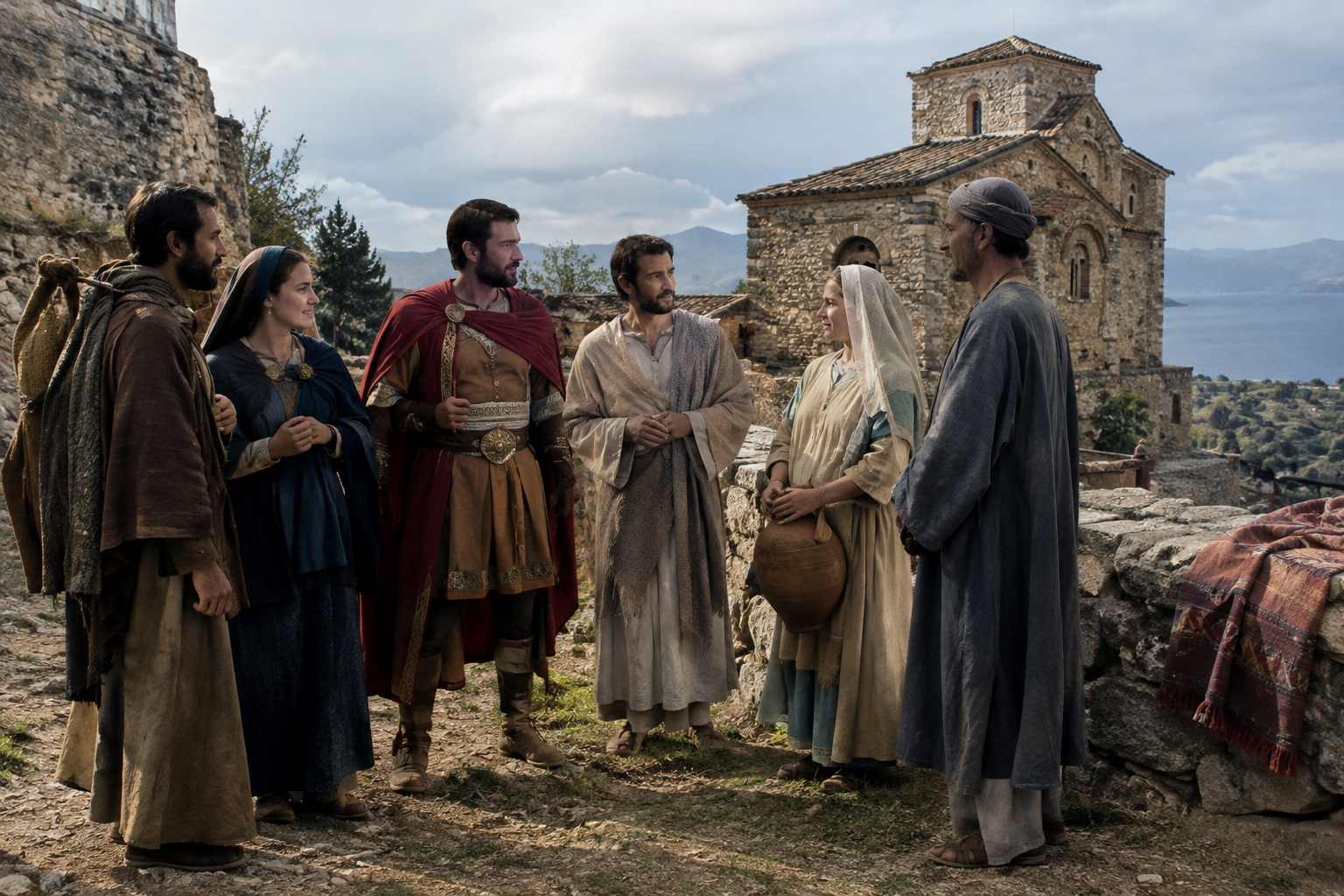
At Las Gobas in northern Spain, one of the more arresting details is not a sword, a brooch, or a grand inscription, but a Y-chromosome result. A man dated to about AD 860, sample ldo050, carried the paternal lineage L1b1. That matters because L1b1 is not the sort of branch most readers expect to meet first in an early medieval Christian landscape in Iberia. Yet there it is: a direct paternal line turning up in a rock-cut cemetery on the northern edge of a changing post-Roman world.
This is the useful thing about Y-DNA when handled carefully. It tracks one direct paternal line only, not a person's whole ancestry or identity, but it can show how lineages moved through very different societies. For L1b1, the ancient evidence provided here does not point to a single kingdom or tribe. Instead, it points to circulation: from Bronze Age Syria to the late Roman Balkans, then into early medieval Italy and Spain.
Las Gobas sits in a part of northern Spain where the early medieval centuries were shaped by local continuity, shifting political control, and new forms of Christian community. The sample ldo050, dated around AD 860, belongs to that world. Even without inventing details about his grave, the context is enough to make the finding important: this was not prehistoric drift in the abstract, but a living paternal line present in medieval Iberia.
That presence also fits a broader lesson from archaeogenetics. Iberia in late antiquity and the early Middle Ages was not sealed off. Roman mobility, post-Roman population mixture, and regional migration all left marks on the peninsula. A useful companion piece for that wider background is MyTrueAncestry's look at Roman Hispania's Lasting Genetic Legacy.
What makes L1b1 interesting at Las Gobas is precisely that it resists simple storytelling. One medieval man in northern Spain does not prove a mass migration of L1b1 carriers into Iberia, nor does he need to. He shows that by the ninth century this paternal branch was part of the human reality of the peninsula.
A second Iberian case pushes the story back a little earlier. The sample I29540, from Visigothic early medieval Spain at Tarragona Cambrils Torre Bargallona, is dated to about AD 606. Here again, L1b1 appears in an Iberian setting, but this time in the era usually described through the language of Visigothic rule, post-Roman administration, and regional diversity.
That last point is crucial. "Visigothic" is a political and cultural label, not a single genetic type. Ancient DNA has repeatedly shown that communities associated with Gothic or post-Roman identities could be quite mixed. In other words, finding L1b1 in a Visigothic-period burial does not make the lineage "Visigothic" in origin. It shows that this branch was present among the people living in that historical milieu.
For readers following the growing picture of Iberian diversity in this period, another relevant MyTrueAncestry article is Ancient DNA reveals diverse origins at a 7th-century Madrid burial site.
Taken together, I29540 and ldo050 suggest that L1b1 was not an isolated curiosity in Iberia. It appears in at least two different early medieval Spanish contexts, separated by region and date, which is much more interesting than a lone occurrence.
The lineage also appears in Italy. Sample ASM_S20, from Santa Maria in Civitate at Amiternum in Abruzzo, is dated to around AD 800. Amiternum is one of those places where the Roman and post-Roman worlds overlap in especially revealing ways: an ancient town with a long life, reused and reshaped through late antiquity and the early Middle Ages.
A genetic study focused on this population has helped frame how communities in central Italy changed across these centuries, and it provides important context for understanding finds such as ASM_S20. See the research on Amiternum here: https://www.ncbi.nlm.nih.gov/pmc/articles/PMC11352919/.
For L1b1, the Italian sample broadens the picture beyond Iberia. We are no longer looking at a branch appearing in one western region alone, but at a paternal line found in different parts of the post-Roman Mediterranean world. That does not mean there was one single migration carrying it neatly from point A to point B. More likely, it reflects the sort of layered movement that characterized the Roman Empire and its aftermath: soldiers, merchants, settlers, captives, clerics, and families moving over generations.
Readers interested in the Italian site itself may want the MyTrueAncestry article on Genetic ancestry of ancient Amiternum from Roman to early medieval Italy.
If we move earlier still, the distribution of the lineage becomes even more revealing. Sample I41139, from late Roman era Aquae Calidae in Bulgaria and dated to about AD 350, places the branch in the Balkans during the closing centuries of Roman imperial rule. That is a region where military movement, trade, resettlement, and imperial administration created highly mixed local populations.
Research on late antique Bulgaria has increasingly emphasized exactly that sort of complexity, including communities historically linked with Goths but genetically far from uniform. For related background, MyTrueAncestry's article Ancient DNA Reveals Mixed Origins of Gothic Communities in Late Antique Bulgaria gives a good sense of the regional picture.
And then there is the oldest sample in this set: ALA128, from the intramural cemetery at Alalakh, dated to about 1685 BC and classified as Amorite. Alalakh, in the northern Levant, is a major Bronze Age site with deep connections to the wider Near East. Here L1b1 is not turning up on the medieval fringe of Europe, but in an urban world of palaces, diplomacy, and long-distance contact.
An ancient DNA study examining Bronze Age Alalakh and its population context is available here: https://www.sciencedirect.com/science/article/pii/S0092867420305092, and it is precisely the sort of work that has transformed how we understand mobility in the eastern Mediterranean. For this article's purposes, the key point is modest but significant: L1b1 has a documented ancient presence in the Near Eastern sphere long before its later appearances in Roman and medieval Europe.
So what sort of article does L1b1 produce? Not one about a neat founder conquering half a continent. It produces something more historically believable. The branch appears in a Bronze Age Levantine context, then in a late Roman Balkan setting, and later in early medieval Italy and Spain. That is the pattern of a lineage moving within interconnected worlds, not a lineage confined to one ethnic label.
For someone researching L1b1 today, these ancient finds responsibly suggest a paternal line with documented appearances across the Mediterranean and adjacent Europe over a very long timespan. The most distinctive point is not prestige or purity, but persistence through change: the same direct male-line branch turning up in Amorite Alalakh, Roman-period Bulgaria, and early medieval Iberia and Italy. That is a small but vivid reminder that paternal ancestry often survives empires, languages, and political identities more stubbornly than historical labels do.




Comments