Haplogroup I2a2

– 5 min read


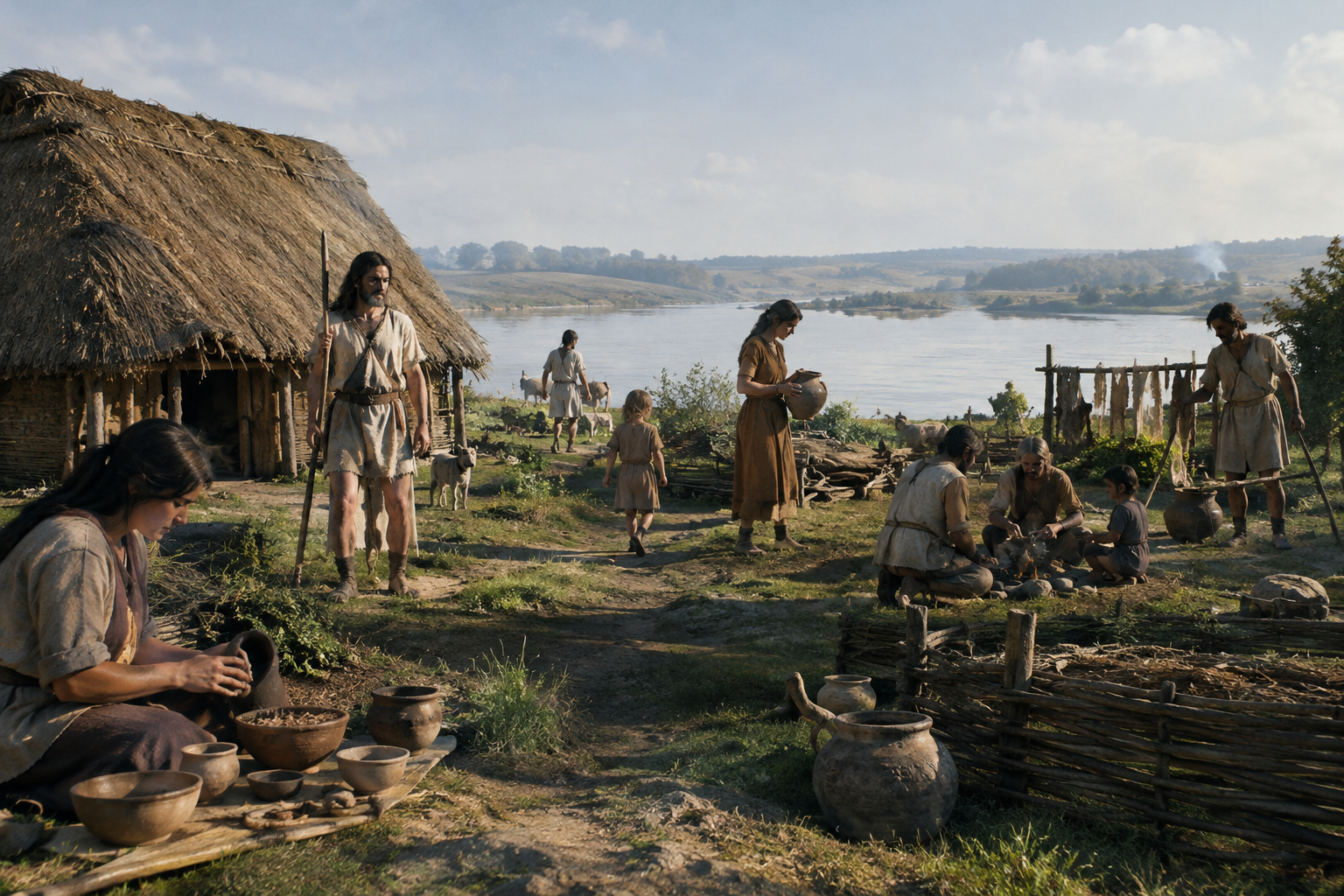
At Hajdúnánás-Eszlári út in Hungary, one Middle Neolithic man, sample I2384, dated to around 5164 BC, gives us an unexpectedly sharp glimpse of haplogroup I2a2. He was living in the Carpathian Basin at a time when farming communities were already well established, yet his paternal line belongs to a branch with much deeper European roots than the first wave of Anatolian-derived agriculture alone would suggest. That is precisely what makes I2a2 so interesting in ancient DNA: it keeps turning up in places where Europe's farmers, foragers, and later metal-age communities were meeting, mixing, and remaking one another.
This is not a haplogroup that can be reduced to a single people or a simple migration arrow on a map. Y-DNA traces one direct paternal line only, not a man's entire ancestry, but even that narrow line can be revealing when it appears repeatedly in archaeological contexts spread from Neolithic Ukraine and Bulgaria to Orkney, Bronze Age Bohemia, and medieval Russia. In the case of I2a2, the pattern is less about one triumphant expansion than about persistence, adaptation, and survival through very different worlds.
The oldest examples in this group come from some of the most important early farming landscapes in southeastern Europe. Alongside I2384 from Hajdúnánás-Eszlári út, there is I2529 from Yabalkovo in Bulgaria, dated to around 5640 BC, and I5870 from Vilnianka in Zaporizhia, Ukraine, dated to around 5413 BC. Even without turning these men into representatives of whole populations, the distribution matters. I2a2 was present in early and middle Neolithic settings from the Balkans into the North Pontic zone.
That broad zone was one of the great laboratories of European prehistory. Farming spread through it, but so did contact with local hunter-gatherer populations, and the paternal record often shows that the story was not simply one of replacement. Research on Neolithic and Copper Age southeastern Europe has repeatedly shown a complicated social and genetic landscape, in which lineages associated with earlier European male ancestry continued within farming societies rather than disappearing at first contact with agriculture. A major ancient DNA study of the region can be found here.
So when I2a2 appears in these early agricultural communities, it should not be read lazily as either "farmer" or "forager." It points instead to a world in which men with different paternal backgrounds were being folded into shared settlements, economies, and burial traditions. The Carpathian Basin in particular was not a genetic cul-de-sac. It was a hinge between the Balkans, the steppe margin, and central Europe.
5th-Millennium Carpathian Basin
One of the most arresting appearances of I2a2 comes far from the Balkans. Sample I2977 from the Tomb of the Eagles in Orkney, dated to around 3200 BC, places the lineage in one of the best-known ceremonial and burial landscapes of Neolithic Britain. Another example, I0518, from Banbury Lane in Northamptonshire, England, dated to around 3230 BC, shows that this was not some isolated northern oddity. By the later Neolithic, I2a2 was present in Britain from the windswept islands of the north to inland England.
That matters because Neolithic Britain has increasingly been understood not just through monuments, but through kinship, ancestry, and the ways communities organized descent around tombs and landscapes. Orkney in particular has produced striking evidence for the social importance of lineages, although one Y-chromosome alone is never the whole story. The presence of I2a2 there suggests that paternal lines with deep European antecedents were part of the populations building and using megalithic tombs at the far northwestern edge of the Neolithic world.
It is tempting to romanticize Orkney, but the real interest lies in comparison. I2a2 appears both in early southeastern European farming zones and in monumental Neolithic Britain. That does not make the Orkney man a direct descendant of any particular Balkan individual, of course. It does show that this paternal branch had become thoroughly entangled in the making of Neolithic Europe.
A similar point appears in Scandinavia. Sample CGG105358 from Sludegaard, Frørup in Denmark, dated to around 3415 BC, places I2a2 in another region where the transition to farming was anything but uniform. Denmark's Neolithic was shaped by prolonged encounters between incoming agricultural traditions and long-established forager communities.
That is why lineages like I2a2 are so useful historically. They complicate any tidy distinction between "old Europeans" and "new farmers." In northern Europe, ancient DNA has shown again and again that the spread of farming involved both migration and local incorporation. Denmark offers one of the clearest examples of that prolonged negotiation, as discussed in broader terms in this MyTrueAncestry piece on Denmark's Mesolithic-Neolithic Transition: Culture, Genetics, and Timing.
For a man carrying I2a2 today, this northern evidence is worth noticing. The lineage was not stranded in one ecological niche or one cultural package. It moved, or rather the families carrying it moved and merged, into farming societies from the Balkans to the North Sea world.
If the Neolithic evidence shows breadth, the Bronze Age material shows staying power. Here the concentration is especially notable in central Europe. Sample I0114 from Únětice-period Esperstedt in Germany, dated to around 2100 BC, belongs to one of the formative Bronze Age societies north of the Alps. Then there is a cluster from Bohemia and neighboring regions: BNL002, BNL003, BNL006, and BNL007 from Brandýs nad Labem; CHL002 from Chleby; ROU005 and ROU007 from Roudnice nad Labem; PDA002 and PDA005 from Prague-Miškovice; PMI004 from Miskovice; and VLI042 from Vliněves in Bohemia, broadly around the earlier to middle Bronze Age.
Now, one must be careful. A cluster of men in the same broad haplogroup across several cemetery sites does not automatically mean a single ruling house, a tribal identity, or even close paternal kin. But the repeated appearance of I2a2 in this central European Bronze Age setting is hard to ignore. It suggests that branches within this lineage were well established in communities living through the era of metalworking intensification, long-distance exchange, and changing burial customs.
That central European continuity is one reason I2a2 cannot be boxed into a purely Neolithic story. The men buried in Bronze Age Bohemia were not simply relics of an earlier age. They belonged to dynamic societies shaped by regional networks stretching across Europe. A recent ancient DNA study on later Bronze Age central Europe, useful for the broader regional picture, is available here.
Other samples widen the map still further. I0826 from Barcelona's Paris Street, dated to around 2296 BC, places I2a2 in Bronze Age northeastern Iberia. poz462 from Biskupin-Gąsawa in Poland, dated to around 1750 BC, and Bul6 from Beli Breyag in Bulgaria, dated to around 2500 BC, show the lineage again in different Bronze Age settings across Europe.
Then, much later, there is SHE007 from Shekshovo in Russia, dated to around AD 1000. That medieval occurrence does not prove an unbroken local line from any one prehistoric burial, but it does underline a larger point: I2a2 did not vanish with the coming of steppe-derived Bronze Age populations, nor with the political and cultural upheavals of the early Middle Ages. It remained part of the paternal landscape of Europe across enormous stretches of time and space.
That may be the most historically useful thing to say about this haplogroup. It is not a label for one vanished tribe. It is evidence for endurance through repeated reshaping of European populations.
The most distinctive feature of I2a2, as shown by these ancient samples, is its breadth across Europe's great turning points: early farming in the Balkans and Carpathian Basin, Neolithic monument-building in Britain, the northern transition in Denmark, and the socially complex Bronze Age communities of central Europe. It appears not as a fleeting curiosity but as a recurring paternal thread in very different archaeological worlds.
For someone researching an I2a2 paternal line today, that does not offer a single heroic origin story, and frankly that is a good thing. What it offers is something more solid: evidence that this lineage was present in Europe very early, remained active within farming and post-farming societies, and persisted through the major demographic rearrangements that created later European populations.






Comments