Haplogroup N1a1a1a1a3a

– 5 min read


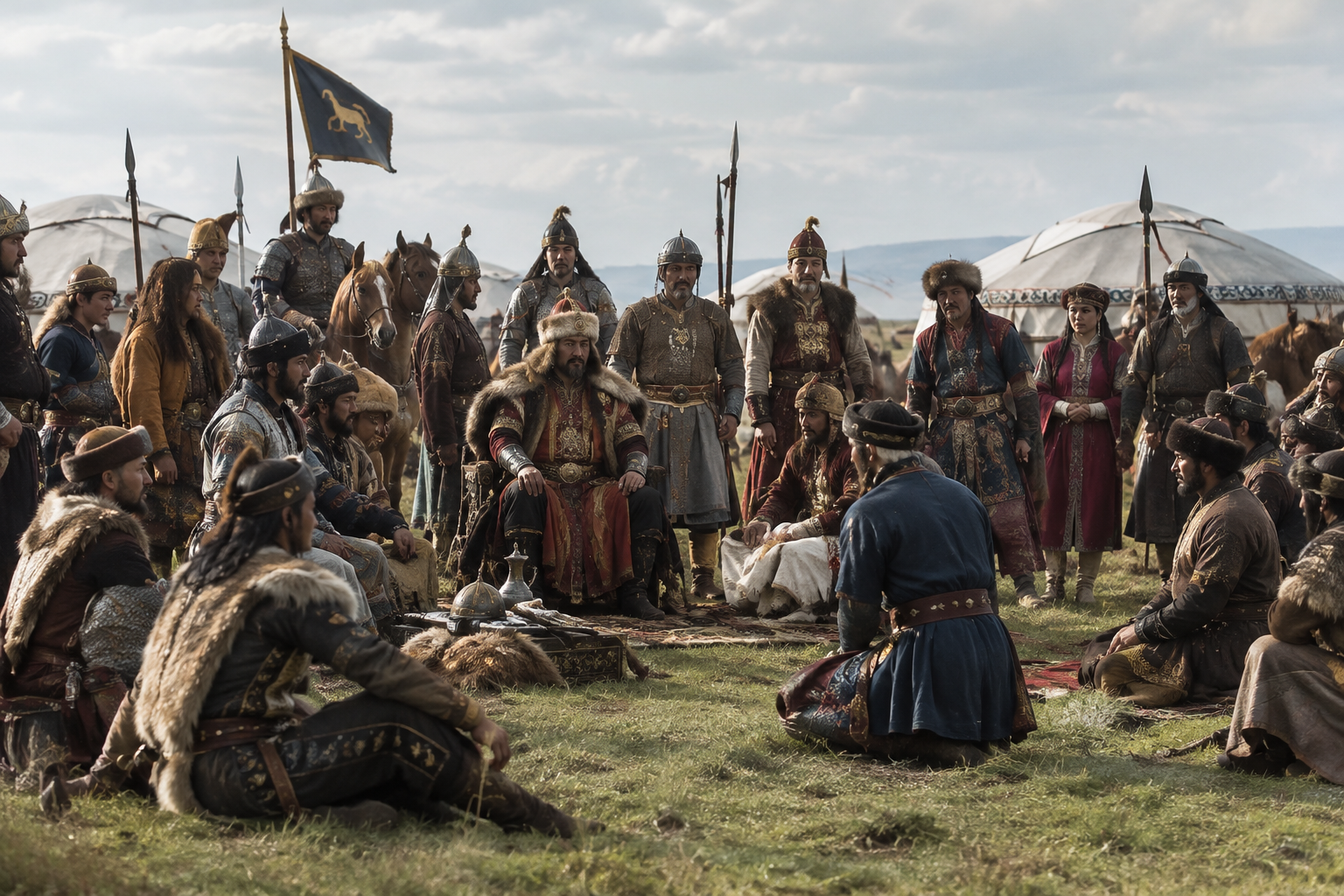
At Kunpeszer in Hungary, a cluster of early Avar elite burials dated to around AD 609 keeps turning up the same paternal signature: N1a1a1a1a3a. The repetition is striking because these are not isolated finds. Sample IDs KUP001, KUP002, KUP005, KUP006, KUP022, KUP026, and KUP027 are all associated with that branch in this early medieval cemetery group, suggesting that one Y-DNA line was unusually prominent among men buried in a clearly high-status Avar setting.
That matters because Y-DNA follows a direct paternal line only - father to son to grandson - and so it can sometimes reveal a social pattern that ordinary grave labels cannot. In this case, the pattern does not tell us the whole ancestry of the Avars, still less the identity of every man in their confederation. But it does suggest that one paternal lineage, N1a1a1a1a3a, was strongly represented in an elite Avar environment in the Carpathian Basin during the seventh century.
The Avar Khaganate dominated much of the Carpathian Basin from the late sixth century onward. Written sources describe a powerful steppe polity on the edge of the Byzantine world, but texts are not very good at telling us who actually formed its ruling circles on the ground. Archaeology helps, and ancient DNA helps again, especially when several burials from one place point in the same direction.
At Kunpeszer, the concentration of N1a1a1a1a3a is hard to dismiss as chance. These graves belong to the earliest Avar horizon in the region, and the cluster includes multiple individuals labelled as elite in the sample descriptions. That does not automatically prove a single dynasty, because shared haplogroups can link men who are separated by many generations. Still, it is precisely the sort of pattern historians look for when asking whether an immigrant or recently consolidated ruling stratum maintained paternal continuity.
An ancient DNA study examining elite Avar-period burials drew attention to the strong eastern genetic component among parts of this population, especially among men in high-status contexts, which fits the broader historical picture of an incoming steppe power establishing itself in Central Europe. The relevant research can be found here.
The same haplogroup appears beyond a single cemetery. A1802, identified as a khagan ruler from Avar-period Budapest and dated around AD 650, is associated with N1a1a1a1a3a. So too is A1822, described as part of a high-ranking khagan retinue at Kunpeszer-Felsopeszeri, and A1823, from the Avar-period military elite at Kecskemet-Sallai. KFP-6, an early Avar leader from Kunpeszer-Felsopeszeri ut Homokbanya, belongs to the same general pattern.
Once you see these names together, the historical point becomes sharper. We are no longer dealing with one unusual family in one graveyard. We are looking at a lineage recurring in rulers, retinues, military elites, and prestigious cemeteries across seventh-century Avar Hungary. That does not mean every elite Avar male belonged to N1a1a1a1a3a, but it does suggest that this branch had a real foothold in the upper levels of Avar political society.
There is also a useful caution here. Avar was a political and archaeological label, not a genetic one. The khaganate gathered together people of different origins, languages, and life histories. What N1a1a1a1a3a seems to capture is not "the Avar people" in some simple sense, but one important paternal thread within an elite formation that was itself mixed and mobile.
Another notable cluster comes from Kunszállás-Fülöpjakab in Hungary. Samples A1812, A1813, A1814, A1815, A1817, A1819, and A1821, dated around AD 700 and described as Avar elite, are all associated with N1a1a1a1a3a. Two earlier Avar-period individuals from nearby Kunszállás Fülöp Jakab, KFJ018 and KFJ033, dated around AD 650, also belong to the same branch.
That continuity across several decades is historically important. The seventh century was not static for the Avar world: power shifted, frontiers tightened and loosened, and relationships with Byzantium and neighboring peoples changed. Yet this paternal line continues to appear in elite settings over time, which suggests endurance rather than a brief flash of founder effect in one generation.
Research on Avar-period cemeteries and post-Roman populations in the region has increasingly shown that status groups could preserve distinctive biological signatures while still participating in broader local mixture. A study linked to material from the region is available here, and it helps place these lineages inside the larger reshaping of the Carpathian Basin after Rome.
N1a1a1a1a3a is not confined to central Hungarian elite sites. LEO009, from an early medieval Avar grave at Leobersdorf-Baden in Austria and dated around AD 720, shows the branch further west within the Avar sphere. CSPF-213 from Csolyospalos-Felsopalos, dated around AD 685, and I16741, an Avar elite individual dated around AD 750, extend the pattern later into the eighth century.
What is interesting here is not simply geographic spread, but the combination of spread and selectivity. We are not seeing hundreds of random men from every social layer. The branch turns up repeatedly in burials identified as elite, leader, ruler, or retinue contexts. Even when one should resist overstatement, that is exactly the sort of repeated archaeological association that makes a haplogroup historically informative.
Leobersdorf-Baden also reminds us that the Avar world was not bounded neatly by modern Hungary. The khaganate's western zones touched what is now Austria, and the archaeology of these frontier regions often shows both local continuity and connections to steppe-linked power structures. A lineage like N1a1a1a1a3a can therefore appear as part of a wider imperial network rather than a strictly local family story.
The branch name itself places this lineage within the broader Y-DNA haplogroup N, a major paternal family with a long history across northern Eurasia. But it would be a mistake to pour the whole history of haplogroup N into this narrower subclade as though they were interchangeable. The article's focus is specifically N1a1a1a1a3a, and the evidence here is not a map of all N lineages. It is a seventh- to eighth-century pattern concentrated in Avar-period elite burials in the Carpathian Basin and its western margins.
That narrower focus is actually what makes the story interesting. Some haplogroups appear in scattered single finds. This one appears in a recognisable historical setting again and again: Kunpeszer, Kunszállás-Fülöpjakab, Budapest, Kecskemet-Sallai, Leobersdorf-Baden. In other words, it is not just old. It is archaeologically contextualised.
For anyone exploring a present-day paternal line, that does not create an instant claim to Avar nobility or to a single named ancestor. What it does offer is a serious and specific historical association: this branch is documented among men occupying high-status positions in the Avar world of the seventh and eighth centuries.
The most distinctive thing about N1a1a1a1a3a is not mystery for its own sake, but concentration. Across the available ancient evidence, this lineage recurs in early medieval Avar graves that are repeatedly described as elite, military, or attached to the khagan's circle. That makes it one of those rare haplogroup stories where the genetics and the archaeology point in the same direction: not to an entire people, but to a powerful paternal strand inside an imperial steppe polity established in Central Europe.
If this is your Y-DNA line, the responsible historical takeaway is a good one. Your direct paternal branch has credible ancient links to the Avar-period world, especially to men buried in prominent contexts in seventh-century Hungary and nearby Austria. That is a precise and unusual kind of deep ancestry to investigate further.






Comments