Haplogroup F

– 5 min read


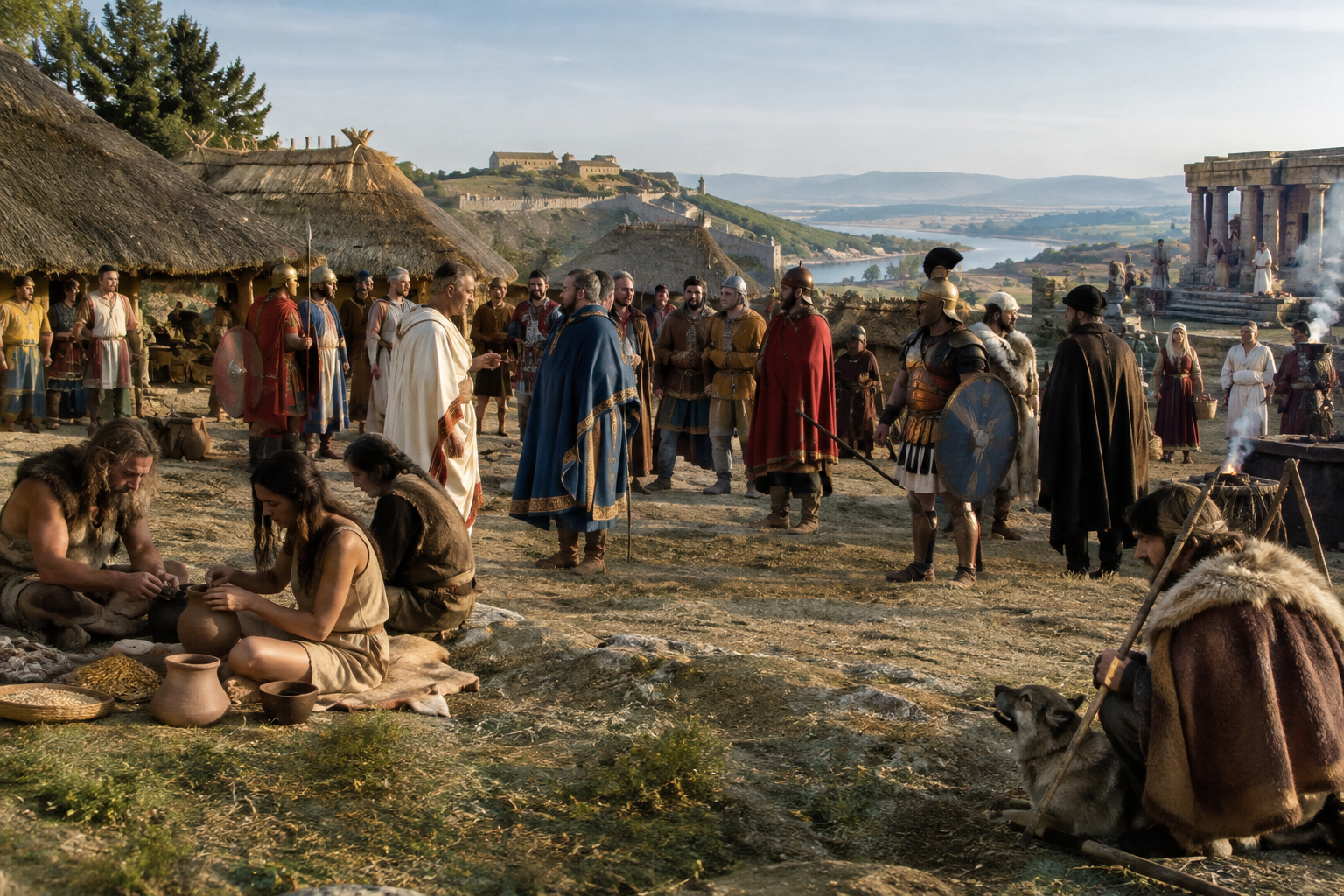
At the Palace of Nestor at Pylos, one of the best-known burials of Bronze Age Greece produced a particularly striking Y-chromosome result. The individual often associated with the palace world of Mycenaean Greece, sample I13519 from around 1480 BC, has been reported under the broad paternal haplogroup F. That is a deceptively simple label for a very old branch near the base of much of Eurasia's later Y-DNA diversity, and seeing it attached to a high-profile Aegean burial is a useful reminder that ancient paternal lineages do not always arrive in the neat, familiar forms expected from modern testing trees.
That matters because haplogroup F is not a narrow late historical clan marker. It is a very broad ancestral branch in the Y-chromosome family tree, and in ancient DNA it can sometimes appear when preservation or sequencing only allows a higher-level assignment rather than a more downstream subclade. In other words, Y-DNA traces one direct paternal line, not a person's whole ancestry, and in the case of ancient samples labelled simply F, the real story is often about how that broad classification turns up in very different archaeological worlds.
The Pylos evidence is a good place to start because it sits in a thoroughly historical landscape. The Palace of Nestor belongs to the Mycenaean world of the Late Bronze Age: literate, palatial, administratively complex, and closely tied to the wider Aegean. Yet a broad Y-DNA call such as F does not make the buried man a representative of some singular "Mycenaean haplogroup". It tells us only that his direct paternal line fell somewhere on a very old branch upstream of many later lineages.
Another Aegean-associated sample in the list, XAN007 from Minoan-period Chania on Crete around 1575 BC, points in the same direction. So does the Greek colonial and military world of Sicily, where I20160 from Himera around 550 BC and I17870, a mercenary linked to the First Sicilian War around 480 BC, are also reported in association with haplogroup F. Taken together, these are not evidence for a single family line stretching from Crete to Pylos to Sicily. They are evidence that this broad paternal designation appears in several Aegean contexts, from palace societies to colonies and armies.
An ancient DNA study examining Aegean populations has helped frame this larger background by showing how intertwined local continuity and outside connections could be in prehistoric Greece and Crete, even when individual paternal labels remain broad or incomplete: https://www.nature.com/articles/nature14317.
If Pylos gives haplogroup F a Bronze Age palace setting, the older samples push the story much further back into the Neolithic. Sample I28427 from Starcevo Vinkovci-Nama in Croatia, dated to about 5650 BC, sits in the world of early farming communities in southeast Europe. Sample I0411 from Els Trocs in Spain, around 5218 BC, and I0807 from Baalberge in Germany, around 3797 BC, show the same broad haplogroup label appearing in other farming settings far to the west and northwest.
That spread should not be exaggerated into one unbroken paternal dynasty marching across Europe. What it does suggest is that broad F-associated lines were present among some of the men caught up in the Neolithic expansion and its later regional developments. Archaeology already shows that early farmers moved, mixed, and settled unevenly across Europe; these male-line signals fit that patchwork better than any tidy migration slogan ever could.
The Croatian sample is especially interesting because the Balkans were one of the great gateways of Europe's farming transition. Recent ancient DNA work on the region has made clear that long-term population history there involved both continuity and repeated shifts in ancestry and paternal lineages, rather than a single permanent replacement. A broad F call in an early Neolithic individual belongs to that larger, messier human story.
Croatia's Shifting Paternal Lines
The most arresting feature of this sample set may be its geographic breadth. I3883, labelled "Shanidar Outlier" from ancient Iraq and dated to about 7900 BC, places haplogroup F in the northern Mesopotamian sphere very early indeed. Far to the northeast, I10900 from Kamenka-1 in Krasnoyarsk Krai, around 3500 BC, carries the same broad designation in Neolithic Siberia.
Now, one must be careful here. A shared parent haplogroup does not mean a close genealogical link between a Neolithic individual in Iraq and another in Siberia. But it does show why haplogroup F has to be understood as a deep trunk, not a narrow twig. By the time we can observe these men archaeologically, the paternal descendants of F had already diversified enormously across Eurasia. Some ancient samples still resolve only to that ancestral level, and that in itself is informative.
This wider Eurasian perspective also helps explain why later F-labelled individuals can appear in very different cultural settings without implying a single historical people. A direct paternal line can survive through many language shifts, social changes, and migrations while the rest of a person's ancestry changes around it.
The later samples linked to haplogroup F are clustered in places where political and cultural boundaries were anything but stable. In Pannonia, several individuals from the fifth and sixth centuries AD are associated with this branch: GYS057 from Arrabona Szechenyi Square in Hungary around AD 425, SZL093 from Longobard-period Savaria Szeleste Barbaricum around AD 525, and MFC018 from post-Roman Arrabona Menfocsanak Barbaricum around AD 550.
These are exactly the kinds of contexts where ancient DNA has complicated older, simpler narratives of "Romans", "barbarians", and migrating tribes. The late Roman and post-Roman Middle Danube was full of movement, alliance, service, intermarriage, and local survival. A broad Y-DNA label like F appearing in several such burials tells us less about ethnic identity than about the persistence of older paternal diversity inside frontier societies that were constantly being reorganized.
Research on post-Roman communities in the Carpathian Basin has repeatedly shown that cemetery populations could be genetically mixed even when archaeology grouped them under familiar historical labels. That is precisely the sort of world these Hungarian samples belong to, and it is one reason broad Y assignments should be read with caution and interest rather than disappointment.
Other samples make the same point in different ways. In Iberia, I18204 from Roman-era Villaricos in Almeria, around AD 75, and I15427 from early medieval Toledo Carranque Santa Maria de Abajo, around AD 607, show haplogroup F appearing in two quite different historical frames: one under Roman rule, the other after the collapse of imperial power in the peninsula.
In Iron Age western Europe the branch also appears in highly local settings: I16087 in Hallstatt-period northwest Bohemia around 550 BC; I13690 from Rowbarrow, Wiltshire, around 560 BC; I16613 from Danebury in Hampshire around 200 BC; I16609 from Middle Wallop Suddern Farm around 190 BC; I13720 from Roquepertuse in southern France around 300 BC; and I14359 from Wattle Syke in West Yorkshire around 50 BC. This is not one people sweeping across Europe. It is a broad paternal marker turning up, at low resolution, in many regional societies that archaeologists already know were distinct.
Even the late sample Skoki_S53 from the Kingdom of Poland, dated around AD 1400, belongs to that same pattern. Medieval Poland was not preserving some untouched relic lineage from prehistory; it was a living society with its own local funerary practices and layered regional history. One paper on atypical burials in early medieval and medieval Poland helps situate such finds within the archaeological complexity of the region rather than treating DNA as the whole story: https://www.researchgate.net/publication/339360948_Atypical_Burials_in_Early_Medieval_Poland_A_Critical_Overview.
The distinctive thing about haplogroup F in ancient DNA is not a single kingdom, tribe, or famous dynasty. It is the opposite: a reminder that some paternal labels sit very high on the Y-tree and can surface in archaeology from Neolithic Croatia to Bronze Age Pylos, from Roman Spain to post-Roman Hungary. For someone researching a direct paternal line today, that makes F less a badge of one historical identity than a sign of deep ancestry whose later branches spread widely across Eurasia. The ancient men listed here do not form one family, but together they show just how old, persistent, and geographically far-reaching that paternal background could be.






Comments