Haplogroup I2

– 6 min read


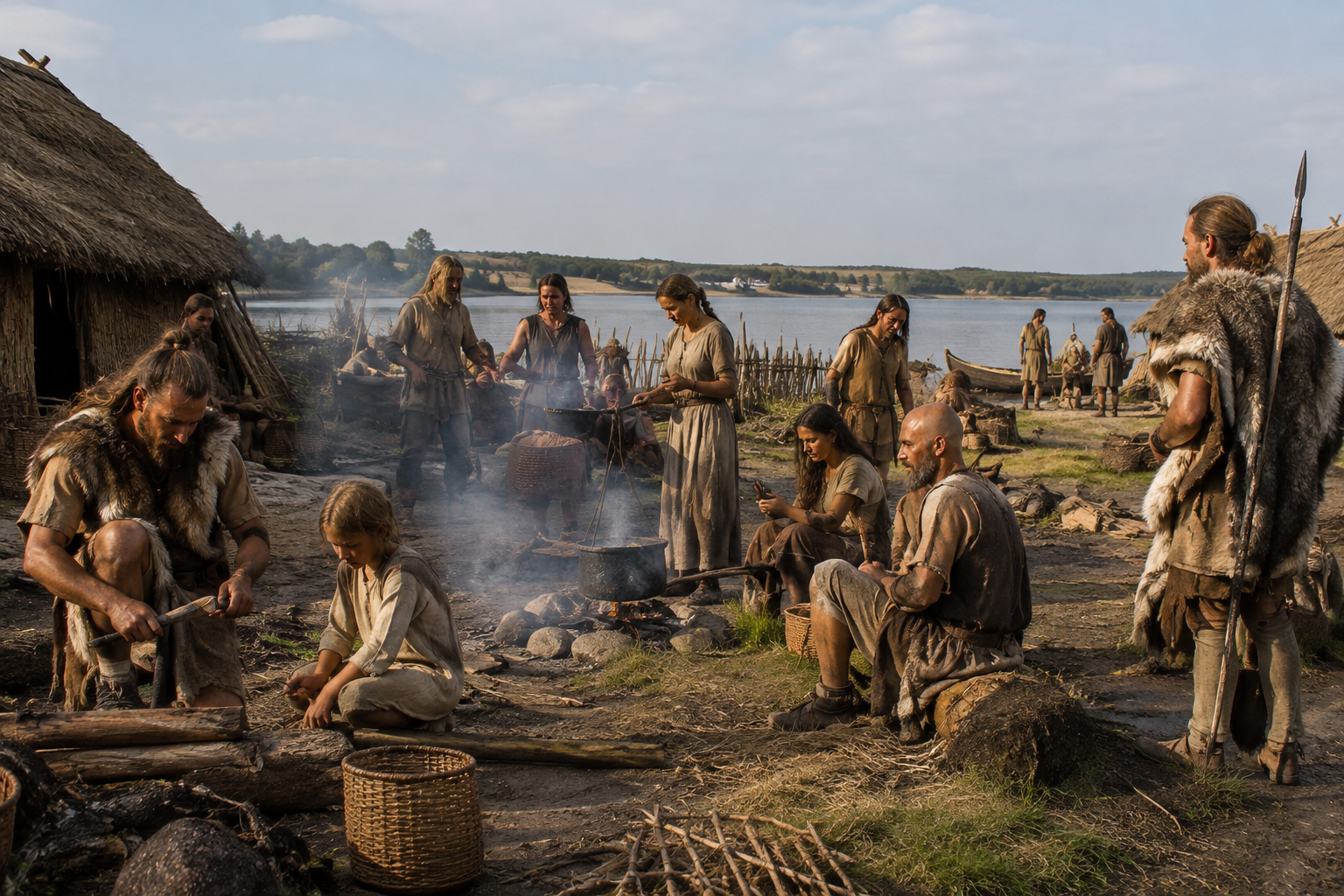
Haplogroup I2 is one of the great old paternal lineages of Europe. If you want a Y-DNA story that begins not with kings, chronicles, or castles, but with hunter-gatherers moving through post-Ice Age forests and shorelines, I2 is a fine place to start. It appears again and again in ancient DNA from Mesolithic and Neolithic Europe, especially around the Baltic, the North Sea, the western forest zones, and parts of southeastern Europe. In other words, this is not a haplogroup that arrives late on the historical stage. It is already there, deep in the prehistoric record.
That needs one important caution from the start. A Y-DNA haplogroup tracks only one line of ancestry: your direct paternal line, father to father to father. It does not represent your whole ancestry, your culture, your language, or your identity. Still, as a narrow thread through time, it can be extraordinarily revealing. In the case of I2, that thread runs from Mesolithic foragers and Neolithic communities into later Bronze Age, Iron Age, Roman, and medieval worlds.
Within the wider Y-chromosome tree, haplogroup I is generally associated with ancient European paternal ancestry, and I2 is one of its best-known branches. Broadly speaking, I2 is often linked with early European hunter-gatherer populations, though later branches spread into farming, metal-age, and historic societies as populations mixed and changed. The story is not one of a single people marching across the map. It is a long process of survival, absorption, regional continuity, and movement.
The supplied ancient DNA makes that plain at once. Some of the earliest and most striking examples come from Scandinavia and the North European plain. Ancient Norway Hummervikholmen Year:7197 BC ID:NEO17 and Ancient Denmark Sjaelland Sigersdal Mose Year:7090 BC ID:NEO759 place I2 in the far north very early indeed. Mesolithic Sweden Stora Forvar Year:6554 BC ID:sbj001 and Mesolithic Sweden Hummervikholmen Year:6000 BC ID:H26 continue that northern pattern.
That northern concentration matters because it helps explain why I2 so often turns up in discussions of Europe's Mesolithic foragers and the difficult transition to farming. Readers interested in that crucial Scandinavian turning point may enjoy this deeper look at Denmark's changing prehistoric populations.
Explore Denmark's Mesolithic Transition
The archaeology of I2 is wonderfully concrete. These are not abstract data points. They are people recovered from bogs, caves, coastal sites, and tombs. Ancient Denmark Sjaelland Sollerod Boldbaner Year:5865 BC ID:NEO600, Ancient Denmark Koed Year:5030 BC ID:NEO586, Ancient Denmark Fannerup D Jutland Year:4942 BC ID:NEO930, and Ancient Denmark Korsor Nor Year:5083 BC ID:NEO791 help show that I2 remained visible across Denmark over millennia.
The Ertebolle world is especially evocative here. Ancient Denmark Jutland Ertebolle Year:4347 BC ID:NEO568 and Ancient Denmark Jutland Ertebolle Year:4347 BC ID:NEO569 belong to a coastal hunter-fisher setting poised on the edge of the Neolithic transition. Then there is Rodhals Man Denmark Hunter Gatherer Year:3886 BC ID:NEO645 and Ancient Denmark Jutland Bog Skeleton Syorelyng Year:3189 BC ID:NEO602, reminders that wetlands and watery places preserved both bodies and clues to vanished lives.
Nor is this only a Scandinavian story. Mesolithic Ukraine Vasilyevka Year:8282 BC ID:I1763x, Ancient Ukraine Vovnigi II Year:4666 BC ID:NEO514, and Neolithic Vilnianka Zaporizhia Ukraine Year:5397 BC ID:I3716 show I2 well to the southeast in the North Pontic zone. That broader east-west spread is important. It suggests that I2 was not some narrow local peculiarity, but part of a much wider paternal landscape among early European populations.
For more on that Black Sea and steppe-margin world, this article is a natural companion.
One of the most interesting things about I2 is that it does not disappear when farming spreads. Instead, it appears in mixed and changing societies. Ancient Sweden Evensas Bohuslan Year:3797 BC ID:NEO260, NEO260a, and NEO260b; Neolithic Britain England Kelco Cave Year:3511 BC ID:Kelco_cave; Neolithic Britain Yorkshire Dales Jubilee Cave Year:3438 BC ID:Jubilee_cave; and Neolithic Britain Trottiscliffe Coldrum Year:3405 BC ID:Coldrum_1 all show that I2 lineages could persist inside very different regional settings.
That persistence continues westward into continental Europe. Neolithic France Year:3500 BC ID:TGM008, Cova de la Guineu Spain Year:2950 BC ID:I10283, Late Neolithic Belgium Grotte du Mont Falise Year:2775 BC ID:I13629 and ID:I13631, and Neolithic Belgium Abri Sandron Year:2888 BC ID:I13657 and Abri Sandron 50 Year:2691 BC ID:I13654 show I2 in cave and burial contexts stretching across Atlantic and inland Europe.
By the Bronze Age, we find it in still more varied contexts. Bronze Age Orkney Banks Chambered Tomb Year:2900 BC ID:NEO630 places it in the megalithic world of island Britain. Unetice Germany Eulau Year:1982 BC ID:I0804 and Early Bronze Age Mala Ohrada Czech Year:1600 BC ID:I16109 show it in central Europe. Bronze Age Germany Tollense Valley Battlefield Mecklenburg-Vorpommern Year:1250 BC ID:WEZ83 places an I2 lineage amid one of Europe's most dramatic prehistoric battle sites. That is a useful corrective to simple stories: old paternal lineages did not stand still while cultures changed around them.
Readers curious about this changing central European landscape might enjoy a broader treatment of continuity and upheaval in the Bronze Age.
Discover Bronze Age Central Europe
The supplied evidence also shows just how geographically wide the I2 story became over time. Bronze Age Vrbicka Montenegro Year:2500 BC ID:I16995 is a reminder of the haplogroup's importance in southeastern Europe, where several later branches of I2 are especially relevant in modern populations. From there the trail runs farther still: Early Bronze Age Nea Styra Euboea Greece Year:3900 BC ID:NST004, a substantial cluster from Armenia including Late Bronze Age Armenia Lchashen Cemetery Year:1250 BC ID:I18276, Early Iron Age Armenia Noratus Year:1100 BC ID:I18468, Year:920 BC ID:I18469, and Iron Age Armenia Sarukhan Year:930 BC ID:I20443, plus Outsider Byzantine Era Stratonikeia Church Aegean Coast Anatolia Year:975 AD ID:I20436.
None of this means all these men belonged to the same close paternal family. Far from it. What it does show is that branches within the broad I2 umbrella could be present in many societies from the Balkans to the South Caucasus and Anatolia. By historical times, I2 is part of a world of armies, trade, migration, and local continuity.
That is visible too in Late Roman Era Aquae Calidae Bulgaria Year:350 AD ID:I41148, Alemanni Grave Switzerland Basel-Waisenhaus Year:376 AD ID:DNA021, North African Early Medieval Spain Malaga Estepona Arroyo Vaquero Year:558 AD ID:I23169, and Late Medieval England Clopton Cambridgeshire Year:1561 AD ID:ATP_PSN_1274. This is not a single ethnic signature. It is a paternal lineage appearing in very different historical contexts.
In this case, the supplied noble-family-and-castle field is empty, which is worth saying plainly rather than pretending otherwise. So there is no responsible way here to attach haplogroup I2 to a particular dynasty, clan, castle, or ancestral seat from the input. That absence is actually a useful lesson in method. Genetics and genealogy are strongest when the evidence is specific. Without named families or documented castle associations, we should not manufacture them.
Still, the medieval and early modern sample trail hints at the kind of world where such connections sometimes become possible. A man buried in Clopton, Cambridgeshire in 1561 AD, sample ATP_PSN_1274, lived in an age of parish records, heraldry, landholding families, and surviving architecture. Yet even there, a shared broad haplogroup like I2 would not by itself prove membership in any noble house. It would simply place a paternal line within a much older and wider European story.
If you want to see how MyTrueAncestry handles named historical lineages when the evidence is there, this family article is a good example of the different kind of material involved.
Read About the House of Musgrave
What haplogroup I2 reveals, above all, is endurance. It begins in the deep European past among foragers of coasts, forests, and river valleys. It persists into the Neolithic, survives major demographic shifts, appears in Bronze Age battlefields and chambered tombs, turns up in Iron Age and Roman-era burials, and remains present in medieval and later individuals. That continuity does not mean sameness. Cultures changed, languages changed, and populations mixed repeatedly. But paternal lines can sometimes endure through all that upheaval.
Ancient DNA gives us something written history cannot: a view of paternal ancestry long before surnames, chronicles, and coats of arms. Written genealogy may begin with a manor, a charter, or a castle. Y-DNA begins with a man on a shoreline in Mesolithic Scandinavia, or buried near the Dnieper, or laid to rest in a Neolithic cave in Britain. The scale is completely different, and that is what makes it so compelling.
If this kind of deep ancestry interests you, you may also enjoy this broader introduction to how ancient DNA has transformed the study of the past.
Upload your DNA to MyTrueAncestry to explore whether your results show connections to ancient individuals such as NEO17, NEO759, I1763x, WEZ83, or other archaeological samples linked to haplogroup I2. These matches do not prove direct descent from a particular ancient person or membership in a noble family, but they can offer a fascinating glimpse into the deeper human story behind your paternal ancestry.
Comments