Haplogroup E1b1b1a1b1a10f

– 5 min read


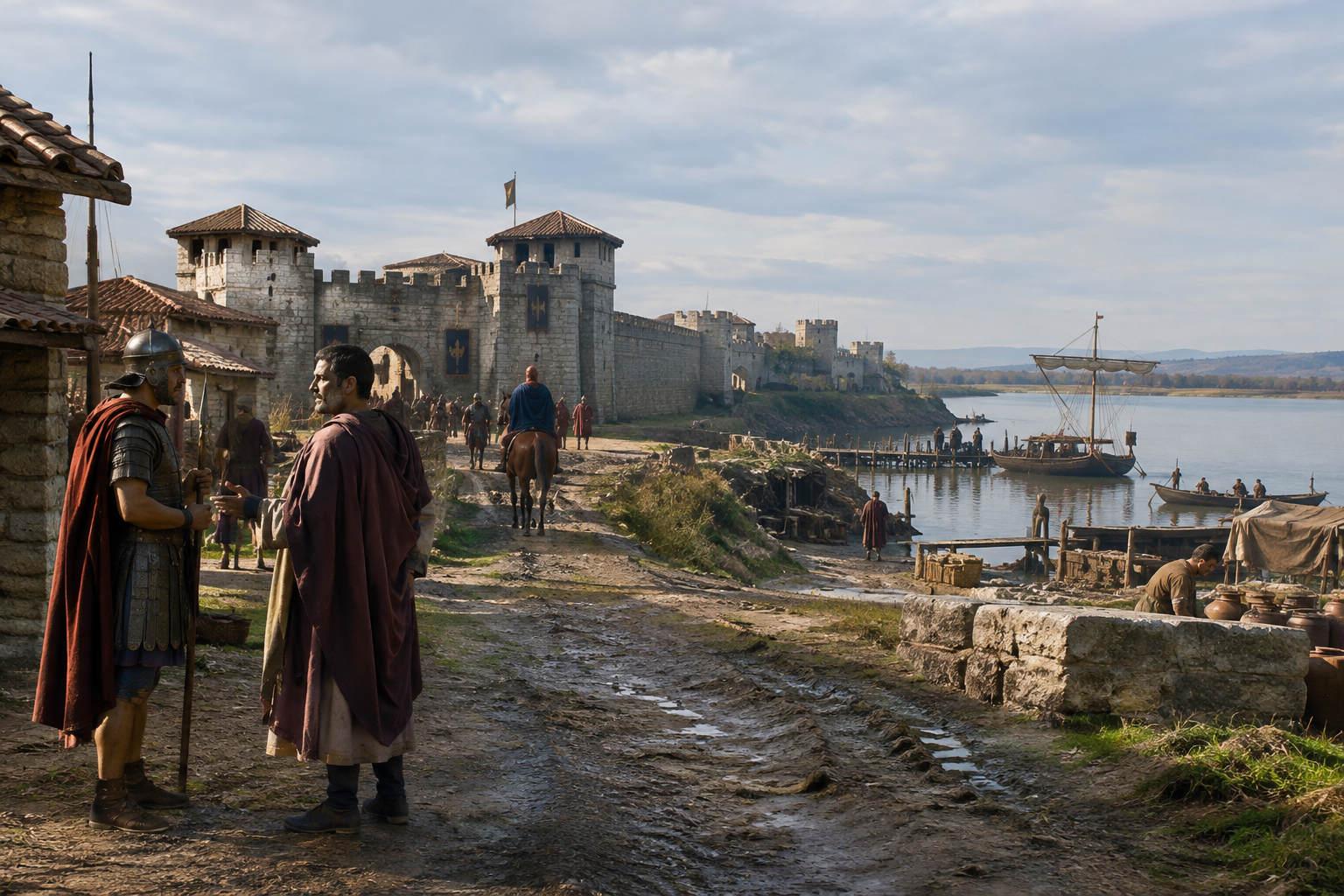
At Viminacium in present-day Serbia, one Late Antique man, identified as VIM6 and dated to around AD 400, offers a small but intriguing glimpse into the paternal history of haplogroup E1b1b1a1b1a10f. Viminacium was no obscure village. It was one of the major urban and military centers of Roman Moesia, a place where soldiers, merchants, officials, families, and migrants from many directions could end up living and dying side by side.
That matters, because a Y-DNA result from such a place should never be read as a neat ethnic label. Y-DNA traces one direct paternal line only. But in a city like Viminacium, even a single paternal lineage can tell us something valuable: not that one branch "belonged" to one people, but that lineages now found in modern testers were already part of the human mixture of the late Roman Balkans.
Viminacium stood near the Danube limes, the great frontier zone where the Roman Empire watched, traded, recruited, and fought. Yet frontiers are not tidy edges on a map. They are contact zones. By the fourth and fifth centuries, this part of the Balkans had seen long centuries of movement: local Balkan populations, settlers from elsewhere in the empire, military transfers, traders from the eastern Mediterranean, and newcomers from beyond the frontier all passed through the same urban world.
So when VIM6 is associated with haplogroup E1b1b1a1b1a10f, the most sensible historical reading is not a dramatic tale of one migration event, but evidence of how mixed Late Antique society could be. A line within the wider E1b1b1 family appearing in Roman Moesia fits the broader picture of southeastern Europe and the Mediterranean as regions of deep and layered connectivity.
An ancient DNA study of Viminacium and the surrounding region has helped show just how varied these communities could be, with people carrying different ancestry profiles and family histories within the same wider Roman setting. The broader research context is reflected in genetic work on the population history of the Roman Balkans, which is precisely the kind of scholarship that makes a single result like VIM6 more meaningful.
The name E1b1b1a1b1a10f is highly specific, but specificity can be deceptive if we pretend it gives more certainty than it really does. The wider haplogroup E1b1b1 has a long history across parts of Africa, the Mediterranean, and southeastern Europe, with many different branches spreading at different times. That does not mean every downstream subclade shares the same route, date, or historical identity.
With VIM6, the secure point is the Late Antique context at Viminacium. That alone is useful. It places this paternal line, or a lineage reported within this branch, in a major Roman center on the middle Danube around the time when imperial structures were under strain but urban and military life still continued.
And that timing is important. Around AD 400, the Balkans were not simply "Roman" in some pure administrative sense, nor had they become something wholly post-Roman. They were both imperial and unstable, local and cosmopolitan, settled and mobile. A paternal lineage in that setting may reflect older Balkan continuity, movement within the empire, or some combination of the two. The evidence here does not permit a narrower claim.
There is a temptation, when only one ancient sample is available for a haplogroup article, to dismiss it as too little. But archaeology often works the other way round. A single securely placed individual can anchor a lineage to a real place, a real period, and a real historical environment. VIM6 is not just a string of letters and numbers; he is a person from one of the most contested and connected regions of the later Roman world.
In practical terms, that gives descendants and DNA researchers a firmer historical frame. E1b1b1a1b1a10f is not appearing here in a mythic vacuum. It is turning up in a landscape shaped by legions, roads, cemeteries, taxation, river traffic, diplomacy, and repeated episodes of upheaval. If your paternal line falls under this branch, that does not prove descent from VIM6, of course. But it does show that related paternal ancestry was present in a major Balkan-Roman population by Late Antiquity.
This is also why ancient DNA from Roman-era and post-Roman sites has become so important. It shifts the conversation away from grand old ethnic stereotypes and toward actual buried individuals. In the Balkans especially, that is a welcome correction.
One of the most misleading habits in popular history is to treat the Balkans as though history there begins only when some famous invading people arrive. In fact, the region had extraordinarily deep demographic roots long before Late Antiquity, and those roots were repeatedly reworked rather than simply erased. The Roman centuries added new layers of mobility, but they did not wipe the slate clean.
That is what makes a lineage like E1b1b1a1b1a10f so interesting in this context. It sits comfortably within a part of Europe that has long acted as a meeting ground between the Mediterranean, the Carpathian Basin, the Aegean, and the steppe-facing north. The appearance of this branch at Viminacium is therefore historically plausible in several different ways, which is another way of saying we should resist oversimplified stories.
Recent work on Balkan population history has repeatedly emphasized deep local roots alongside later admixture and movement. Readers interested in that larger background may want to compare this Late Antique evidence with the broader regional picture explored in Balkan Hunter-Gatherers Shaped Post-Ice Age Europe, where the time depth is much earlier but the lesson is similar: southeastern Europe has been central, not peripheral, to the making of European ancestry.
Viminacium also reminds us how slippery labels such as Roman can be. A man buried in a Roman city in AD 400 might have had local Balkan forebears for generations. He might equally have had paternal ancestors who moved in from another part of the empire long before his own lifetime. By this date, "Roman" often described political world, military service, law, taxation, and urban belonging more than any single ancestry profile.
That is exactly why ancient DNA has proved so revealing for the Roman world. Study after study has shown that imperial populations could be highly mixed, especially in ports, capitals, military zones, and important provincial centers. Viminacium, on the Danube and within reach of both imperial administration and frontier pressures, fits that picture very well.
For a useful comparison from another Roman context, see Roman Hispania's Lasting Genetic Legacy. The geography is different, but the underlying historical point is comparable: Roman rule did not create uniform people, it created connected populations.
For this haplogroup, the standout evidence is modest but solid: VIM6 places the branch in Late Antique Viminacium, in Roman Moesia, around AD 400. That anchors E1b1b1a1b1a10f to a historically rich setting at the crossroads of empire, frontier, and long-term Balkan continuity. It suggests that this paternal line belonged to the same mixed human world that made the late Roman Danube such a complicated place.
For someone researching their paternal ancestry today, that is the real value of the evidence. Not a fantasy of instant tribal identity, and not a shortcut to one named people, but a documented connection to the densely peopled, mobile, and stubbornly interconnected world of the late Roman Balkans.
Comments