Haplogroup I2a1b2a2a3

– 5 min read


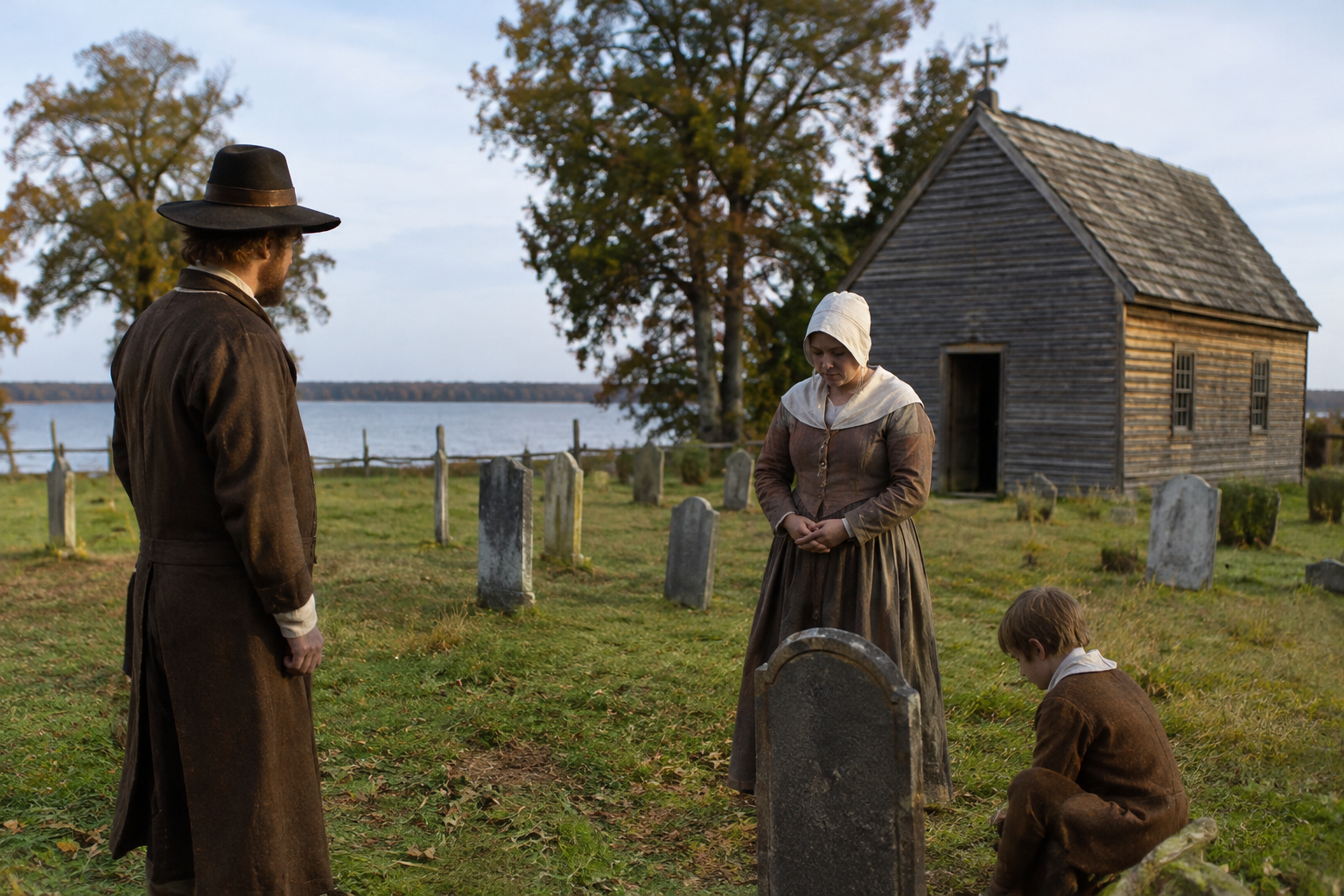
At Historic St. Mary's City in Maryland, one burial from the Chapel Field cemetery brings the Y-DNA haplogroup I2a1b2a2a3 into a very specific and very human setting. The individual is recorded as sample I15296, dated to 1634 AD, from one of England's earliest colonial settlements in North America. That matters because this is not a prehistoric cave, a Bronze Age barrow, or a royal mausoleum. It is an early colonial cemetery tied to a town whose founders were trying to build a new society across the Atlantic.
That gives this haplogroup an unusually sharp historical frame. Instead of meeting it first in deep prehistory, we encounter it in a documented colonial landscape: churchyard burial, English Atlantic migration, and the fraught beginnings of seventeenth-century Maryland. Y-DNA follows one direct paternal line only, not a person's whole ancestry, but that single line can still anchor a story in a real place and moment.
St. Mary's City was founded in the 1630s as the first capital of Maryland, part of the wider English colonial push along the Chesapeake. The Chapel Field cemetery belongs to that formative period, when settlement, religion, law, trade, and disease were all being worked out on the ground rather than in theory. A man buried there with haplogroup I2a1b2a2a3 is therefore part of a population history that is both intimate and geopolitical.
What makes sample I15296 especially useful is not lavish archaeological detail, because none is safely available here, but context. This was a burial in a Christian cemetery connected to the settlement's chapel precinct, placing the individual within a recognizably colonial community. In other words, the haplogroup appears here not as an abstract branch on a phylogenetic tree, but as a paternal line carried into the Chesapeake during the first decades of English colonization.
A recent ancient DNA study on St. Mary's City explored the community's biological legacy and colonial-era diversity, offering the broader research setting for finds such as this one: research published on the genetic legacy of seventeenth-century St. Mary's City.
The branch name is precise, but precision can be deceptive if we rush ahead of the evidence. Haplogroup I2 is a large and old European Y-chromosome family with deep roots in the continent, and many of its sub-branches have long histories in different regions. But this article is about I2a1b2a2a3, a much narrower paternal line. We should not simply pour the whole story of broader I2 into this one smaller branch as if nothing changed along the way.
What the St. Mary's City burial shows securely is that one man in early colonial Maryland belonged to this direct paternal lineage. That strongly suggests the branch was present among populations involved in seventeenth-century Atlantic migration, very likely through the British colonial world. It does not, by itself, tell us exactly where his distant paternal ancestors had lived centuries earlier, nor does it identify an ethnicity, language, or social rank from the Y chromosome alone.
Still, the larger frame is historically suggestive. Early Maryland drew people from the British Isles and from connected parts of the English world. So when I2a1b2a2a3 appears in this cemetery, it sits inside a demographic process shaped by migration from northwestern Europe, colonial settlement, and the reproduction of Old World paternal lines in a New World setting.
There is something refreshingly corrective about this evidence. Popular discussions of Y-DNA often jump straight to famous dynasties, warrior tribes, or grand origin myths. But most paternal lines survive because ordinary men had sons, moved, married, worked, worshipped, and were buried in places that later archaeologists could recover. Sample I15296 reminds us that the archive of the past is often built from parish grounds and settlement cemeteries, not only from crowns and castles.
That is also why St. Mary's City matters archaeologically. Colonial cemeteries are one of the places where written history and biological history begin to overlap in unusually productive ways. We know the broad political setting: English expansion, Catholic-Protestant tensions in Maryland, contact and conflict in the Chesapeake, and the creation of a plantation colony. Ancient DNA adds a more personal dimension by showing that these events were carried by real bodies, real families, and real paternal lines.
The great temptation with a single colonial-era Y-DNA result is to turn it into a neat migration arrow: this branch came from here, then went there. History is rarely so tidy. Seventeenth-century Chesapeake populations were already mixtures of regional British backgrounds, and before that, the paternal line itself may have passed through many earlier European settings. A colonial burial gives us a fixed point in time; it does not magically fill every earlier gap.
But fixed points are precious. In fact, they are how careful archaeology works. With I15296, we can say that haplogroup I2a1b2a2a3 was present in one of the foundational English colonial communities of mainland North America. For descendants tracing paternal ancestry today, that places the lineage inside a world of early transatlantic settlement rather than only in anonymous modern distributions.
This wider issue, of how genetics can illuminate movement, mixture, and historical identity without collapsing them into each other, is also central to broader work on population history visualization and interpretation.
How ancestry patterns are read
Some haplogroups are represented in MyTrueAncestry by long runs of prehistoric and medieval samples across many sites. This one is different in the material provided here. Its article rests on a single well-placed colonial burial, and that limitation is not a weakness so much as a discipline. It keeps the story honest.
With I15296, the interest lies in context rather than quantity. We are looking at a direct paternal line carried by a man buried at the very start of Maryland's colonial history. That turns a technical label, I2a1b2a2a3, into evidence for continuity of European paternal ancestry across the Atlantic world, embedded in one of the earliest English colonial capitals.
There is a broader historical resonance too. Early American population history is often discussed in terms of empires, plantations, and migration streams. Yet each of those streams was made up of lineages like this one: inherited narrowly, lived locally, and recovered archaeologically centuries later.
North Sea migrations and Britain
For someone researching haplogroup I2a1b2a2a3, the most responsible takeaway is clear. This branch is not just a deep European inheritance floating in the abstract; it is attested here in a named colonial cemetery, at St. Mary's City, in the first generation of Maryland's history. That does not make every bearer of the haplogroup a descendant of this man, or of one national group alone. But it does give the lineage a firm archaeological foothold in the early modern Atlantic world, which is a remarkably vivid place to find a paternal ancestor's branch.





Comments