Haplogroup R1a1a1b2a2a1d6a

– 5 min read


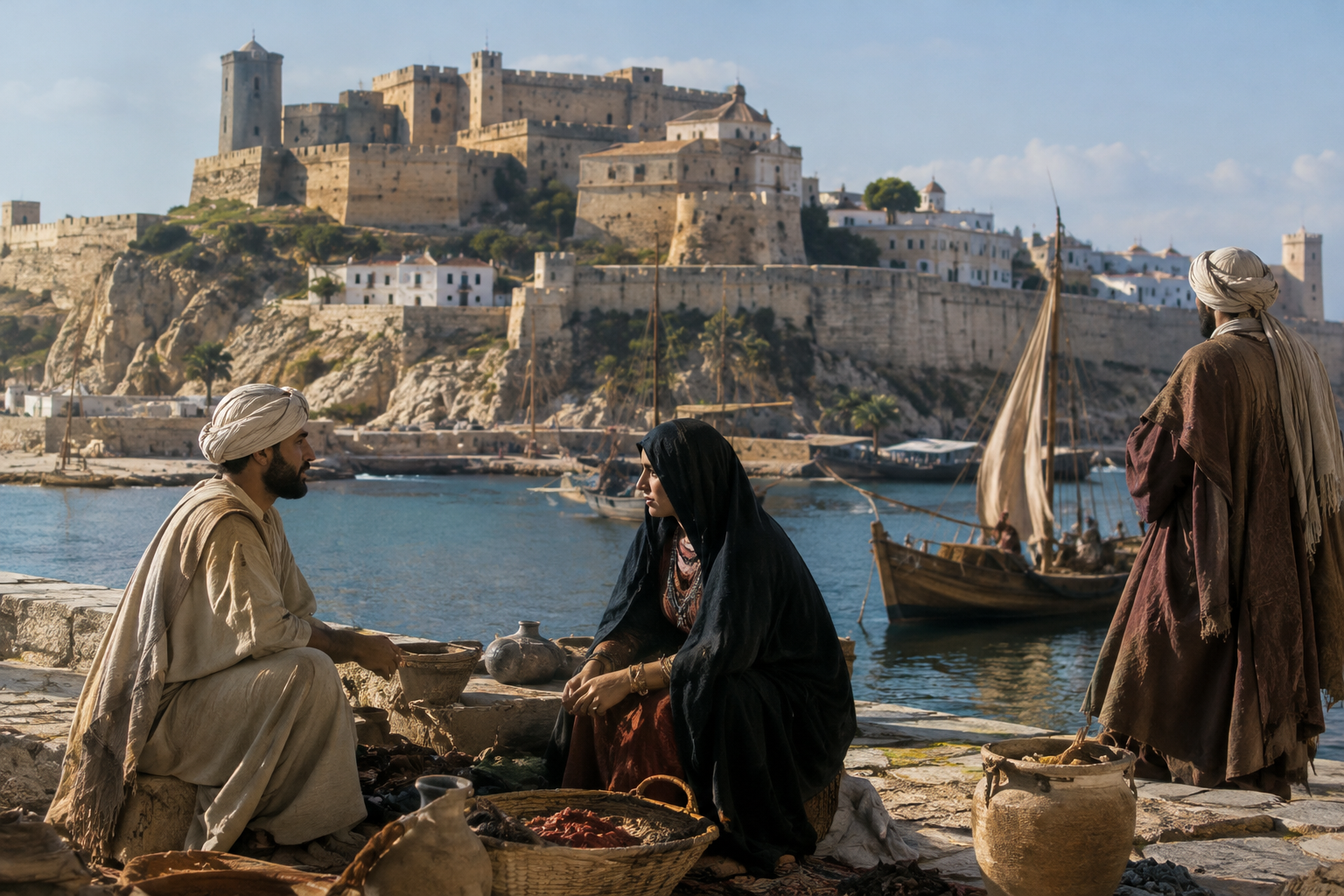
In about AD 950, a man buried in Islamic Ibiza entered the genetic record under the identifier ldo115. He is not famous in the way a king is famous, and that is exactly why he matters. Finds like this give us something rarer than prestige: a glimpse of ordinary or at least non-royal life in a place where Mediterranean trade, conquest, religion, and migration all met on a small island.
The Y-DNA lineage associated here is R1a1a1b2a2a1d6a, a very narrow paternal branch within the much broader R1a family. That broader haplogroup has a long and complex history across Eurasia, but a subclade this specific should not be made to carry the whole burden of that story. What the Ibiza evidence can show, more carefully, is that one direct male line linked to this branch was present in al-Andalus in the Balearics during the 10th century, in a society that was already anything but simple.
Medieval Ibiza was no isolated backwater. In the centuries after the Islamic conquest of parts of Iberia, the Balearic Islands sat within maritime networks that connected the western Mediterranean to North Africa, Iberia, Sicily, and beyond. Ports, garrisons, merchants, farmers, scholars, captives, converts, and settlers all helped shape island populations. A burial from this world cannot be reduced to a single label such as "local" or "foreign" without much fuller evidence.
That is why ldo115 is interesting. A paternal lineage like R1a1a1b2a2a1d6a traces only one line of descent, father to son to son, not a person's total ancestry, language, or identity. But placed in medieval Ibiza, it becomes part of a larger archaeological question: how mixed were the communities of the Islamic Balearics, and what kinds of family histories were being folded into island life by the 10th century?
A recent MyTrueAncestry discussion of this setting is especially relevant here:
There is always a temptation with a precise-looking Y-DNA label to turn it into a complete migration saga. Resist that temptation. R1a1a1b2a2a1d6a is a terminal or near-terminal style designation in a branching paternal tree, but ancient archaeology rarely lets us map such a branch neatly onto one named people, one language, or one political power.
What can be said more securely is that lineages within the wider R1a family are found across large parts of Eurasia and appear in many different historical settings. By the medieval period, such lineages could reach islands like Ibiza through any number of long-established channels: movement into Iberia in earlier periods, mobility within the Islamic world, mercenary service, trade, enslavement, resettlement, or multi-generational local continuity after earlier arrivals. The sample itself does not choose between those options.
That caution is not a weakness. It is the strength of ancient DNA when properly used. Rather than forcing one grand origin story, it lets us see that medieval island societies were composed of real family lines with deep and varied pasts.
The medieval evidence from Ibiza makes most sense against the longer background of Balearic population history. These islands had already seen repeated episodes of contact and change long before the 10th century: prehistoric settlement, Phoenician and Punic influence, Roman incorporation, late antique transformation, and then integration into the Islamic western Mediterranean. Each phase altered the social world into which later islanders were born.
That broader point has been explored in work on island population history across the central and western Mediterranean, including the Balearics. MyTrueAncestry has covered this longer arc in its post on Balearic genomic history:
Seen in that context, ldo115 is not a stray curiosity. He belongs to a landscape where ancestry was already layered. Islamic-period burials on Ibiza are therefore valuable not because they confirm some tidy replacement of one people by another, but because they show how island communities continued to absorb and recombine different human histories.
It is easy to talk about al-Andalus as though it were a single block, but the historical reality was full of regional variation. Cities such as Cordoba, Seville, Toledo, and later Granada had different political fortunes; frontier zones differed from coastal hubs; islands had their own logistical importance. Ibiza, in particular, was part of a maritime world where movement by sea mattered just as much as overland expansion.
Ancient DNA from early medieval and Islamic-period Iberia increasingly supports that picture of diversity. Some burial grounds reveal individuals with ancestry profiles pointing to local Iberian roots, others show stronger North African or more mixed signatures, and still others underline how inadequate old ethnic shorthand can be. One useful comparison is the growing evidence for varied origins in central Iberia during the early medieval period.
Diverse Origins in Medieval Madrid
That does not make Ibiza identical to Madrid, of course. But it does place ldo115 in a broader Iberian pattern: local communities were often genetically heterogeneous, and political rule did not erase older ancestries or prevent new ones from entering the picture.
Research on medieval Islamic Ibiza has also been framed in exactly those terms, looking at both ancestry and disease history in the burial population. The study record linked through this research entry is therefore relevant not because it magically explains one Y-lineage in isolation, but because it points to the wider archaeological and biomolecular context in which that lineage was identified.
When evidence is sparse, there is a tendency either to say too much or to shrug and say almost nothing. Better to do neither. One sample, ldo115, cannot define medieval Ibiza, cannot stand for all Muslim-period islanders, and cannot by itself tell us whether his paternal ancestors arrived generations earlier or only recently. But he does establish the presence of this paternal branch in a specific place and time: Ibiza, around AD 950, within the world of al-Andalus.
For people researching their own paternal ancestry, that is often the most useful kind of finding. It puts a lineage not into myth but into history. In this case, R1a1a1b2a2a1d6a is not just an abstract string of letters and numbers. It is a line carried by at least one man living in a medieval Mediterranean society shaped by commerce, conquest, faith, and constant human movement.
There is also a wider lesson here. Medieval island worlds were not culturally or biologically sealed containers. The same is visible in nearby Sicily, another place where Islamic, Christian, and Mediterranean networks created unusually mixed populations over time.
Medieval Sicily's Multi-Faith DNA
The most distinctive thing we can responsibly say about R1a1a1b2a2a1d6a from the present evidence is not that it belonged to a famous dynasty or a single migrating tribe, but that it appears in a documented medieval Islamic burial from Ibiza. That places this paternal line inside the social reality of the 10th-century western Mediterranean: connected, mobile, and genetically diverse. If this is your haplogroup, the ancient clue is modest but meaningful - your direct paternal line was present in a world where island life and long-distance history met every day.

Comments