Haplogroup J2a1a1a2b2a2b2b2

– 5 min read


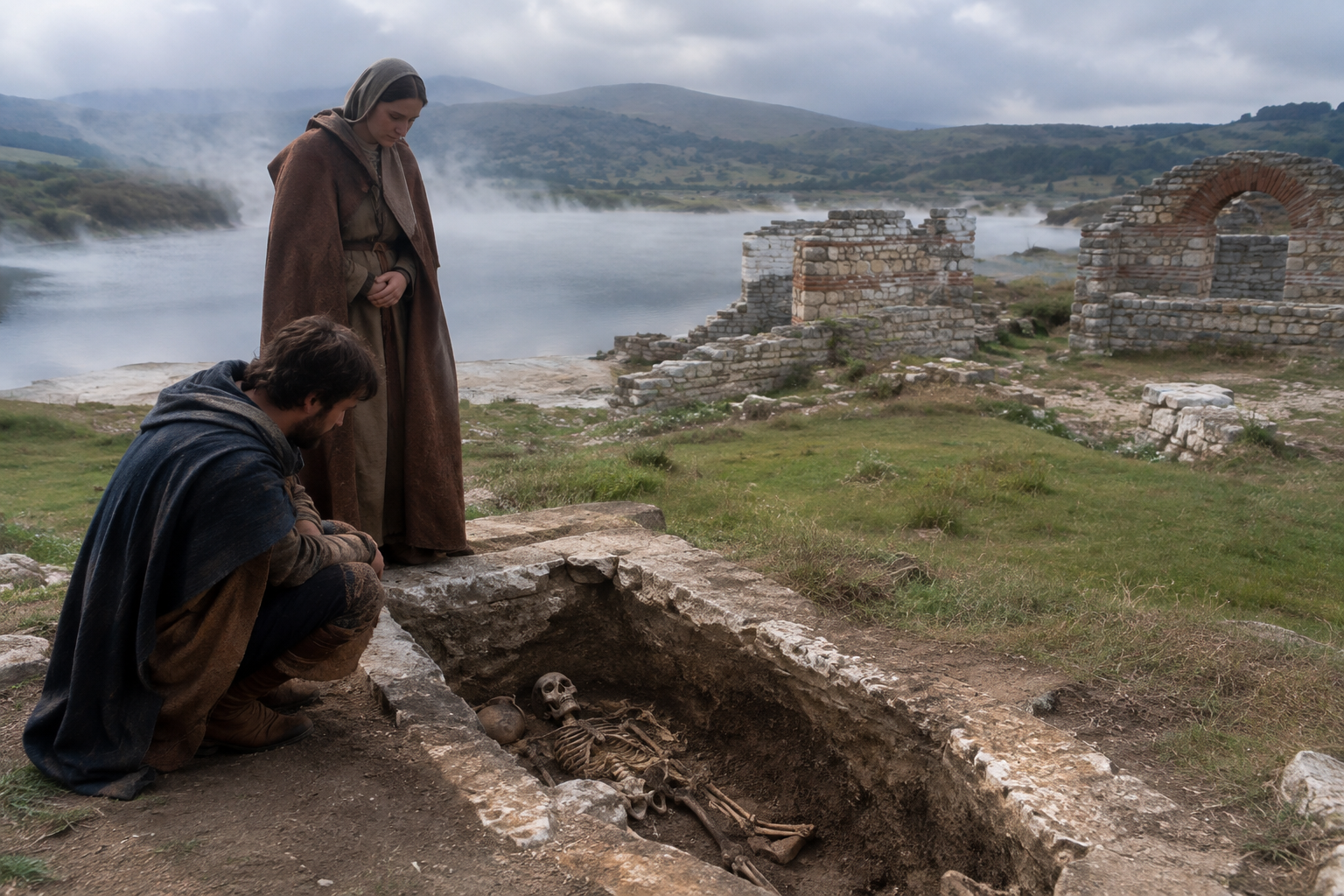
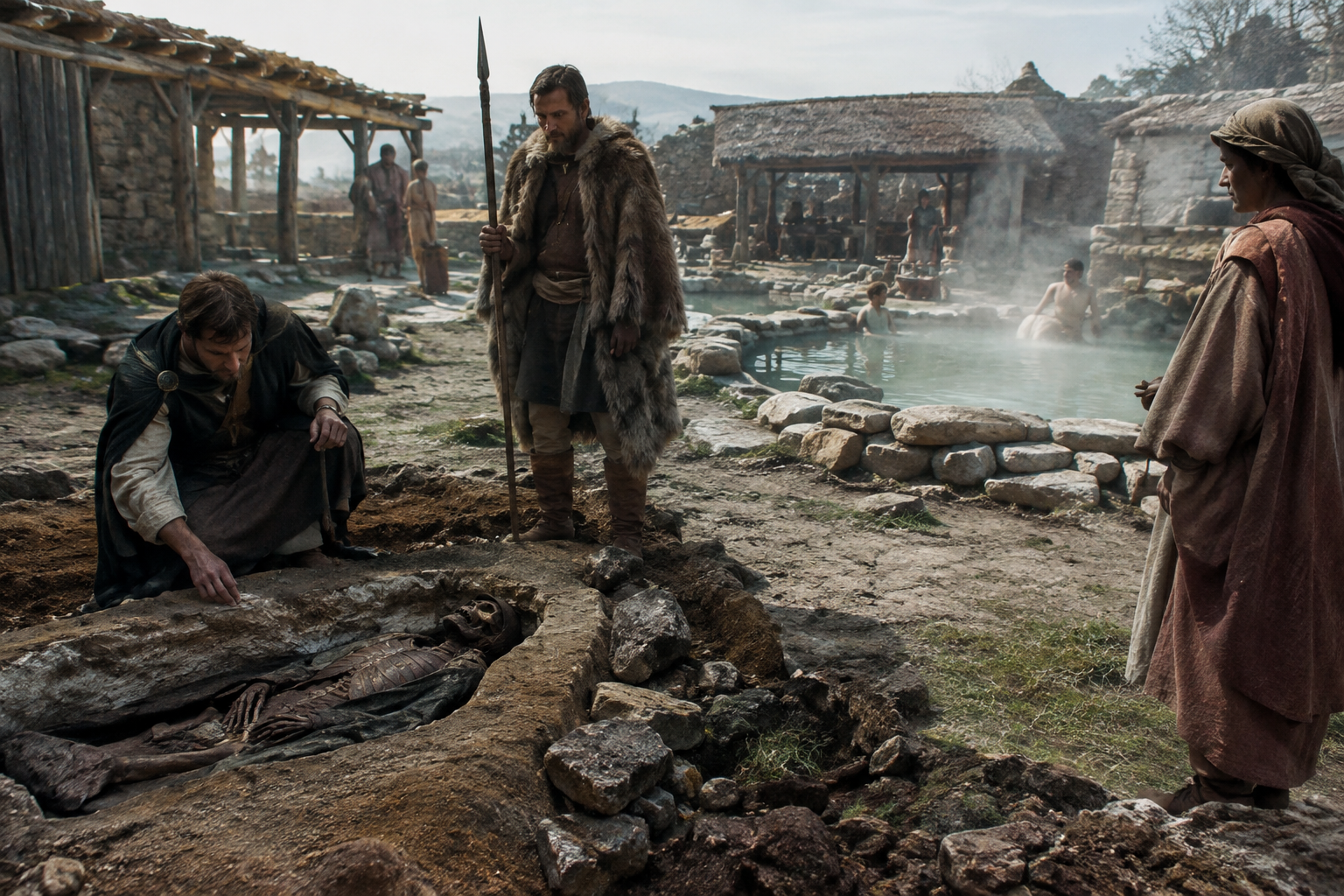
At Aquae Calidae, the hot-spring center near modern Burgas on the Bulgarian Black Sea coast, one man buried around AD 350 has become a particularly useful guide to a much larger story. He is sample I41137, identified as a Gothic grave from the Roman era, and he has been associated with the Y-DNA haplogroup J2a1a1a2b2a2b2b2. That long string of letters and numbers is not a label for an ethnic group or a complete ancestry profile; it marks one direct paternal line, passed from father to son, inside a far bigger human family tree.
What makes this case interesting is not simply that a man from a Gothic-context burial carried a branch of J2. It is that he appears in late antique Bulgaria, in a zone where Roman institutions, Black Sea exchange, and mobile Gothic communities were all meeting one another. In other words, this is exactly the sort of place where ancient DNA complicates the old habit of imagining peoples like the Goths as biologically neat and sealed-off tribes.
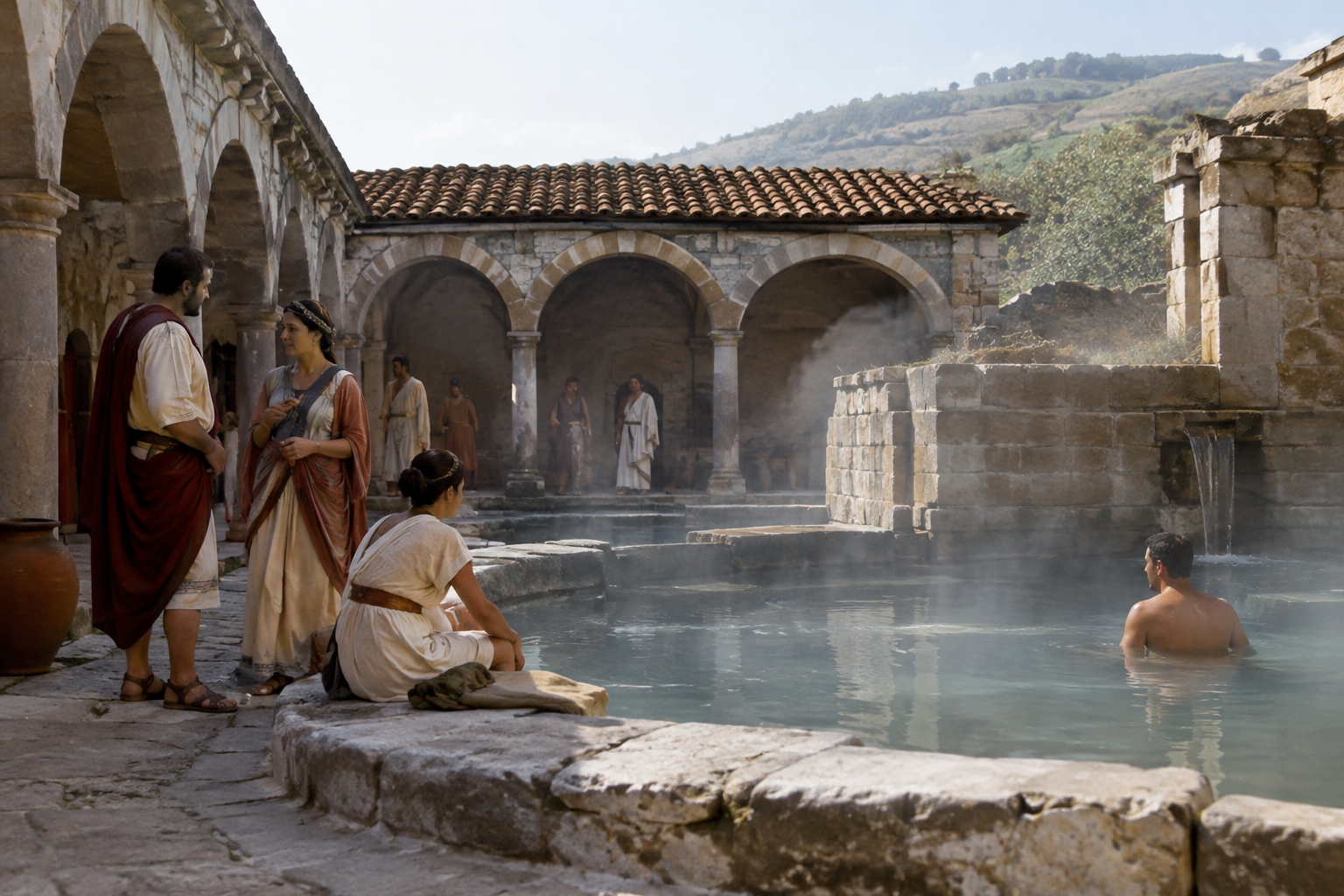
Aquae Calidae was no remote outpost. Thermal sites in the Roman world tended to attract movement: soldiers, traders, officials, locals, and travellers, all passing through a place already important because of its waters and its position on the western Black Sea. By the fourth century AD, this was also a region shaped by the pressures and opportunities of the later Roman Empire, when groups described in written sources as Goths were active both beyond and within imperial frontiers.
That is the setting in which I41137 matters. A paternal lineage assigned to J2a1a1a2b2a2b2b2 sits awkwardly with any simplistic picture of "Gothic bloodlines." It suggests instead that at least one man in a Gothic burial context belonged to a branch more often associated, in broad terms, with lineages that have deep roots across parts of the eastern Mediterranean and western Asia. That does not tell us where he was born, what language he spoke, or how his family came to Aquae Calidae. It does tell us that Gothic communities in late antique Bulgaria could include paternal lines that were anything but narrow or uniform.
This broader point fits the direction of recent work on the region. A preprint examining these late antique Bulgarian burials has highlighted the mixed origins of Gothic-associated communities rather than treating them as a single biological block; see the research here: https://www.biorxiv.org/content/10.64898/2026.03.03.709317v1.
Late Antique Goths in Bulgaria
With a haplogroup as specific as J2a1a1a2b2a2b2b2, the temptation is to tell a grand migration tale at once. That would be a mistake. The deeper parent haplogroup J2 has a long and complicated history across the Near East, Anatolia, the Caucasus, the Mediterranean, and southeastern Europe, but a very narrow downstream branch cannot automatically be given the full biography of its parent.
So the careful way to read I41137 is this: one late Roman-era individual in a Gothic grave at Aquae Calidae has been linked to this paternal branch, and that is firm enough to make the sample interesting. What we should not do is pretend that this one grave proves that the branch was characteristically Gothic, or that every later carrier of the branch descends from some known historical migration episode. Ancient DNA is often most useful precisely when it blocks those overconfident stories.
There is another reason for caution. Archaeological labels such as "Gothic grave" describe context, style, and scholarly interpretation of a burial setting. They do not turn a chromosome into an ethnicity. In late antiquity, people moved, served in armies, married across communities, and were absorbed into shifting political formations. A paternal lineage found in one Gothic-context grave may reflect family history stretching through the Balkans, the Black Sea, or further south and east long before that burial was made.
If one wanted to design a region in which lineages like this might turn up in unexpected places, the western Black Sea would be an excellent candidate. For centuries before AD 350, this coastline linked Greek colonies, Thracian populations, Roman provincial life, maritime traffic, and inland routes crossing the Balkans. By late antiquity, the area was also entangled with federate military service, frontier diplomacy, raiding, resettlement, and the constant business of empire.
That is why a J2-lineage man in a Gothic-associated burial should not seem bizarre at all. It belongs to a historical landscape in which "Roman" and "barbarian" were political and cultural categories that often overlapped in practice. People could be buried in one cultural idiom while carrying family histories assembled over generations from several regions.
Recent MyTrueAncestry coverage has repeatedly shown this pattern around the Roman world: communities near frontiers and transport corridors were rarely homogeneous. The Bulgarian Gothic material belongs to that same wider late antique reality.
The old picture of the Goths imagined a people marching across Europe with a stable biological core. Ancient genomics has been steadily dismantling that image. Language, military allegiance, dress style, burial custom, and political identity can spread without everyone sharing the same paternal ancestry. In fact, mobile confederations are especially likely to gather people of varied origins.
I41137 is useful because he gives that argument a human scale. Here is not an abstract claim about diversity, but one man from one grave in late antique Bulgaria whose Y-DNA points away from any fantasy of a single "Gothic haplogroup." His lineage reminds us that historical communities are often coalitions. They recruit, absorb, inherit, and re-form.
That aligns well with broader genomic discussions about the spread of Germanic languages and identities. Such processes were social and historical, not mere maps of male-line descent.
Germanic Languages and Genomics
A single Y-DNA branch is a strange kind of evidence: very narrow, yet sometimes very revealing. It tracks only one line of fathers and sons out of a person's entire ancestry. After a few centuries, any individual has countless forebears, but just one Y-chromosome line. That means J2a1a1a2b2a2b2b2 may preserve a deep paternal thread while telling us almost nothing by itself about the majority of I41137's ancestry.
Yet that narrowness is also its value. Because paternal lines can persist through dramatic cultural change, they sometimes expose continuity or mixture where historical labels look deceptively tidy. At Aquae Calidae, this branch suggests that a man buried in a Gothic setting belonged to a paternal history wider than the burial label alone would imply. In a frontier province of the later Roman Empire, that is not an anomaly. It is the sort of thing we should expect.
Comparable studies elsewhere in the Roman and post-Roman world have found similar complexity: local continuity mixed with newcomers, soldiers beside civilians, and burials whose cultural presentation tells only part of the biological story.
For anyone researching haplogroup J2a1a1a2b2a2b2b2 today, Aquae Calidae offers one solid historical glimpse: by around AD 350, this paternal branch, or a very closely related line reported under it, was present in a Gothic-context burial on the Black Sea edge of the Roman world. That does not make the branch uniquely Gothic, nor does it reduce its history to a single migration. What it does suggest is something more interesting: this was a lineage capable of turning up in one of late antiquity's most mixed and politically fluid settings, where Roman provincial life and Gothic identity met face to face.



Comments