Haplogroup R1b1a1b1a1a2b1c1c

– 5 min read


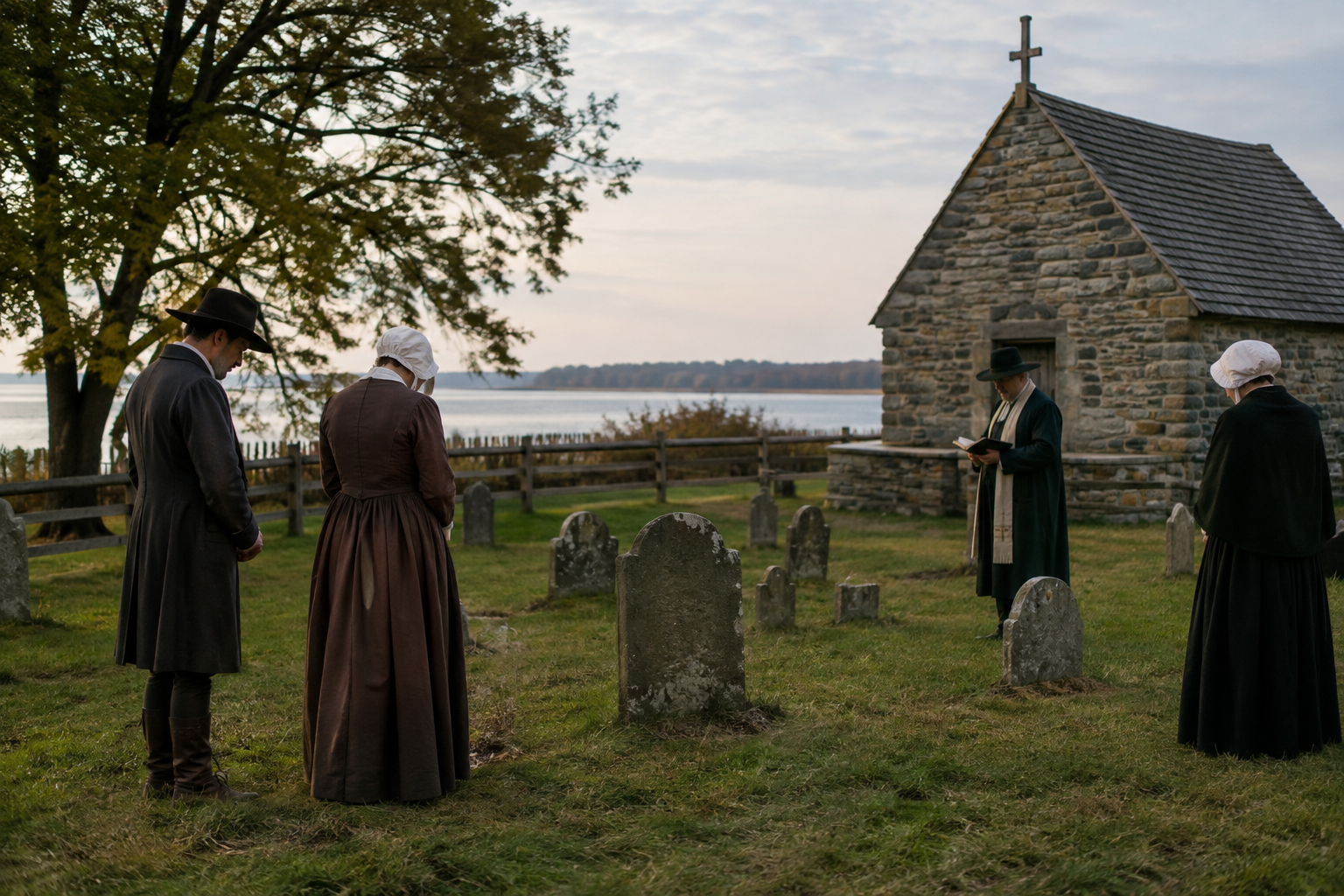
At St. Mary's City in Maryland, archaeologists and geneticists have been able to look unusually closely at the people buried in one of early English America's first colonial cemeteries. One of those men, identified as I15300 from the Historic St. Mary City Chapel Field Cemetery and dated to around 1634 AD, is associated here with the Y-DNA haplogroup R1b1a1b1a1a2b1c1c.
That string of letters and numbers is very precise, but the historical setting is the real point of entry. St. Mary's City was not an abstract dot on a haplogroup map. It was the first capital of colonial Maryland, founded in the tense and mobile world of the seventeenth-century Atlantic. A Y-chromosome lineage such as R1b1a1b1a1a2b1c1c traces one direct paternal line only, yet in a cemetery like this it becomes a way of asking who these settlers were, where their male lines may have come from, and how quickly European family histories were being replanted in North America.
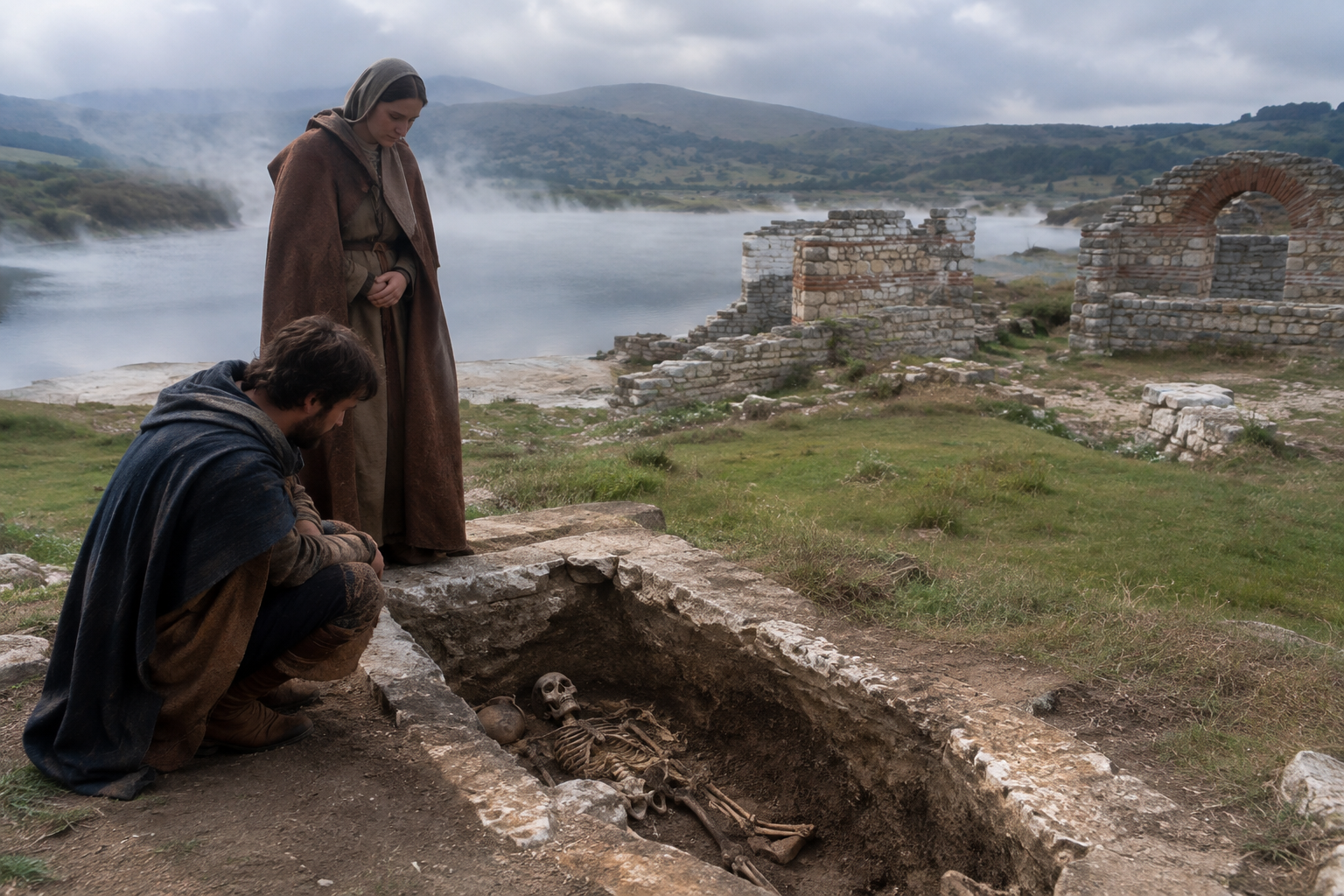
The Chapel Field Cemetery belongs to the earliest phase of Maryland's colonial experiment. Founded in the 1630s, St. Mary's City was meant to be both a political center and a working settlement on the edge of English expansion. Its burials therefore matter not simply because they are old, but because they belong to a formative generation: people living through the hazardous business of transplanting a society across the Atlantic.
In that context, I15300 is valuable precisely because he is not a legendary founder or a named grandee. He is a documented ancient DNA individual from a real cemetery tied to the colony's opening decades. The presence of a highly resolved R1b branch here fits a broader historical expectation that many paternal lines in early English colonial settlements would derive from western European populations, but the significance lies in the specific colonial setting. This is a lineage carried not in prehistoric barrows or medieval churchyards, but in the bones of a man buried at the beginning of Maryland's recorded history.
An ancient DNA study of this community, published in Current Biology, helps frame the cemetery as more than a collection of isolated burials. Research of this sort can reveal ancestry, relatedness, and patterns of population formation in the colony, even when the surviving written record is uneven. What matters for this haplogroup article is that I15300 anchors the branch in an excavated and historically intelligible place.
R1b1a1b1a1a2b1c1c is a narrow twig on the very large Y-DNA tree of R1b, one of the major paternal haplogroups in western Europe. It would be a mistake to flatten those two levels together. The broad parent haplogroup has a very long and complex prehistoric history, while this article's exact branch represents a much more recent subdivision somewhere within that wider paternal family.
That distinction matters because a terminal or near-terminal branch can tell you about a more focused line of descent, but not by itself about language, class, nationality, or complete ancestry. A man buried in seventeenth-century Maryland with this Y-lineage might have had paternal roots in Britain or adjacent parts of Europe, yet his total ancestry, cultural identity, and family story would have been shaped by many other lines as well. Y-DNA is sharp but narrow: excellent for following one father-to-son thread, not for reducing a whole life to one chromosome.
One of the most interesting things about St. Mary's City is that it sits at the meeting point of archaeology and documentary history. We are no longer in the murky world where all context must be inferred from pottery and grave form alone. This cemetery belonged to a colonial capital connected to English law, Atlantic shipping, religious politics, labor migration, and contact with Indigenous communities.
So when a lineage like R1b1a1b1a1a2b1c1c appears here, it belongs inside that larger machinery of movement. Early Maryland drew settlers from a world already shaped by centuries of migration within the British Isles and across the North Sea. That is one reason posts on subjects such as Germanic-language spread and later British population history remain useful background reading: they remind us that colonial America inherited people whose own ancestors had been moving for a very long time before anyone crossed the Chesapeake.
The burial of I15300, then, is not just "European ancestry in America." That would be too vague to be interesting. The better point is that a specific paternal branch was already present in one of the earliest generations of Maryland colonists, embedded in a settlement where identities were being remade under colonial conditions.
Ancient DNA from colonial-period cemeteries occupies an awkward but fascinating position. It is recent enough to sit close to the era of surnames, parish records, and traceable family lines, yet old enough to illuminate people who often vanish from the archive as individuals. For descendants and haplogroup researchers, that makes sites like Chapel Field especially valuable.
I15300 does not stand in for every carrier of R1b1a1b1a1a2b1c1c, and he certainly does not define the branch's entire history. But he does show the branch in a concrete historical moment: early colonial Maryland, in a chapel cemetery, among the dead of a fragile new capital. That kind of evidence is far more informative than a floating modern map frequency, because it ties paternal ancestry to an excavated community with dates, place, and social context.
It also encourages caution. A colonial cemetery can contain newcomers from different regions, people born on opposite sides of the Atlantic, and families with very different biographies. One Y-line in one man is evidence of one paternal descent line, not a shorthand for the whole settlement. But once enough individuals are studied, such burials begin to show how male lineages were carried into the colonial world and how those lineages sat alongside more complex genome-wide ancestry patterns.
Although this article begins in seventeenth-century Maryland, the branch ultimately points back to the long formation of western European paternal diversity. That does not mean we can leap directly from I15300 to a single medieval house, Iron Age tribe, or Bronze Age migration. It means only that his direct paternal line belonged to a deeply rooted European Y-chromosome tradition that had already branched many times before it reached colonial America.
For MyTrueAncestry readers, this is often the most useful mental model. Think of R1b1a1b1a1a2b1c1c not as a ready-made ethnic label, but as a breadcrumb trail. In the present case, the breadcrumb lands firmly at St. Mary's City, where archaeology and genetics meet in the first decades of Maryland's history. From there, further evidence from family history, additional testers, and older ancient samples may help place that paternal line more precisely within the wider story of Britain, Ireland, or nearby continental Europe.
The most distinctive thing about R1b1a1b1a1a2b1c1c here is not grandeur or antiquity for its own sake, but its appearance in a documented burial from the opening years of Maryland. Sample I15300 places this paternal line in the lived world of early colonial settlement: a chapel cemetery, a new Atlantic society, and a population still being assembled. For anyone researching this haplogroup today, that is a solid and historically meaningful clue - a reminder that your direct paternal line may connect not only to broad European ancestry, but to the very first generations who carried those lineages into colonial America.

Comments