Haplogroup E1b1b1a1b1

– 5 min read


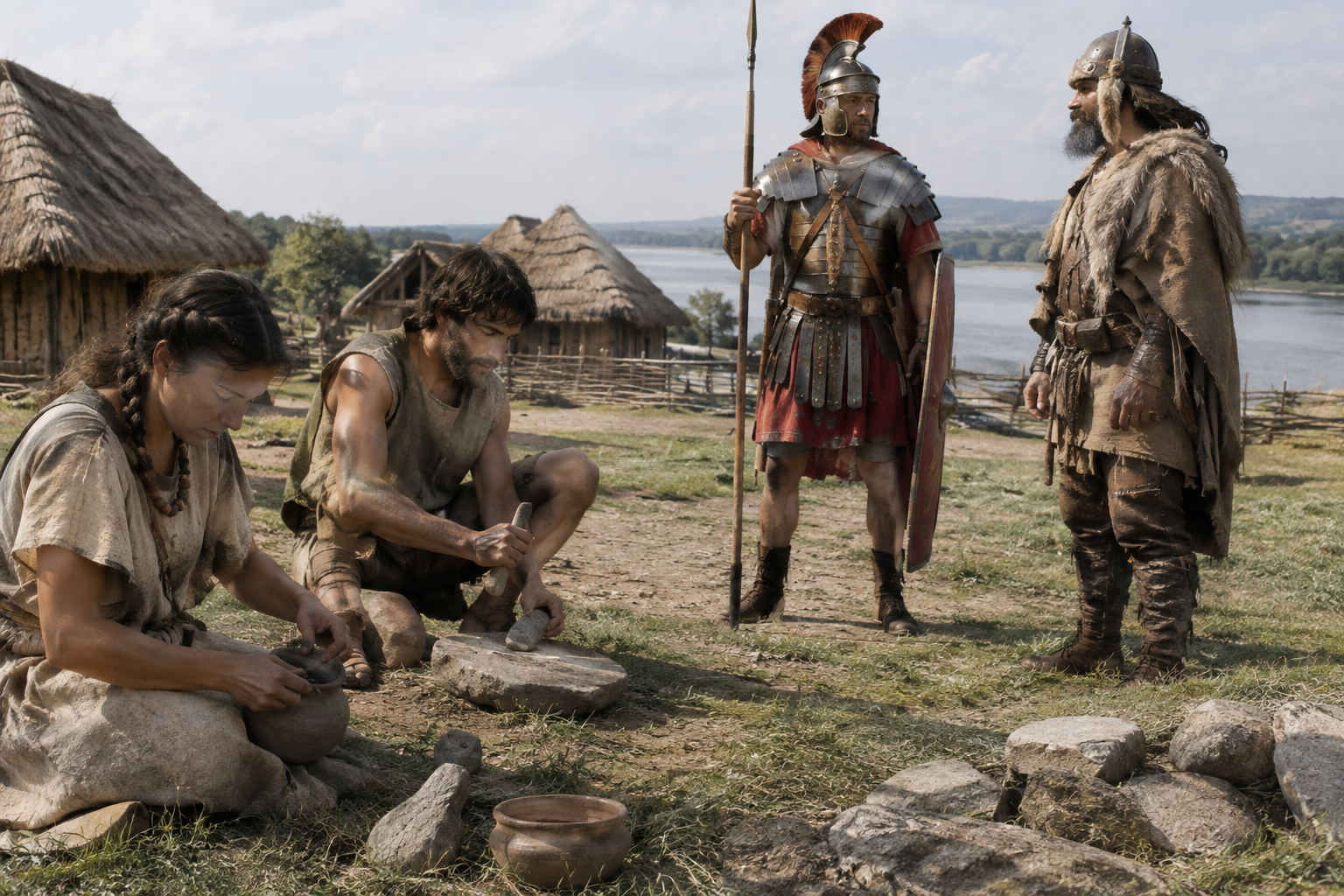
At Deriivka in Ukraine, one of the oldest entries linked here to haplogroup E1b1b1a1b1 is sample UKR102, dated to about 6397 BC. That is an arresting starting point, not because one burial can explain a whole lineage, but because it places this paternal branch in the north Pontic world very early indeed, in a landscape that would later become a corridor for farmers, herders, traders, raiders, and imperial armies.
The samples associated with E1b1b1a1b1 do not sit neatly inside a single people or a single migration event. Instead they appear across a striking series of archaeological settings: Neolithic Ukraine, Minoan Crete, Thracian and Scythian contexts around the Black Sea, Roman and late Roman sites in the Balkans, post-Roman and Avar-period Hungary, medieval Sicily, England, Belgium, Spain, and Russia. Y-DNA follows one direct paternal line only, not a person's total ancestry, but even that narrow line can be historically revealing when it turns up again and again at old crossroads.
Sample UKR102 from ancient Deriivka is the sort of find that forces us to slow down. A lineage now associated in many modern discussions with later Mediterranean and Balkan populations is already present far to the north of the Aegean in the 7th millennium BC. That does not mean continuity of one untouched male line in one fixed population. It does mean that the north Pontic zone was involved in very old population histories that are often flattened into simple steppe stories.
A study focused on mobility in Ukraine and the wider north Pontic region helps frame why this matters: these lands were not an empty stage waiting for Iron Age nomads or medieval kingdoms, but a long-used contact zone where populations mixed, shifted, and persisted over millennia across changing archaeological periods. For E1b1b1a1b1, Deriivka is less a point of origin than an early fixed pin on a map that will later grow crowded.
The densest cluster in this set lies around the western and northern Black Sea. There are Thracian-associated individuals from Kapitan Andreevo in Bulgaria, all around 800 BC - I20185, I19494, I20183, I20181, I20180, and I19495. There is also UKR007 from early Iron Age Kartal in the Odesa region, described as Thracian Hallstatt, and later Black Sea steppe-era individuals such as UKR091 and UKR089 from the Scythian hillfort of Bilsk in Poltava, dated around 450 BC and 400 BC.
This is precisely the sort of evidence that resists tidy ethnic labels. Thracian, Hallstatt-influenced, Scythian, and Greek-colonial worlds overlapped in this region. A paternal lineage like E1b1b1a1b1 appearing in several of them does not make it a "Thracian haplogroup" or a "Scythian haplogroup". It shows that male lines could pass between neighboring cultural spheres that archaeologists distinguish for good reasons, but which real human lives often ignored.
The Black Sea pattern becomes even more interesting when one adds I10166 from ancient Macedonian-era Idomenae Isar Marvinci Valandovo around 300 BC, I19500 from Iron Age Kazanlak in Bulgaria around 250 BC, and the much later UKR152 from Olbia. Olbia, of course, was one of the great Greek foundations on the north Black Sea littoral. Whatever the exact assignment depth for each man, the larger pattern suggests a paternal line comfortable in contact zones linking inland Balkans, steppe margins, and maritime colonies.
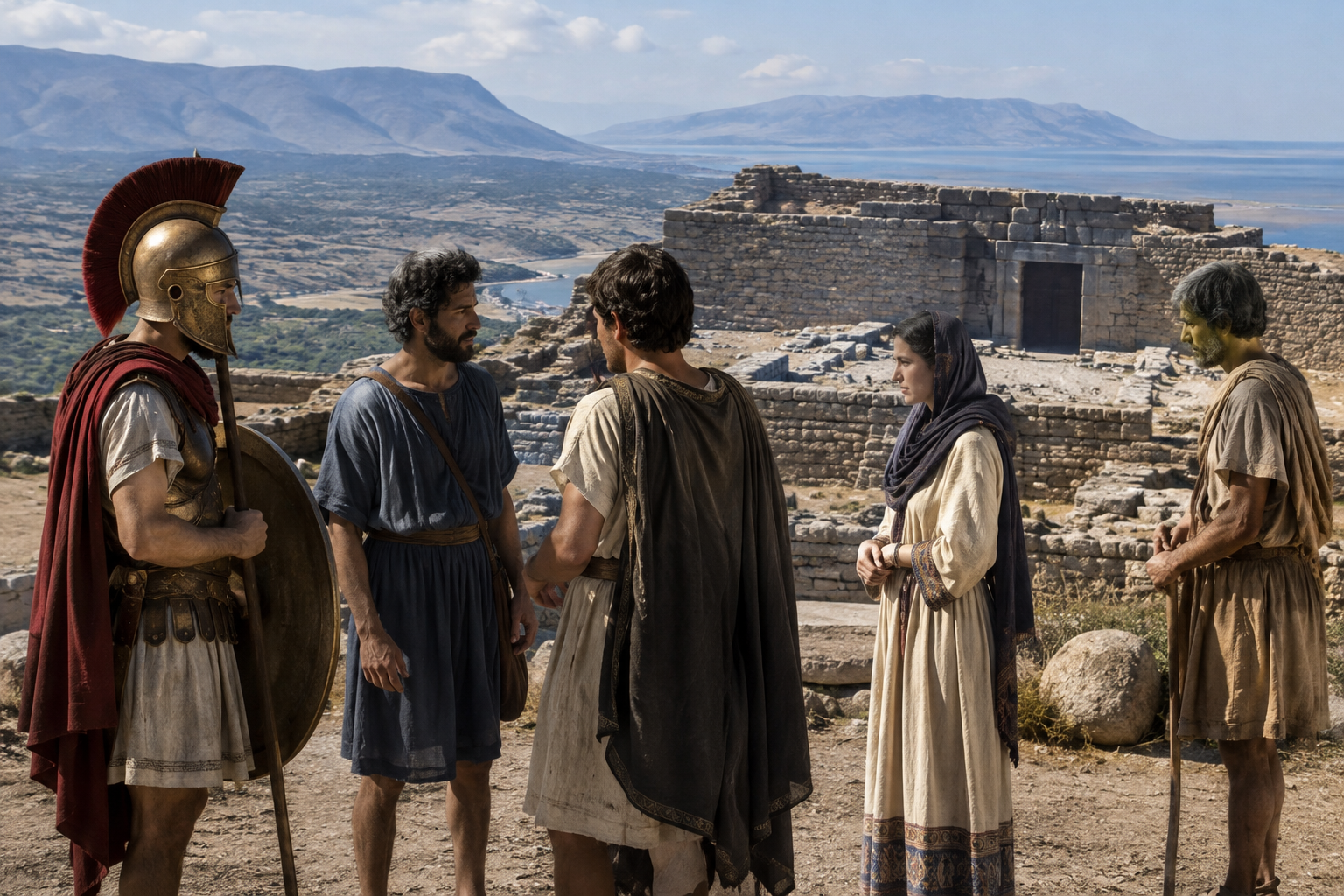
One of the most eye-catching older Mediterranean appearances is XAN016 from Chania, Crete, dated to about 1575 BC in the Minoan period. Here again, caution is needed: a single paternal line in Minoan Crete does not define the island's male population. But it does fit a wider picture in which the eastern Mediterranean was already deeply networked in the Bronze Age, with people, goods, and probably families moving between coasts and islands.
Further west, Sicily offers two very different contexts. Sample I12848 comes from Mozia in western Sicily, dated around 569 BC and described as a Hellenic-Carthago mix. Another, I17872, is an ancient mercenary from the First Sicilian War at Himera, around 480 BC. Those labels alone tell you enough to see the larger history: Sicily was no sealed island community, but a place where Greek, Punic, and other Mediterranean populations met in colonies, ports, garrisons, and battlefields.
Later on, the same branch appears again in medieval Sicily at Teatro di Segesta, sample SGBN20, dated around 1220 AD. That long arc, from classical and Punic Sicily to the medieval island, fits well with Sicily's documented role as one of the Mediterranean's great human mixing chambers. A recent MyTrueAncestry piece on the island's population history is especially relevant here.
If the Black Sea cluster shows regional depth, the Roman-era samples show imperial mobility. E1b1b1a1b1 appears in Viminacium in Serbia, with R6750 from around 150 AD and I15512 from the late Roman Empire at about 225 AD. It turns up in Roman and late Roman Croatia as R3745 from Zadar, BBC038 from Karlovac in Pannonia Savia, and I34296 plus I35009 from the Radoševic Palace site on Hvar around 400 AD. There is also I18792 from Boyanovo in Bulgaria and FVD009 from Fonyod in Hungary.
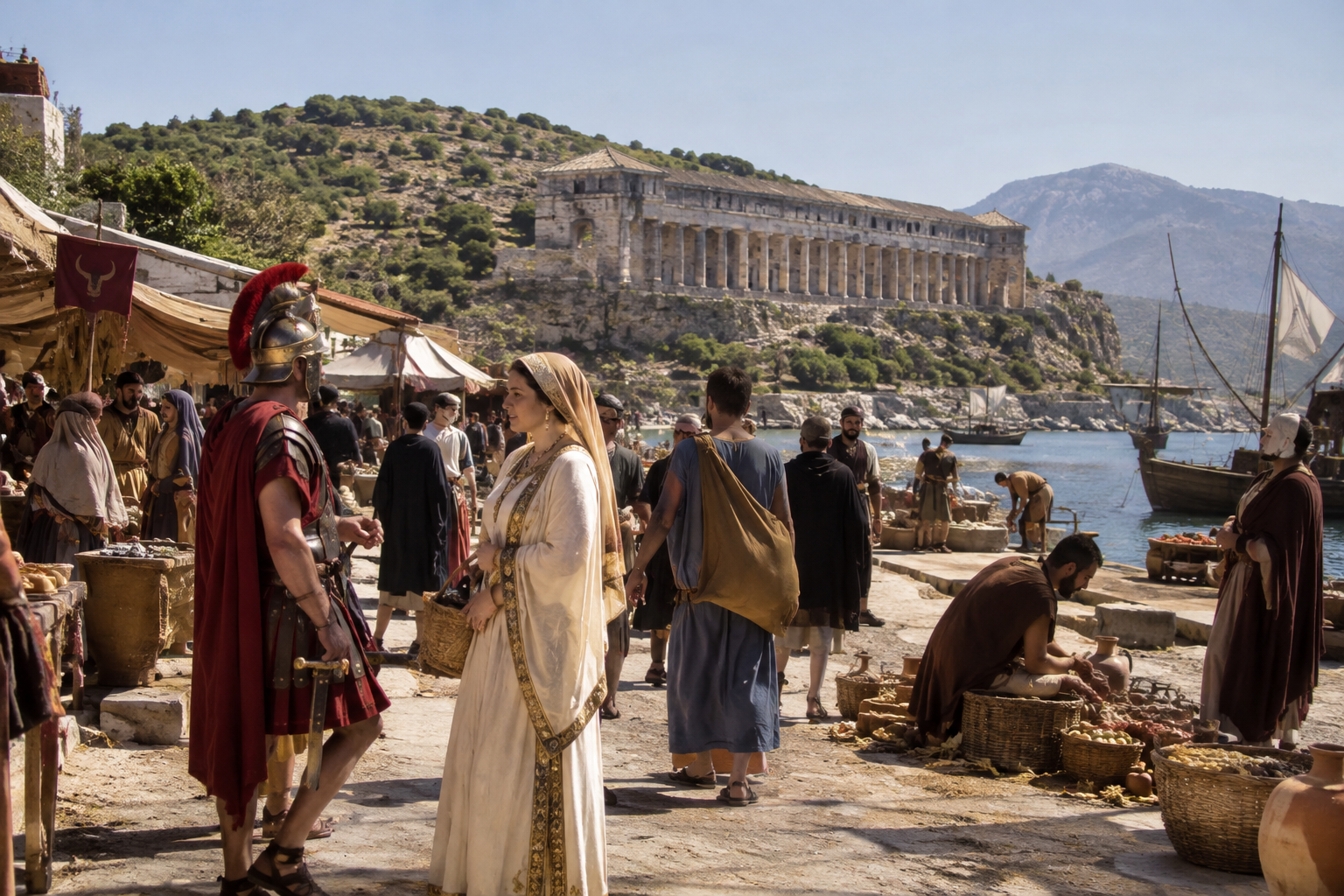
This is not surprising in historical terms. The Roman Balkans were threaded with roads, forts, ports, veteran settlements, towns, and administrative centers. Men moved through the empire as soldiers, merchants, laborers, officials, slaves, and descendants of all of the above. A paternal lineage found in this setting might represent local continuity in some cases and long-distance relocation in others; the archaeology matters site by site.
Research on ancient southeastern Europe has repeatedly shown that late antique communities were not biologically simple, and that older Balkan and eastern Mediterranean ancestry mixed in changing ways with newcomers from the north and east in region-wide ancient DNA work. That is exactly the historical background in which a branch like E1b1b1a1b1 becomes visible in multiple Roman and post-Roman cemeteries without belonging to just one imperial category.
The early medieval record is particularly varied. In Hungary, the branch appears in elite or high-status Avar and post-Roman contexts such as KUP021 from Kunpeszer around 609 AD, RKC003 and RKO016 from Rakoczifalva around 650 AD, and I20799 from Derecske-Hosszu around 750 AD. In the same broad era it also shows up in RTW002 from Rathewitz in Germany, I20396 from post-Roman Girona in Spain, and VEN008 from early medieval Venosa in Italy.
Then come the medieval town and cemetery finds: ST2363 at Sint-Truiden in Belgium around 1050 AD, ATP_PSN_27 at St John's Hospital, Cambridge around 1100 AD, PDH005 in the Duchy of Sandomierz around 1150 AD, SHE001 from medieval Shekshovo in Russia around 1000 AD, and I10853 from Sant Julia de Ramis in Girona around 1060 AD.
What is useful here is not a fantasy of one great migration carrying this exact branch intact from place to place. The useful point is that E1b1b1a1b1 repeatedly appears where medieval Europe was made: in frontier zones, hospital cemeteries, trading regions, post-imperial settlements, and politically mixed landscapes. It is a lineage that keeps turning up where people met.
On present evidence, E1b1b1a1b1 looks less like the signature of one narrowly bounded tribe and more like a durable paternal thread running through the Balkans, the Black Sea zone, the eastern and central Mediterranean, and parts of medieval Europe. The standout pattern is not prestige or purity, but persistence at crossroads: Deriivka, Bilsk, Kapitan Andreevo, Viminacium, Hvar, Sicily, and later medieval towns.
For someone researching this haplogroup today, that is the sensible historical takeaway. Your direct paternal line may connect most strongly to ancient populations shaped by movement around the Balkans and Mediterranean-facing worlds, but the ancient record also warns against simplistic labels. E1b1b1a1b1 appears in farmers, islanders, frontier communities, imperial provinces, and medieval urban cemeteries - a lineage not of one closed people, but of repeated historical contact.
Comments