Haplogroup I1a1

– 4 min read


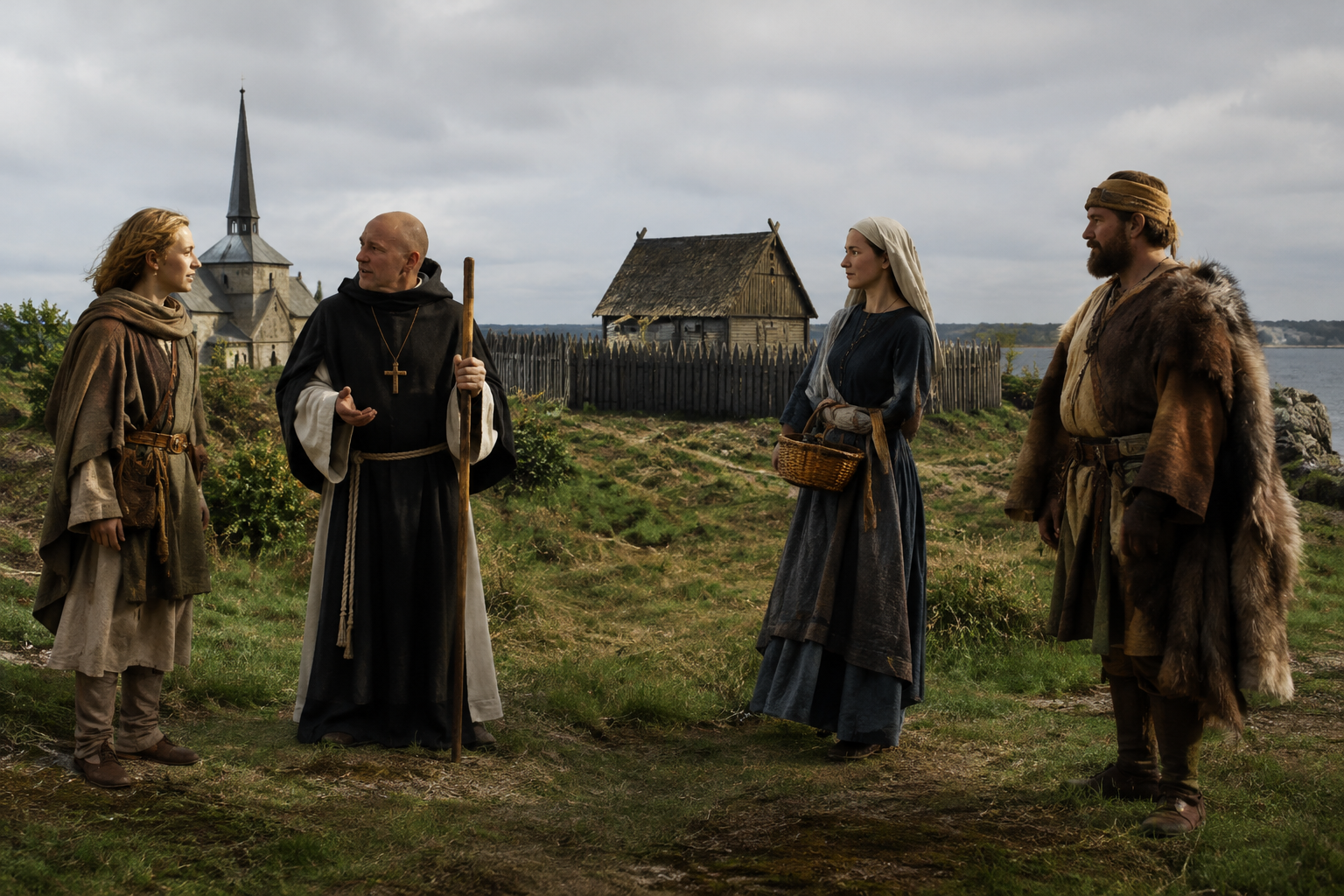
At Sandby borg on Oland, a ringfort destroyed in the 5th century AD, archaeologists uncovered one of the starkest frozen moments in Scandinavian archaeology: people left where they fell after a violent attack, their settlement never properly reoccupied. Among the men identified there is sample snb013, dated to around AD 475 and associated here with the Y-DNA haplogroup I1a1. That matters because it places this paternal line not in legend or later medieval genealogy, but in a real community caught in the upheavals of the Migration Period.
I1a1 is a branch within the wider I1 paternal haplogroup, a lineage long associated with northern Europe, especially Scandinavia. Y-DNA tracks one direct male line only, so it does not describe a person's whole ancestry, but in archaeology it can still be revealing. In this case, the supplied ancient samples sketch a striking arc: from a violent 5th-century ringfort on Oland, to Viking-Age strongholds and towns in Denmark and Sweden, and finally to a medieval friary in England.
Sandby borg is not just another Scandinavian settlement site. It belongs to that unsettling class of places where catastrophe preserved social reality. The fort's destruction belongs to a period when the old Roman world was breaking apart and northern Europe was being reshaped by shifting alliances, raiding, and local competition. A paternal lineage like I1a1 appearing here tells us that this branch was already present in eastern Scandinavian communities well before the Viking Age.
That point is worth pausing over, because modern discussions of northern lineages often jump straight to Vikings, as if everything began with longships. Sandby borg reminds us that the demographic foundations of later Scandinavian history were already in place centuries earlier. An ancient DNA study examining broad prehistoric and historic Scandinavian populations was published in Cell, and the wider pattern has consistently made clear that the north's genetic history reaches far deeper than the Viking centuries alone.
Gotland and Scandinavian Deep History
We should be careful not to turn one ringfort victim into a tribal mascot or dynastic founder. But snb013 does show that a line classified here as I1a1 was part of the human landscape of the Baltic islands in late antiquity. In historical terms, that places it in the centuries that set the stage for the later societies of Vendel and Viking Age Scandinavia.
The sample CGG106823, dated to about AD 975 from Viking Age Trelleborg in the Kingdom of Denmark, brings this lineage into a very different archaeological setting. Trelleborg is one of the famous Danish ring fortresses usually connected with the centralising monarchy of the late 10th century, often linked to Harald Bluetooth and the political consolidation of Denmark.
That does not mean every man buried or found there was a royal retainer, nor does a Y-chromosome result make anyone a court insider. Still, the setting matters. Here I1a1 appears in a world of planned fortifications, military organisation, and expanding royal power. The lineage is not just present in the background population of Scandinavia; it is visible in one of the emblematic sites of the Viking state's emergence.
A useful way to think about this is continuity with change. The paternal line seen at Sandby borg in the 5th century persists into a 10th-century Danish fortress world that was politically transformed but still deeply rooted in Scandinavian populations. The people changed, kingdoms formed, Christianity advanced, and yet some male lines remained part of that long regional story.
Denmark's Long Genetic Prehistory
If Trelleborg represents fortification and royal power, sample grt060 from St. Gertrud in Sigtuna, dated to around AD 1050, represents something else: town life in a Christianising and increasingly connected Scandinavian world. Sigtuna was one of early medieval Sweden's key urban centres, closely tied to kingship, commerce, minting, and the new ecclesiastical order.
The presence of I1a1 here is interesting precisely because Sigtuna was no isolated village. This was a place where regional elites, craftspeople, merchants, and clergy moved through a growing town tied into Baltic and wider European exchange networks. A paternal lineage turning up in such a setting suggests not merely survival from earlier Scandinavian populations, but participation in the new urban forms of the 11th century.
That broader Scandinavian transition from pagan-era power centres to Christian towns and churchyards is one of the most important shifts in northern European history. Research on medieval and Viking-Age Swedish burials continues to refine that picture, and a more recent ancient-DNA preprint on Swedish material can be found here. For I1a1, the key point is not a grand claim about ethnicity, but a grounded one: this paternal branch appears in Sweden during the period when Scandinavian society was being reorganised around towns, churches, and kingdoms.
Early Christian DNA in Scandinavia
The latest sample in this set, ATP_PSN_709, comes from the Augustinian Friars in medieval England and is dated to about AD 1290. This is a very different context again: not a ringfort and not a Viking fortress, but a religious house in a society shaped by centuries of Anglo-Saxon settlement, Viking activity, Norman rule, and constant movement across the North Sea.
By the late 13th century, an I1a1 line in England need not point to one single historical episode. It could reflect ancestry from earlier Scandinavian settlers in parts of England, from Anglo-Saxon era movements from the continental North Sea zone, or from later medieval mobility linking England with northern Europe. The point is not to force a single route, but to recognise that this haplogroup sits very comfortably within the connected world of the North Sea basin.
That is one reason the English friary sample is so useful. It shows how a paternal lineage with deep Scandinavian visibility also belongs to the mixed medieval populations of Britain. By this stage, old distinctions between "Viking," "Anglo-Saxon," and local English descent were often blurred in real family histories, however clear they may appear in textbooks.
North Sea Migrations to Britain
With only four ancient samples, caution is essential. But these four are unusually coherent. They place I1a1 in eastern and southern Scandinavia from late antiquity through the Viking Age, and then in medieval England within the wider North Sea world. That is not proof of one unbroken family line, of course; it is evidence of a durable paternal branch repeatedly appearing in historically meaningful northern European settings.
For someone researching I1a1 today, that is probably the most responsible takeaway. This haplogroup's ancient visibility fits well with Scandinavian and North Sea history: Migration Period communities, Viking-Age state formation and urbanisation, and medieval movement into England. It is a lineage best understood not through fantasy pedigrees, but through real sites, real burials, and the long, complicated human traffic of northern Europe.






Comments