Haplogroup G2a2

– 5 min read


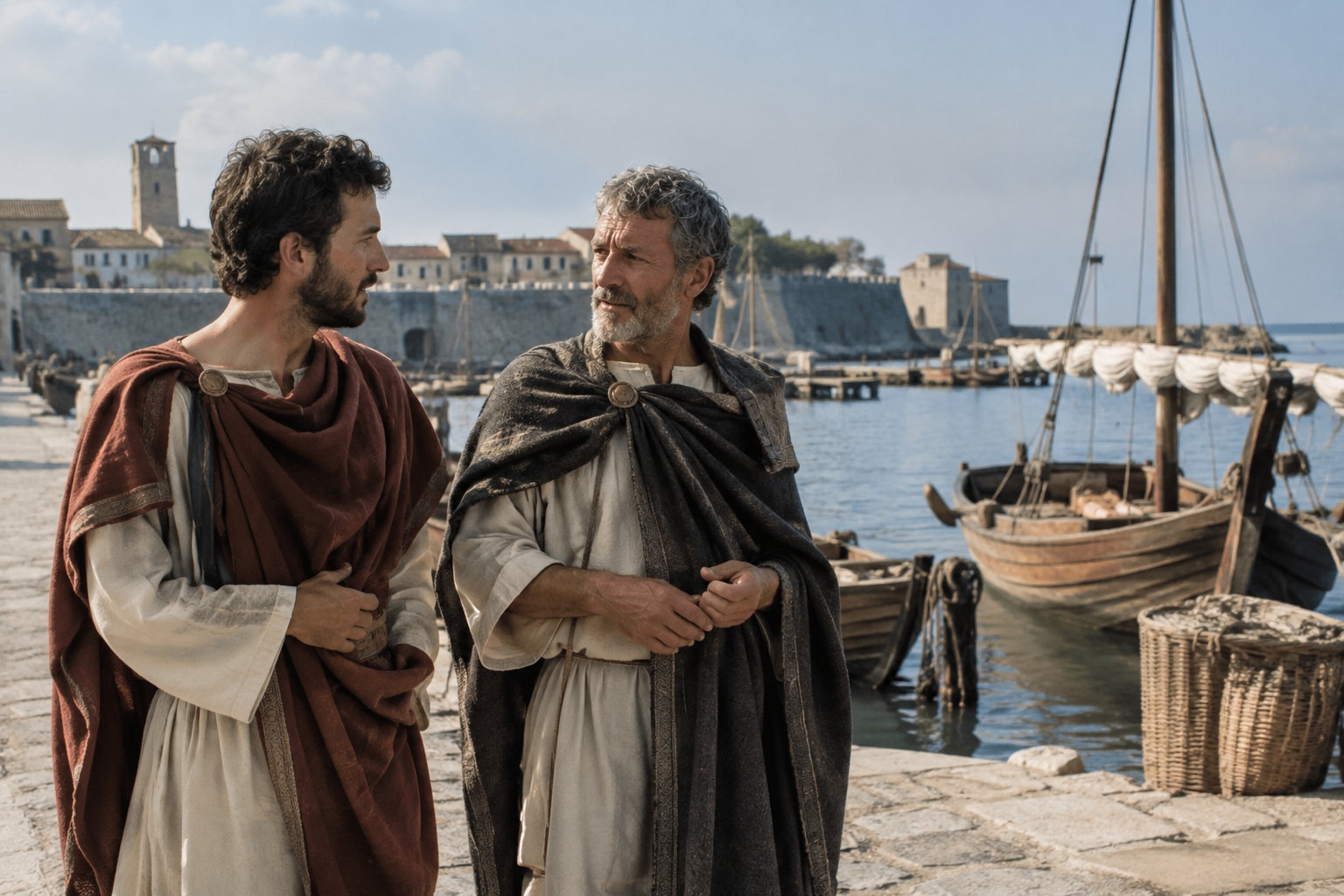
In the material from post-imperial Pesaro on Italy's Adriatic coast, two men dated to around AD 600 stand out for a very simple reason: both are reported under the Y-DNA haplogroup G2a2. Their sample IDs, PF28 and PF32, do not come with the sort of lavish archaeological biography historians dream of. But even that sparseness is revealing. In a period when Italy was no longer Roman in the old imperial sense and not yet anything like a unified medieval kingdom, these two paternal lines hint at continuity, survival, and the mixed human landscape of the early Middle Ages.
That matters because G2a2 has a long and rather distinguished prehistory in Europe. It is one branch within the wider haplogroup G, a paternal lineage especially famous in ancient-DNA work for its strong association with many early farming communities of Neolithic Europe. Y-DNA tracks one direct male line only, not a person's whole ancestry, but when G2a2 appears in early medieval Italy it raises an interesting historical question: are we looking at a lingering paternal thread from very old Mediterranean and European populations, or at one of the many later redistributions of people around the Roman and post-Roman world?
Pesaro, on the Adriatic side of central Italy, sat in a region that had seen centuries of movement before these men were buried there. Roman administration, military traffic, trade across the sea, and then the political upheavals of Late Antiquity all passed through this coast. By around AD 600, communities here were living in a world shaped by the collapse of western imperial institutions, Byzantine attempts to retain influence, and the presence of new post-Roman powers in Italy.
So PF28 and PF32 should not be imagined as representatives of a sealed-off local tribe or a single ethnic bloc. Early medieval cemeteries in Italy often belong to societies already layered by centuries of mobility. Two G2a2 males in the same broad setting may indicate a local paternal presence that persisted through the end of Roman rule, but they do not by themselves prove close kinship, a dynasty, or a single-origin migration story.
A genetic study of ancient Italian populations and their transition from Roman to early medieval settings is exactly the kind of research frame in which such individuals become useful evidence, and one recent research lead connected with these burials is available here: https://www.biorxiv.org/content/10.1101/2024.03.18.585512v1.
Among ancient European Y-chromosomes, G lineages are archaeologically famous because they appear so often in Neolithic farmers. That does not mean every later G2a2 man in Europe was a straightforward untouched descendant of the first farmers; history is never so neat. But it does mean that when this branch turns up in later periods, it can preserve a paternal strand with very deep roots in Europe's agricultural past.
In Italy that possibility is especially tantalising. The peninsula was a meeting point rather than a genetic island. Neolithic settlers arrived by sea and overland; later came Bronze Age changes, Iron Age regional cultures, Roman expansion, imperial immigration, and post-Roman restructuring. A G2a2 lineage in AD 600 could therefore represent continuity from much older inhabitants, survival of a minority paternal line through repeated social change, or reshuffling within Mediterranean networks that had already mixed populations for millennia.
One of the big lessons from archaeogenetics in Italy is that continuity and change usually coexist. Some regions preserve striking links to earlier local populations; others show clear signs of newcomers; many display both at once. That is why a lineage like G2a2 is historically valuable. It refuses the easy story in which every early medieval burial in Italy must belong either to "locals" or to dramatic incoming groups.
Instead, PF28 and PF32 sit in the awkward, interesting middle ground where real history usually lives. Their Y-DNA belongs to a branch with deep time depth in Europe, but their lives unfolded in a period shaped by imperial retreat, Christianisation, military reorganisation, and shifting political control. A paternal lineage can be old, while the society carrying it is thoroughly transformed.
The Adriatic was not a backwater. It linked Italy to the Balkans and the eastern Mediterranean, and in the centuries around AD 600 these connections could matter enormously. Troops, clerics, merchants, refugees, and administrators moved through coastal zones with a frequency that written sources only partly capture. Genetics has become one of the best ways of testing how mixed or stable such communities really were.
That broader setting makes the Pesaro evidence more suggestive than it first appears. If two men from the same post-imperial Adriatic context carried G2a2, that may point to a lineage established enough to recur locally in the burial record. It does not let us write a family tree, but it does suggest that old paternal lines were still part of the demographic fabric of the coast during the centuries after Rome's western empire had fallen apart.
Comparable work elsewhere in post-Roman Europe has repeatedly shown that burial communities were often more diverse than older historical labels implied. The headline might say "Gothic," "Lombard," "Roman," or "Byzantine," but the people in the ground could carry a much wider range of ancestries and paternal histories.
Because the available details are limited, the safest way to read PF28 and PF32 is as a small but useful cluster. They show that G2a2 was present in post-imperial central Italy on the Adriatic in the early medieval period. That alone is worth noting, because many public discussions of ancient European Y-DNA become dominated by later Bronze Age and Iron Age expansions, while older paternal branches can seem to vanish from the story. Often they did not vanish at all; they simply persisted at lower frequencies and in more regionally varied ways.
There is also a methodological lesson here. Ancient DNA becomes especially powerful not only when we have royal tombs or spectacular grave goods, but when ordinary or lightly documented burials accumulate into patterns. Two men from the same place and period do not solve the history of G2a2 in Italy. They do, however, anchor that history in real individuals from a recognisable historical landscape.
For readers following the wider Roman and post-Roman genetic story in Iberia as well as Italy, there is a useful comparison in how long-lived local lineages interacted with imperial and migration-period changes.
Roman Hispania's genetic legacy
If your own Y-DNA falls under G2a2, the Pesaro burials offer a sober but fascinating clue. This is a paternal branch that can appear in early medieval Italy not as an exotic intrusion, but as part of the lived population of a post-Roman Adriatic community. Its deeper history is often associated with Europe's first farmers, yet these samples show that such lineages remained woven into much later societies shaped by Rome's collapse and the making of medieval Europe.
That is perhaps the most interesting thing about G2a2: not that it belongs to one famous people, but that it survived repeated historical upheavals and still surfaces in the graves of real men living through one of Italy's great transitions.
Comments