Haplogroup R1b1a1a1a

– 4 min read


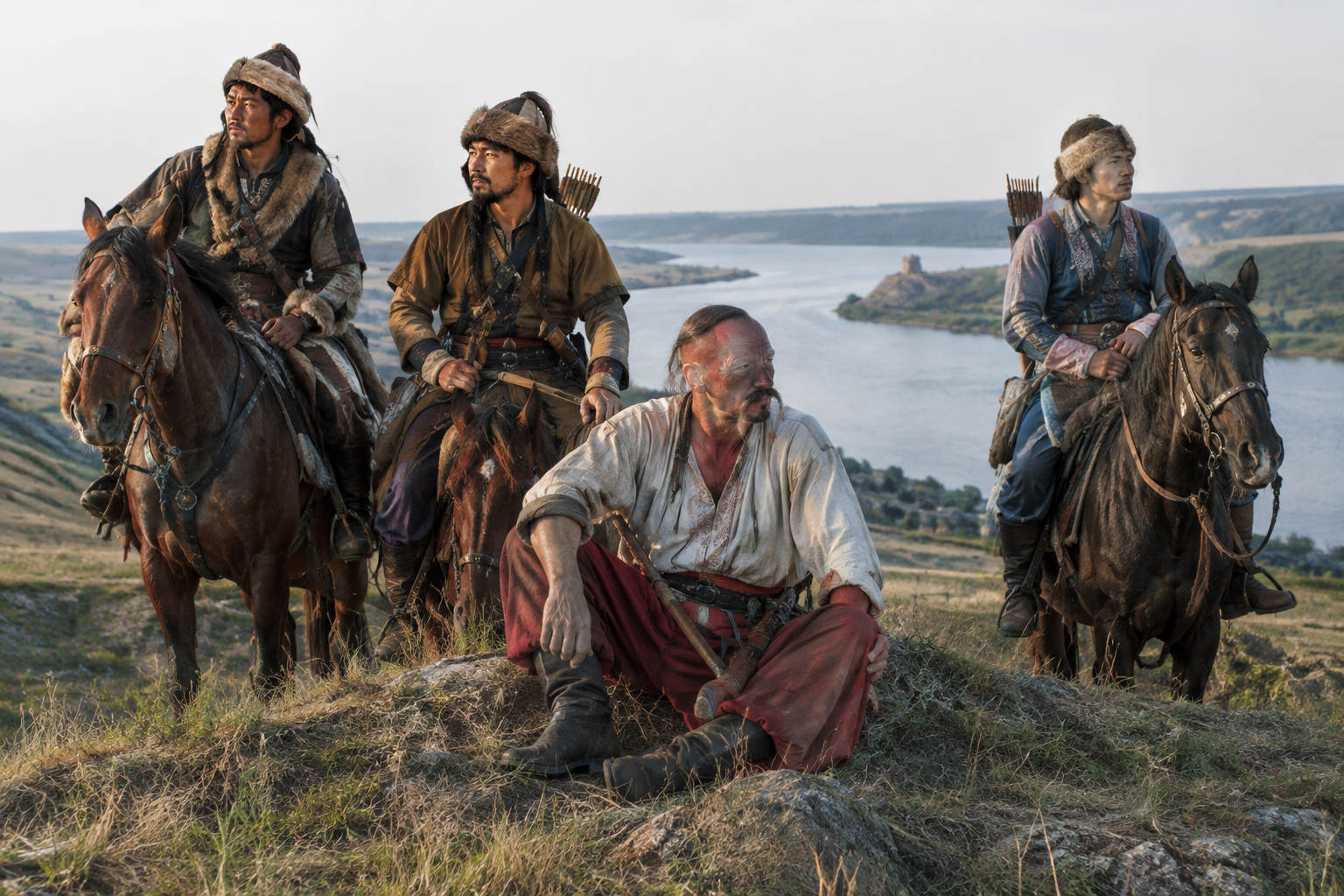
At Mamay-Gora in the Zaporizhzhia region of Ukraine, one medieval burial adds a sharp little point of focus to a much larger history of movement across the steppe. The individual known as UKR016, dated to about AD 1450, belongs to the Y-DNA haplogroup R1b1a1a1a. That label is not a biography, of course, but it does place one direct paternal line inside a landscape long shaped by trade, raiding, migration, and political upheaval along the northern Black Sea.
What makes this particularly interesting is that UKR016 does not stand alone in the material supplied here. Two earlier steppe-associated males, DA93 from around AD 732 and DA87 from around AD 800, are linked to Turkic and Kimak contexts and are also associated with the same broad paternal branch. Taken together, these finds do not tell a simple tale of one people marching in one direction. They suggest something more historically plausible: that a paternal line within the wider R1b family could persist across changing steppe worlds, appearing under different political and cultural labels over several centuries.
By the fifteenth century, the lower Dnieper and the wider Zaporizhzhia zone were frontier country in the fullest historical sense. Powers rose and receded here; populations mixed; identities could be local, mobile, military, pastoral, or imperial, sometimes all at once. A genetic study touching on mobility in Ukraine across long time spans helps frame that broader setting without turning one burial into a grand ethnic verdict: research on the North Pontic crossroads underlines just how connected and changeable this region was.
Within that world, UKR016 matters because he anchors haplogroup R1b1a1a1a in a concrete medieval context on the north Pontic frontier. Y-DNA traces one strictly paternal line, not a person's total ancestry, language, or political loyalty. Still, a securely placed male line in a region like this is historically useful: it shows that this branch was present in a zone where Slavic, Turkic, steppe, and Black Sea influences continually overlapped.
R1b1a1a1a is a sub-branch within the much larger R1b haplogroup, one of the best-known paternal lineages in western Eurasia. But that broad fame can be misleading. A narrower branch should not automatically inherit every migration story ever told about R1b as a whole, and in this case the evidence in front of us is medieval and steppe-centered rather than prehistoric and universal.
So the safe historical point is this: the article's branch appears here in males connected with the Eurasian steppe and the north Pontic region between the eighth and fifteenth centuries AD. That is already interesting enough. It places this paternal line in the world of mounted mobility, frontier exchange, and shifting confederations, rather than leaving it as an abstract code on a chart.
The earlier sample DA93, dated to around AD 732 and described as belonging to a Turkic tribe of the steppes, offers the first of the article's earlier anchor points. This date falls in a period when steppe confederations were politically active across Inner Eurasia, and when male lines could spread through alliance, incorporation, conquest, and ordinary family continuity.
That is important because steppe societies were rarely closed biological blocks. They were often composite political formations. A Y-line found in a Turkic-labeled context need not mean the lineage "originated" as Turkic in any simple sense; it shows that by the eighth century this paternal branch was already part of a community identified within that historical sphere.
A major ancient DNA study of the Eurasian steppe, published in Science Advances, helped establish just how mixed and dynamic these populations could be over time: research on ancient genomes from the Eurasian steppe. Without forcing DA93 into a bigger claim than the evidence supports, that wider work is a useful reminder that steppe history is full of blending, replacement, and persistence all at once.
The sample DA87, dated to around AD 800 and identified with the Kimak Turkic world, adds a second and slightly different setting. The Kimaks are historically associated with the steppe belt of Central Eurasia, and their appearance here broadens the picture beyond a single place or episode. We are no longer looking at one isolated burial, but at a paternal branch that shows up in more than one early medieval steppe context.
That does not prove a continuous documented family line between DA93 and DA87, let alone between those men and UKR016 centuries later. What it does suggest is durability. Haplogroup R1b1a1a1a was present among men living inside Turkic political and cultural environments at a time when the steppe was being reorganized repeatedly by new unions and rival powers.
The Kimak connection also helps correct a common misconception. People often imagine Y-DNA branches as belonging neatly to one modern nation or one ancient ethnicity. Steppe archaeology keeps spoiling that tidy picture. The same paternal branch can pass through different languages, alliances, and ruling structures while remaining biologically continuous down the male line.
If we place DA93, DA87, and UKR016 side by side, the most striking feature is not a straight-line migration map but a corridor of recurrence. The steppe and the north Pontic region formed one of Eurasia's great connective zones. Goods moved through it, armies crossed it, captives were resettled within it, and pastoral groups shifted across it seasonally and politically.
In that setting, the reappearance of R1b1a1a1a across several centuries makes historical sense. A paternal lineage could survive because families survived, because confederations absorbed earlier groups, and because steppe societies often preserved male descent within otherwise fluid populations. The labels changed: medieval Ukrainian, Turkic tribe, Kimak. The direct paternal signal remained.
For readers with ancestry in eastern Europe, the Black Sea zone, or the wider Eurasian steppe, that is the real value of these ancient matches. They do not assign one fixed identity to the haplogroup. They show that this branch participated in worlds where identities were layered, mobile, and often negotiated on frontier ground.
Haplogroup R1b1a1a1a emerges here not as a badge of one kingdom or one dynasty, but as a line repeatedly visible in the medieval steppe zone from early Turkic contexts to late medieval Ukraine. That is a modest conclusion, but a valuable one. If this is your paternal haplogroup, the strongest supported insight from these samples is that your line belongs to a branch that was present in the mobile, mixed, and politically restless societies of the Eurasian steppe and the north Pontic frontier.






Comments