Polovtsian Burial at the Krasny IV Kurgan Cemetery
– 5 min read


Polovtsian Burial at the Krasny IV Kurgan Cemetery: Archaeological and Genetic Analysis
This comprehensive study examines one of the most remarkable discoveries from the Krasny IV kurgan cemetery in the Rostov region: kurgan 16, burial 3. This richly furnished Polovtsian grave provides an extraordinary glimpse into life, status, and identity on the medieval Eurasian steppe, combining detailed archaeological analysis with cutting-edge ancient DNA research to reconstruct both individual biography and broader population histories.
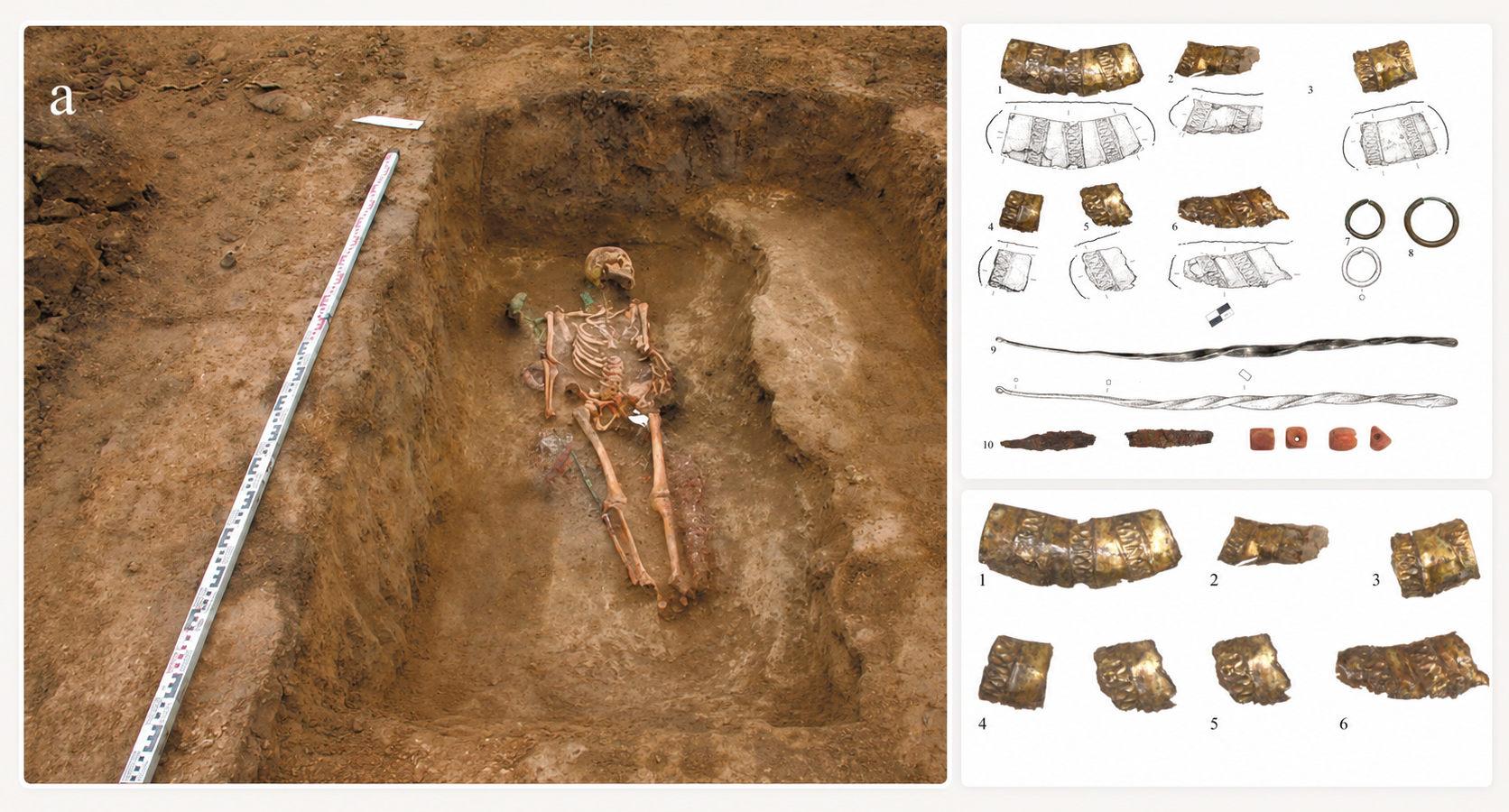
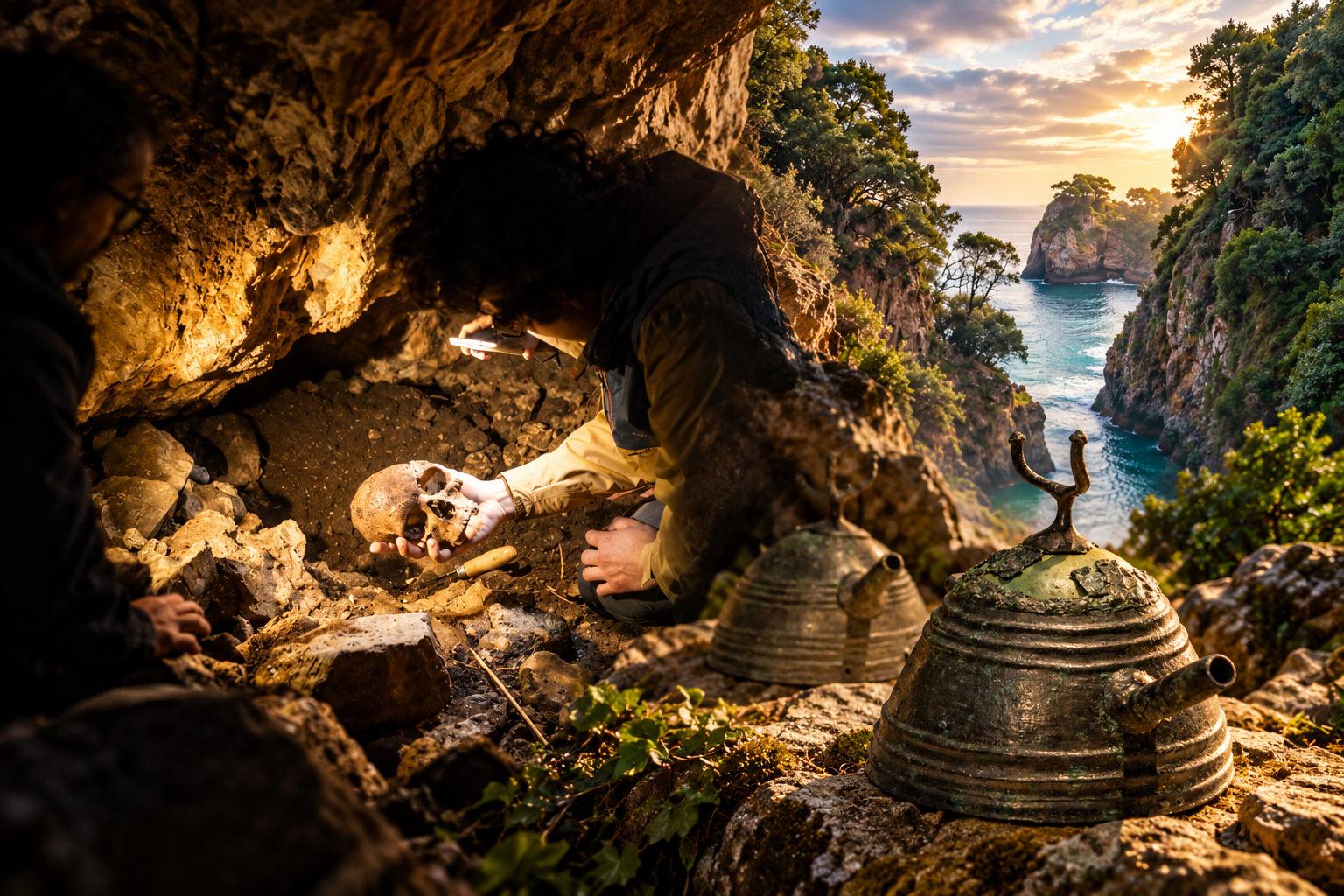
The burial chamber at Krasny IV was no ordinary grave. After meticulous excavation and cleaning, archaeologists uncovered a carefully staged funerary scene containing a remarkable assemblage of personal items. The grave goods included bronze fastening rings, gilded bronze plates from a braid ornament, a fragment of fabric, amber beads, chalk, a wooden object likely belonging to a scabbard, a silver neck ring, and fragments of an iron knife blade. These artifacts collectively create a vivid portrait of a carefully dressed and ceremonially equipped individual.
The most striking element is the gilded braid ornament, whose plates and fittings suggest an elaborate hairstyle or headdress decorated with gleaming metal pieces that would have caught the light and marked the wearer's high status in life as well as death. The silver neck ring reinforces this impression of display and prestige, while the amber beads introduce notes of color and evidence of long-distance trade networks. Even the fragmentary iron knife hints at the practical world this individual once inhabited.
Particularly remarkable is the survival of perishable materials. A fabric fragment provides rare evidence of clothing or burial wrapping, while the wooden find, probably from a scabbard, reminds us that much of steppe material culture was made from organic materials that typically vanish without trace. The presence of chalk in the grave adds another intriguing dimension, possibly indicating ritual purification, marking, or other ceremonial actions performed at the graveside.
The excavation documentation through detailed plans and photographs allows reconstruction of how the body was positioned and equipped. This was clearly not a hurried burial but a ceremonial farewell that spoke of identity, appearance, and ritual care. The individual emerges not as an anonymous skeleton but as someone once adorned with decorated braids, wearing precious jewelry, and accompanied by both practical tools and symbolic objects.
The scientific analysis faced a crucial challenge: proving the authenticity of ancient genetic material and extracting meaningful historical information from it. Ancient DNA typically survives in highly degraded fragments and can easily be contaminated by modern handling. The research team examined the DNA for characteristic age-related damage patterns, particularly the chemical deterioration that appears near fragment ends over time.
The genetic material from the Krasny IV burial, designated Pol01, displayed exactly the damage profile expected from genuinely ancient DNA. This authentication was essential because it acts as a temporal signature, confirming that the sample represents medieval rather than modern genetic material. With authenticity established, the team could proceed to place this individual within the broader context of Eurasian population history.
The genomic analysis compared Pol01 with an extensive database of ancient and modern populations from across the steppe zone and beyond. This included medieval groups from Kazakhstan, Kyrgyzstan, Mongolia, Hungary, southern Russia, and the North Pontic region. The comparative approach revealed that the Krasny IV individual did not represent an isolated local population but belonged to the interconnected world of medieval Eurasian nomadic peoples.
Analysis of mitochondrial DNA revealed that the Krasny IV individual belonged to haplogroup T1a5, a specific branch of maternal ancestry that can be traced through detailed phylogenetic reconstruction. This maternal lineage provides another thread connecting this single burial to broader patterns of human movement and kinship across medieval Eurasia. The phylogenetic tree places the individual precisely within this maternal branch and shows relationships to both ancient and more recent samples.
The mitochondrial evidence complements the archaeological findings by adding a biological dimension to questions of identity and origin. While the grave goods speak of cultural affiliation and status display, the maternal lineage reveals deeper ancestral connections that may reflect centuries of population movement, intermarriage, and cultural exchange across the steppe zone.
The most historically significant findings emerge from comparing Pol01 with medieval steppe populations across Eurasia. The individual shows strongest genetic affinities with groups associated with the broader Kipchak-Cuman world, including medieval burials from Kazakhstan such as Lisakovsk-1 and Nurataldy-2, Ukrainian sites including Kumy, Mamay-Gora, and Velyka Znamianka, and related populations from the Carpathian Basin and Central Asia.
These connections are historically compelling because they link the Krasny IV burial to the wider network of medieval nomadic confederations. Rather than representing a purely local population, the genetic evidence suggests participation in the mobile, interconnected world that stretched from the Pontic steppe to the Tian Shan mountains. The comparisons include sites from Xinjiang, Mongolia, and Hungary, emphasizing the continental scale of these population networks.
Particularly striking are the genetic similarities with Kipchak-era individuals from Kazakhstan and Cuman burials from Ukraine. Since historical sources often treat Polovtsians and Cumans as closely related or overlapping groups, these genetic affinities provide biological confirmation of suspected historical connections. The Krasny IV burial thus represents not an isolated regional phenomenon but one manifestation of a broader Kipchak-Cuman world spanning vast distances.
The integration of archaeological and genetic evidence creates an unusually rich portrait of medieval steppe life. The burial goods reveal an individual of evident status and cultural sophistication, buried with elaborate ornaments, precious metals, exotic materials, and practical equipment that speak to both local identity and long-distance connections. The genetic analysis places this person within the broader tapestry of medieval Eurasian nomadic populations, revealing biological ties that mirror the archaeological evidence for cultural and economic networks.
What makes this study particularly significant is how it transforms our understanding of individual agency and identity in the medieval steppe world. The Krasny IV individual was not simply a representative of some abstract population group but a real person whose life story encompasses elements of dress and adornment, craft specialization, trade relationships, and kinship networks that extended across continents.
The kurgan cemetery itself represents a landscape of memory where burial mounds served as visible markers in an open world of movement and horizons. Within this setting, the elaborate furnishing of burial 3 in kurgan 16 speaks to community investment in ritual display and the preservation of social memory. The combination of local burial traditions with far-reaching genetic connections exemplifies the complex dynamics of medieval steppe societies.
This research demonstrates how modern scientific techniques can breathe life into archaeological discoveries, transforming ancient remains into vivid historical narratives. The individual from Krasny IV emerges not as a silent artifact but as a participant in the dynamic, interconnected world of medieval Eurasia, where local communities maintained distinct identities while participating in continental networks of exchange, migration, and cultural transmission. Through careful integration of material culture studies and population genetics, we can begin to reconstruct the lived experiences of people whose stories were previously accessible only through fragmentary historical records and archaeological traces.
 Храпов С.Е.
Comments