Haplogroup R1b1a1b1a1a2c1a4b2d1a

– 5 min read


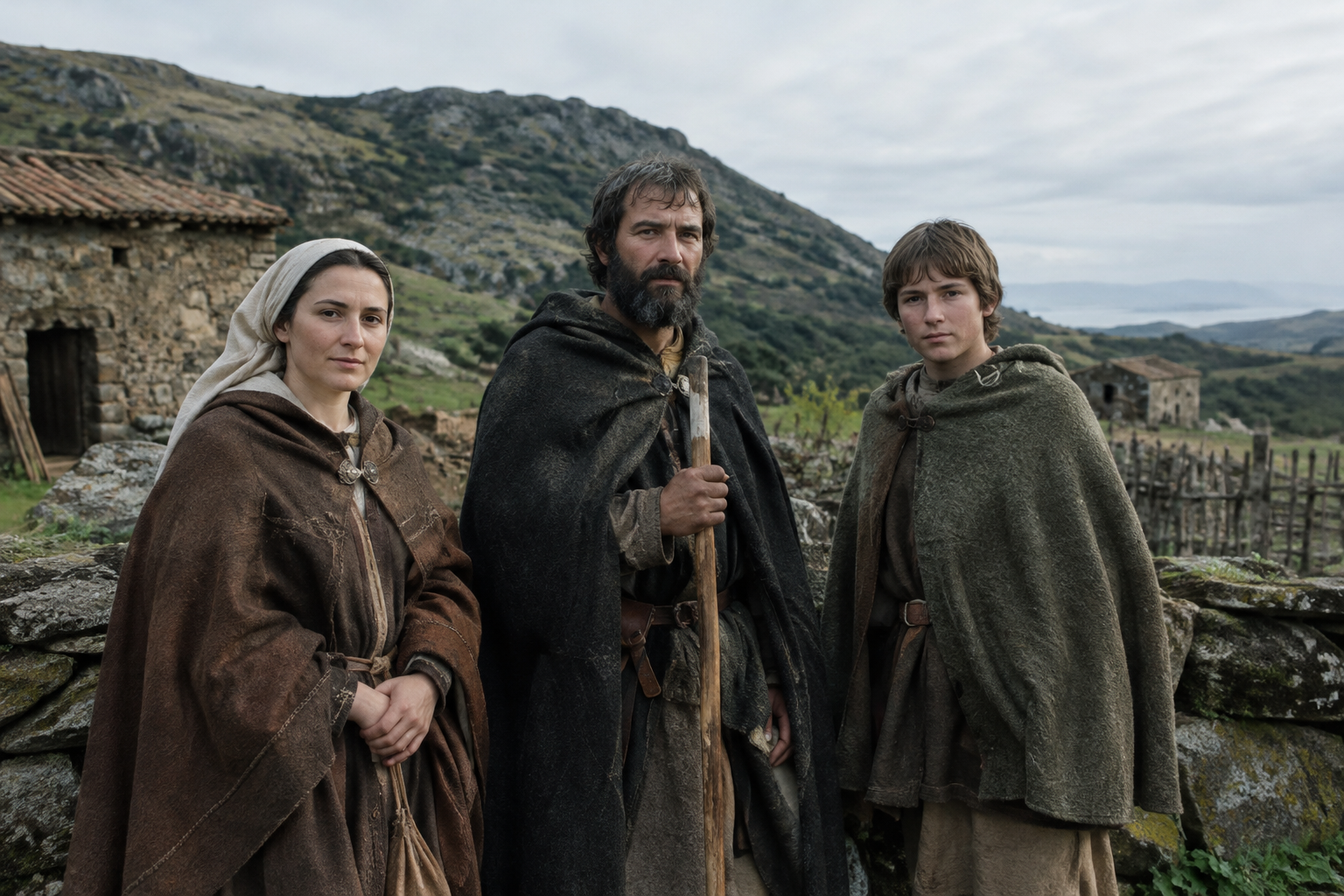
At Las Gobas in northern Spain, three medieval male individuals dated to about AD 1000-1025, identified as ldo056, ldo056a, and ldo056b, have been associated with the Y-DNA haplogroup R1b1a1b1a1a2c1a4b2d1a. That may look like an intimidating string of letters and numbers, but archaeologically it matters because it anchors a very specific paternal line in a real community, at a real site, in the centuries when the Christian kingdoms of Iberia were consolidating their hold across the north.
Las Gobas is interesting precisely because it is not a royal tomb or a famous battlefield. It is the sort of place that lets ancient DNA speak about ordinary historical population structure rather than dynastic legend. Y-DNA traces one direct male line only, not a person's whole ancestry, but repeated appearances of the same broad paternal background in one medieval setting can still tell us something useful about continuity, kinship patterns, and the male-line makeup of a local population.
The Las Gobas material places this branch in a frontier-shaped world of villages, churches, burial grounds, and shifting political boundaries. Around AD 1000, northern Spain was not a blank slate waiting for "Reconquista" narratives to tidy it up. It was already a layered landscape, carrying Roman legacies, Visigothic and post-Visigothic transformations, and centuries of interaction across Christian and Islamic polities.
The three individuals linked here, ldo056 from about AD 1000 and ldo056a and ldo056b from about AD 1025, come from that historical setting. Even without inventing family ties or grave details that are not in evidence, the cluster is striking. We are not looking at one isolated paternal signal, but at multiple men from the same region and near the same period associated with the same narrow lineage label.
An ancient DNA study investigating burials from this broader regional context is available through this research paper. For readers of Iberian archaeogenetics, the value of such work lies in showing how medieval communities can preserve both local continuity and the effects of earlier migrations, conquests, and social reorganization.
The haplogroup in this article, R1b1a1b1a1a2c1a4b2d1a, is a highly specific branch within the much broader R1b family, one of the major paternal lineages found across western Europe. That broader fact, however, should not be flattened into a simplistic story. A medieval man in northern Spain carrying this narrow subclade was not automatically "Celtic," "Roman," "Visigothic," or anything else on the basis of Y-DNA alone.
What the Las Gobas samples do provide is a securely medieval occurrence of this paternal branch in Iberia. That is valuable because so much discussion of Y lineages tends to leap straight from prehistory to the present, skipping the thousand years in which local populations were being reshaped by lordship, church organization, warfare, migration, and inheritance. Medieval burials help fill that gap.
It is also worth keeping the resolution issue clear. The article haplogroup is extremely precise, but ancient DNA coverage sometimes supports broader or narrower confidence depending on the sample and analysis. In cases like this, the safest reading is that these Las Gobas men are reported in association with this branch, while the larger historical importance lies in the repeated paternal signal at the site rather than in any grand claim about a single founding ancestor.
Three individuals from one medieval Spanish site associated with the same paternal branch raise an obvious possibility: local male-line persistence. That does not prove these men were close relatives, still less that they formed a ruling family. But it does suggest that this lineage was not a one-off arrival. In practical historical terms, that can point to a stable community in which particular paternal lines remained embedded across generations.
This matters in the archaeology of early medieval and high medieval Iberia because many communities were negotiating continuity and change at the same time. Some places show movement and mixture; others seem to retain deeper local roots. A site like Las Gobas gives us a glimpse of how paternal lines could endure within a settlement history that was anything but static.
There is another reason not to dismiss such evidence as merely local. Medieval social life was organized through households, landholding, parish structures, and inheritance. Recurrent Y-DNA at one site can therefore illuminate the long, patient mechanics of population history: who stayed, who married in, and which male lines continued to be represented in burial grounds over time.
Roman Hispania's Genetic Legacy
To understand why a lineage like R1b1a1b1a1a2c1a4b2d1a appears in medieval northern Spain, one has to think less in terms of single invasions and more in terms of accumulation. Roman Hispania did not vanish when imperial administration weakened. Roads, estates, town networks, Christianity, and patterns of settlement continued to shape post-Roman life. Later political upheavals worked on top of those structures rather than replacing them wholesale.
That is especially relevant in the north, where mountain zones, valleys, and local strongholds often preserved communities through long periods of change. By AD 1000, the people buried at places like Las Gobas were heirs to many centuries of regional history: prehistoric Iberian foundations, Roman integration, post-Roman fragmentation, and medieval consolidation. A Y-chromosome lineage surviving there is part of that deep local story, not a shortcut around it.
Recent MyTrueAncestry coverage of Iberian population history has repeatedly shown that the peninsula was genetically varied and historically connected, rather than divided into neat and timeless blocks. The Las Gobas samples fit that broader picture well. They place this paternal branch in a documented medieval community rather than in an abstract map of modern frequencies.
The most useful question raised by ldo056, ldo056a, and ldo056b is not "who was the first man with this haplogroup?" but "how did particular paternal lines persist through Iberia's medieval transformations?" That is a more archaeological question, and a better one. It asks us to connect DNA with settlement history, burial practice, and regional continuity, rather than with mythology.
In that sense, Las Gobas belongs beside other Iberian studies that look at mobility and mixed origins without assuming that every genetic signal must reflect dramatic migration. Some lineages arrive through major demographic shifts; others survive because families remain rooted in place for centuries. Medieval northern Spain likely saw both processes at once.
If your paternal line falls under R1b1a1b1a1a2c1a4b2d1a, the clearest ancient anchor offered here is a cluster of men buried at Las Gobas in northern Spain around AD 1000-1025. That does not make every present-day carrier "from Las Gobas," nor does it reduce your ancestry to one medieval village. What it does offer is something better grounded: evidence that this direct male line was present in a real Iberian community during the Middle Ages, in a region where continuity and change were tightly intertwined.
That is often how ancient DNA is most revealing. Not through spectacular crowns and famous names, but through a handful of excavated individuals who show that a paternal line was living, dying, and being buried within the ordinary fabric of history.
Comments