Haplogroup R1a1a1b1a1a1c1a

– 5 min read


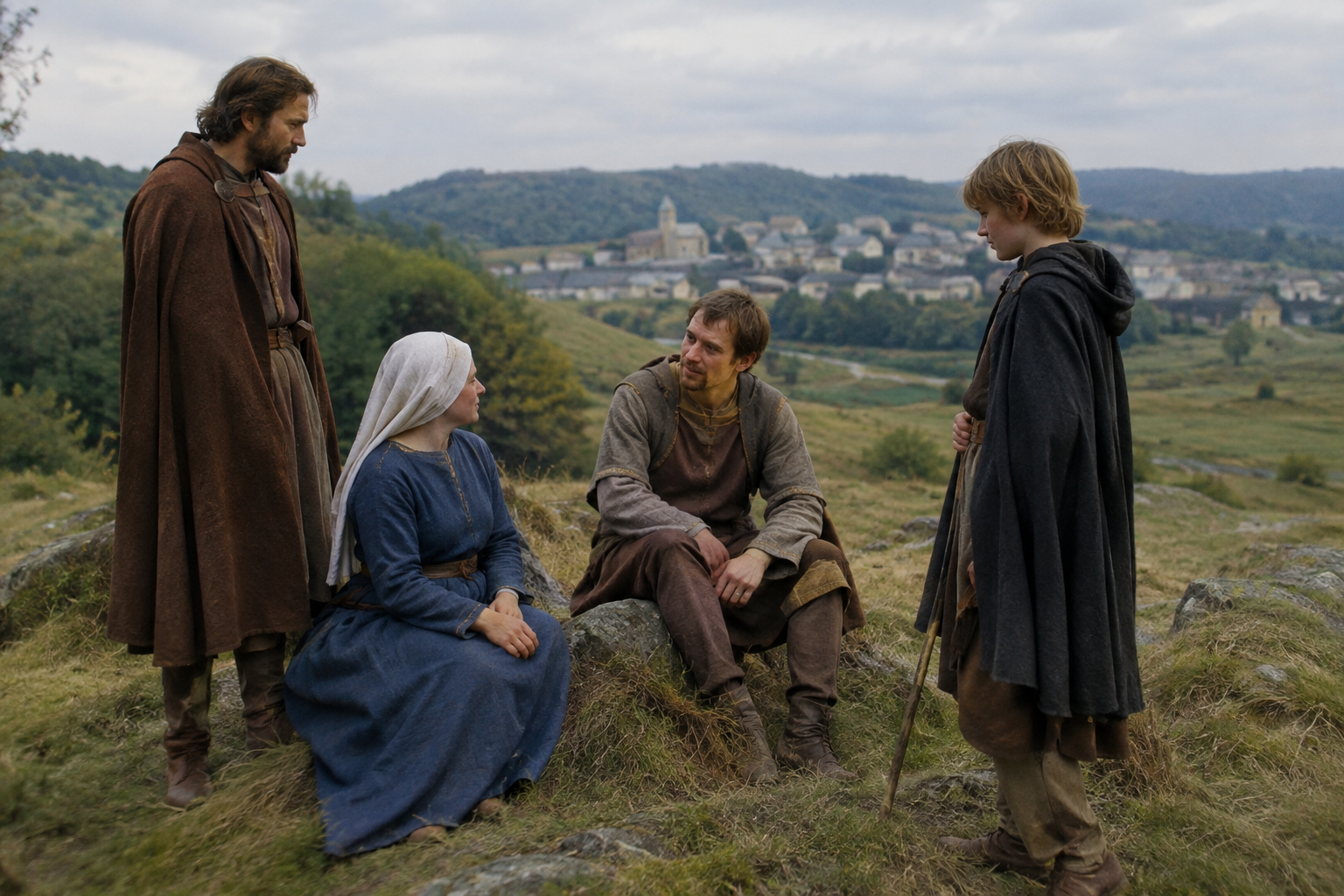
At Krakauer Berg near Peissen in medieval Germany, four men dated to around AD 1140 carry the same unusually specific Y-DNA assignment: R1a1a1b1a1a1c1a. Their sample IDs - KRA003X, KRA003b, KRA003, and KRA001 - are not the names of kings or famous warlords. That is precisely why they matter. Ancient DNA is often most revealing when it turns up not in legend-soaked dynasties, but in ordinary burial grounds where several paternal lines can be glimpsed in the same local community.
In this case, the interest lies in repetition. One medieval cemetery, one regional setting in central Germany, and multiple men assigned to the same narrow paternal branch: that is the sort of pattern that invites careful historical reading. Y-DNA traces one direct male line only, not a person's total ancestry, but when the same branch appears several times at one site it can hint at continuity, kin clustering, or the local success of a particular paternal lineage within a settlement.
The four Peissen individuals are all associated with Krakauer Berg, a medieval site in Germany, and all are dated to roughly the same period around AD 1140. The repeated appearance of R1a1a1b1a1a1c1a across KRA003X, KRA003b, KRA003, and KRA001 does not by itself prove they were immediate relatives. Medieval cemeteries can include extended kin, neighbors, dependants, newcomers, and people linked by parish or lordship rather than close blood ties. Still, the concentration is striking.
That matters because medieval central Europe was not genetically uniform in any simple sense. Burial grounds often preserve a mixture of paternal lines, reflecting generations of settlement, marriage, migration, and local inheritance. A recurring Y-line in one cemetery suggests that this branch was not a passing curiosity there; it had become part of the male landscape of the community.
An ancient DNA study examining medieval and earlier central European burials is available through this research publication, which helps place such cemetery evidence into a broader regional frame. Even where one site offers limited biographical detail for each skeleton, the combination of archaeology and genetics lets us see how local communities were structured by real families rather than by abstract historical labels.
R1a is a very broad and historically widespread Y-chromosome lineage, found across large parts of Eurasia and represented in many different ancient and modern populations. But that larger fame can be misleading. The article haplogroup here is not "R1a in general"; it is the much narrower branch R1a1a1b1a1a1c1a, and the evidence at hand ties it specifically to these medieval German burials.
That distinction is important. It would be easy, and wrong, to load this subclade with every migration ever associated with R1a as a whole. What the Peissen evidence actually shows is more modest and more useful: by the 12th century, a paternal line within the wider R1a family was established enough in this German setting to appear repeatedly in the cemetery record.
For family historians, this is often the most valuable scale. Rather than asking whether a lineage once moved somewhere in deep prehistory, the more revealing question can be whether a branch had become embedded in a real medieval community. Krakauer Berg gives exactly that kind of snapshot.
Around AD 1140, the lands of central Germany were part of a densely changing medieval world. Villages, churches, lordships, market centers, and agricultural estates were all shaping how communities reproduced themselves and how men ended up buried together. A cemetery from this period is not just a container for bones; it is a record of who belonged, over time, to a place.
The repetition of one paternal branch may reflect families with local staying power, perhaps across several generations. It may also fit broader processes seen across medieval Europe, where some male lines expanded successfully within villages or estates while others disappeared from the record. Ancient DNA cannot supply surnames for the Peissen men, but it does make visible the fact that medieval society was built from lineages with uneven demographic fortunes.
Research published on comparable central European ancient populations in this scientific paper shows how archaeology and genomics together can sharpen our picture of regional population history. The key point is not that one haplogroup "belongs" to one people, but that repeated paternal signatures can mark the lived structure of historical communities.
Single high-status burials tend to dominate public imagination, but clusters like Krakauer Berg are often better for understanding population history. One man can be an exception. Four men from one place and time, sharing the same narrow Y-branch, begin to suggest a local pattern.
KRA003X, KRA003b, and KRA003 are especially intriguing because their IDs already hint at close archaeological association, though the identifiers alone do not prove biological kinship. KRA001 broadens that picture. Together, they show that R1a1a1b1a1a1c1a was present across more than a single isolated burial at the site.
That does not entitle us to speak of a "dynasty" at Peissen. Medieval burial grounds usually served communities larger than one household. But it does allow a more grounded historical thought: some paternal lines were reproduced again and again in particular places, and this branch appears to have been one of them here.
There is a tendency in popular genetic history to jump instantly from a haplogroup label to sweeping maps of tribal movement. Krakauer Berg encourages the opposite habit. Start with the cemetery, the date, and the cluster. Only then ask what larger histories might sit behind it.
For R1a1a1b1a1a1c1a, the securely visible story in this article is a medieval one: a paternal branch recurring in a German burial ground around the middle of the 12th century. That fits a Europe in which older lineages had long since been folded into settled agrarian life, Christian burial customs, and regional communities whose identities were shaped as much by landholding and parish as by distant origins.
That perspective also makes these samples relatable. Most paternal lines that survive into the present did not do so through crowns and chronicles. They survived because generations of men lived, married, worked, inherited, and were buried in places like Peissen.
If your paternal line falls under R1a1a1b1a1a1c1a, Krakauer Berg offers a concrete historical anchor: this branch is attested in multiple men from medieval Germany around AD 1140. That is not proof of direct descent from any one of KRA003X, KRA003b, KRA003, or KRA001, and it does not define the branch's whole history. But it does show that this lineage was part of an identifiable medieval community in central Europe, not merely a modern testing result floating free of history.
For many people, that is the real value of ancient DNA. It restores scale. A haplogroup stops being just a technical code and becomes something more human: a paternal thread visible in the graves of a specific place, at a specific time, among men who once belonged to the ordinary fabric of medieval life.
Comments