Genomic Confirmation of the Ottonian Emperors: Authenticating the Remains of Otto I and Henry II through Ancient DNA
– 7 min read


Ottonian Emperors in the Lab: DNA, Cathedrals, and a Thousand Years of History
This comprehensive study follows two of the most powerful men of the 10th and early 11th centuries – Emperor Otto I "the Great" and Emperor Heinrich (Henry) II "the Saint" – not through chronicles and charters, but through their bones. Using ancient DNA extracted from remains preserved in two great German cathedrals, scientists have tested whether these bones really belong to these famous rulers, and whether their genetic relationship matches what medieval writers claimed about their family connections.
Advances in archaeogenetics have made it possible to trace our DNA back thousands of years, linking us to cultures long lost to time. You can see where your lineage fits in this vast human map at MyTrueAncestry.com.
The investigation opens in the world of the Ottonian, or Liudolfing, dynasty – the family that transformed the East Frankish kingdom into what later generations would call the "Holy Roman Empire". Their heartland lay around the Harz Mountains, in a region known as the "King's Landscape", stretching across areas that today encompass Lower Saxony, Saxony-Anhalt, and parts of Thuringia. The founding king, Heinrich I, ruled from 919 and was married to Queen Mathilde. Among their children was Otto I, born in 912, who became king in 936 and emperor in 962, reviving the imperial title in the Latin West after several decades without a crowned emperor.
Otto's son Otto II and grandson Otto III followed him on the throne. After Otto III died without children in 1002, power passed to his grandnephew Heinrich II, crowned emperor in 1014 and ruling until 1024, when the male line of the Ottonians died out. These rulers stood in conscious competition with Byzantine emperors and lived in the long shadow of Charlemagne. Their family married into royal and ducal houses across Europe – Burgundy, France, and the future Salian dynasty – forming a dense web of elite kinship that stretched across the continent.
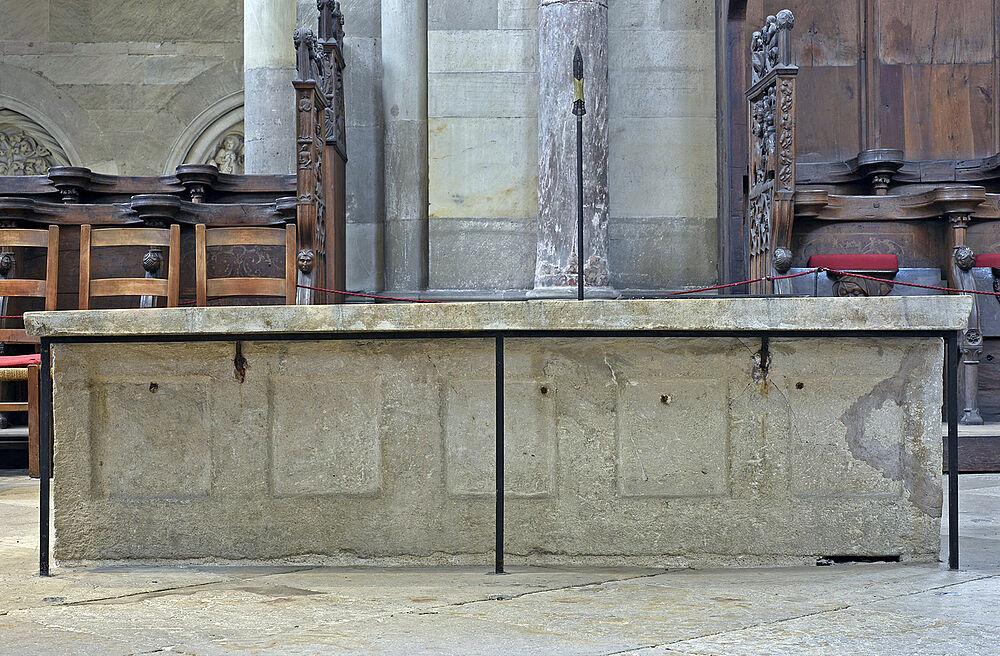
Otto I was born, most likely, at Wallhausen in 912 and spent his reign in almost constant motion. Medieval sources credit him with at least 50 sieges and 16 battles. At Lechfeld in 955, facing a Hungarian army, he vowed that if victorious he would found an archbishopric at Magdeburg. He kept that promise in 968, transforming Magdeburg into one of the great ecclesiastical centres of his realm. This choice of Magdeburg as a spiritual centre was matched by a deeply personal decision: Otto selected Magdeburg Cathedral as the burial place for himself and his first wife, Queen Edgitha.
When Otto died in Memleben in 973, most of his body was brought to Magdeburg, though his intestines were left behind in Memleben, following elite burial customs of the time. The cathedral itself underwent numerous transformations across the centuries. Originally founded by Otto, it was rebuilt several times, including a complete reconstruction in the 13th century. Otto's grave was opened in 1844, but documentation was poor: only a rough interior sketch and a drawing of a skull survived. Security was inadequate, leading to concerns about interference with the tomb, and over the following century and a half, doubts grew about whether the bones inside still truly belonged to the emperor.
Modern archaeological work began with his wife Edgitha's remains in the early 21st century. While her bones were studied in detail from 2008 to 2010, the ancient DNA in her remains had decayed too far to be recovered. Otto's tomb remained sealed until necessary renovation work at Magdeburg Cathedral in 2025 led to a new opening of the grave under strict documentation and conservation standards, allowing scientists to sample his remains.
The second protagonist, Heinrich II, represents a different branch of the family tree. Otto's brother Heinrich, Duke of Bavaria, married Judith of Bavaria. Their son, another Heinrich who became Duke of Bavaria, married Gisela of Burgundy. Their son – the emperors' great-nephew – was Heinrich II, born in 973, probably at Bamberg. When Otto III died in 1002, Heinrich II successfully secured the throne. His marriage to Cunigunde of Luxembourg was celebrated in contemporary documents as a true love match, yet the couple remained childless.
Medieval observers blamed Heinrich's health problems: he suffered repeated bouts of severe pain, described as colic or possibly resulting from accidents, which sometimes forced him to halt royal journeys for weeks. He died in 1024 at the royal castle of Grone. With his death, and shortly afterwards that of his brother Brun, the direct male Ottonian line came to an end. Like Otto, Heinrich tied his memory to a cathedral he had founded, choosing burial in Bamberg Cathedral, the centre of a diocese he himself had created.
Heinrich's posthumous story becomes even more complex due to his canonization. By the late Middle Ages, both Heinrich and Cunigunde had been declared saints – Heinrich in 1146, Cunigunde in 1200. Their tomb in Bamberg features a magnificent sculpted monument by Tilman Riemenschneider, created around 1500, into which most of Heinrich's body was moved in the 16th century. However, because his bones and those of Cunigunde were treasured as relics, his skull and certain bones were separated from the main burial for veneration. They were even transported to Rome at one stage. By the 21st century, Heinrich's skull and that of Cunigunde were displayed in reliquary containers, while a femur associated with him had been relocated and only repatriated to Bamberg in 2024.
The research window that opened in 2025 allowed the team to sample both rulers under controlled conditions. In Magdeburg Cathedral, they extracted a tiny incus bone from Otto's ear from the grave long attributed to him. In Bamberg Cathedral, they sampled the petrous portion of Heinrich's temporal bone from his skull, along with material from his femur. These specific bones were chosen because they often preserve DNA exceptionally well, even after a millennium.
In the laboratory, the bone fragments were carefully dissolved, and surviving DNA molecules were extracted and converted into libraries for sequencing. Despite their age, both samples yielded high-quality amounts of human DNA with the characteristic damage signature expected from ancient remains, confirming that the genetic material was genuinely ancient rather than modern contamination. Both genomes proved unequivocally male, which, while seemingly obvious, helps confirm identity in the context of potentially disturbed or mixed medieval graves.
Medieval genealogists and modern historians agree that Otto I and Heinrich II were related as great-uncle and great-nephew in the male line. The study tested this relationship through two primary genetic approaches. First, researchers searched for shared DNA segments – long, identical stretches of genetic material inherited from common ancestors. When the genomes of Otto and Heinrich were compared, they displayed several long shared segments across multiple chromosomes. The pattern and length of these segments matched expectations for a third-degree relationship, specifically the genetic closeness seen between a great-uncle and great-nephew through the male line.
Computer simulations of hundreds of different possible family relationships confirmed that the observed pattern of shared segments fell squarely among simulated third-degree relatives linked through siblings, not cousins or more distant connections. The second approach examined the Y chromosome, which passes virtually unchanged from father to son across generations. Both Otto and Heinrich belonged to the same extremely rare paternal lineage, labeled R1b-FTA63331 in modern genealogical databases.
This lineage appears today in only a handful of living men in countries such as Germany, Denmark, the Netherlands, and South Africa. The estimated origin of this male line falls around the middle of the first millennium CE, comfortably before the Ottonian period. The combination of the same rare Y-chromosome signature and exactly the expected level of genome-wide similarity for great-uncle and great-nephew makes it overwhelmingly likely that these remains genuinely belong to the historical emperors Otto I and Heinrich II.
The mitochondrial DNA, inherited through mothers, revealed different lineages for each emperor, exactly as expected given their separate maternal ancestries. Otto I carried a mitochondrial lineage seen today at low frequency in northwestern Europe, while Heinrich II possessed a distinct lineage appearing mainly among central Europeans. This difference reinforces the authenticity of the identification, as it aligns perfectly with known aristocratic marriage patterns where male lines remained concentrated in specific regions while elite women moved across broader European landscapes to form political alliances.
The authenticated remains of Otto and Heinrich serve as invaluable fixed points in time for archaeological science. Contemporary written sources record their dates of birth and death with unusual precision, making their bones "ground truth" anchors for calibrating various scientific methods. Radiocarbon dating can be affected by dietary factors, as medieval elites often consumed foods that alter carbon isotope balances in the body. By comparing known calendar dates of death with radiocarbon dates from their bones, scientists can better understand and correct for these "reservoir effects" in other high-status burials.
Similarly, these skeletons provide perfect test cases for age estimation methods based on bones and teeth. Since the exact ages at death are historically documented, their remains can be used to validate and refine techniques used to estimate age at death in medieval populations more broadly. The authenticated imperial remains also serve as reference points for studying the effects of elite diets and lifestyles on various bioarchaeological indicators.
The Ottonian dynasty was deeply embedded in the marriage politics of early medieval Europe, with family members marrying into the Capetian rulers of France, the kings of Burgundy, and the Salian family that would succeed them. Having high-quality genetic profiles for Otto I and Heinrich II means that other supposed royal and noble burials across Europe can now be compared against these authenticated emperors. Future discoveries of skeletons in medieval contexts sharing the same rare Y-chromosome line or showing expected patterns of DNA segment sharing could help confirm the identity of other Ottonian relatives or political allies.
This genetic authentication transforms how medieval elite cemeteries can be interpreted. Rather than relying solely on grave goods, tomb inscriptions, or artistic evidence, archaeologists can now incorporate direct biological relationships to known historical figures. The study demonstrates how specific graves – one imperial tomb sealed in a cathedral rebuilt over centuries, one saintly burial reshaped by piety and relic-veneration – can become powerful anchors for reconstructing not just family trees, but the lived networks of power, marriage, and memory that defined early medieval European politics.
Through careful ancient DNA analysis, this study has definitively confirmed that the remains venerated for centuries in Magdeburg and Bamberg cathedrals do indeed belong to Emperor Otto I and Emperor Heinrich II. More than simply solving a historical mystery, this work demonstrates how modern scientific methods can illuminate the complex relationships between medieval documentation, religious veneration, and biological reality. The genetic evidence not only validates medieval chroniclers' genealogical claims but also provides new tools for understanding the broader landscape of elite power and kinship in medieval Europe.
The cathedrals of Magdeburg and Bamberg now stand as authenticated repositories of both spiritual and scientific significance, where stone effigies and bone fragments together preserve the remarkable story of a dynasty that helped shape the political foundations of medieval Europe. These imperial remains, having survived a millennium of political upheaval, religious transformation, and architectural change, continue to reveal new insights about the past through the application of cutting-edge genetic technologies to ancient questions of identity, kinship, and power.
Original source article: https://doi.org/10.64898/2026.03.18.712637
Discover how your DNA connects to ancient civilizations at www.mytrueancestry.com.
Comments