Haplogroup R1b1a1b2a

– 5 min read


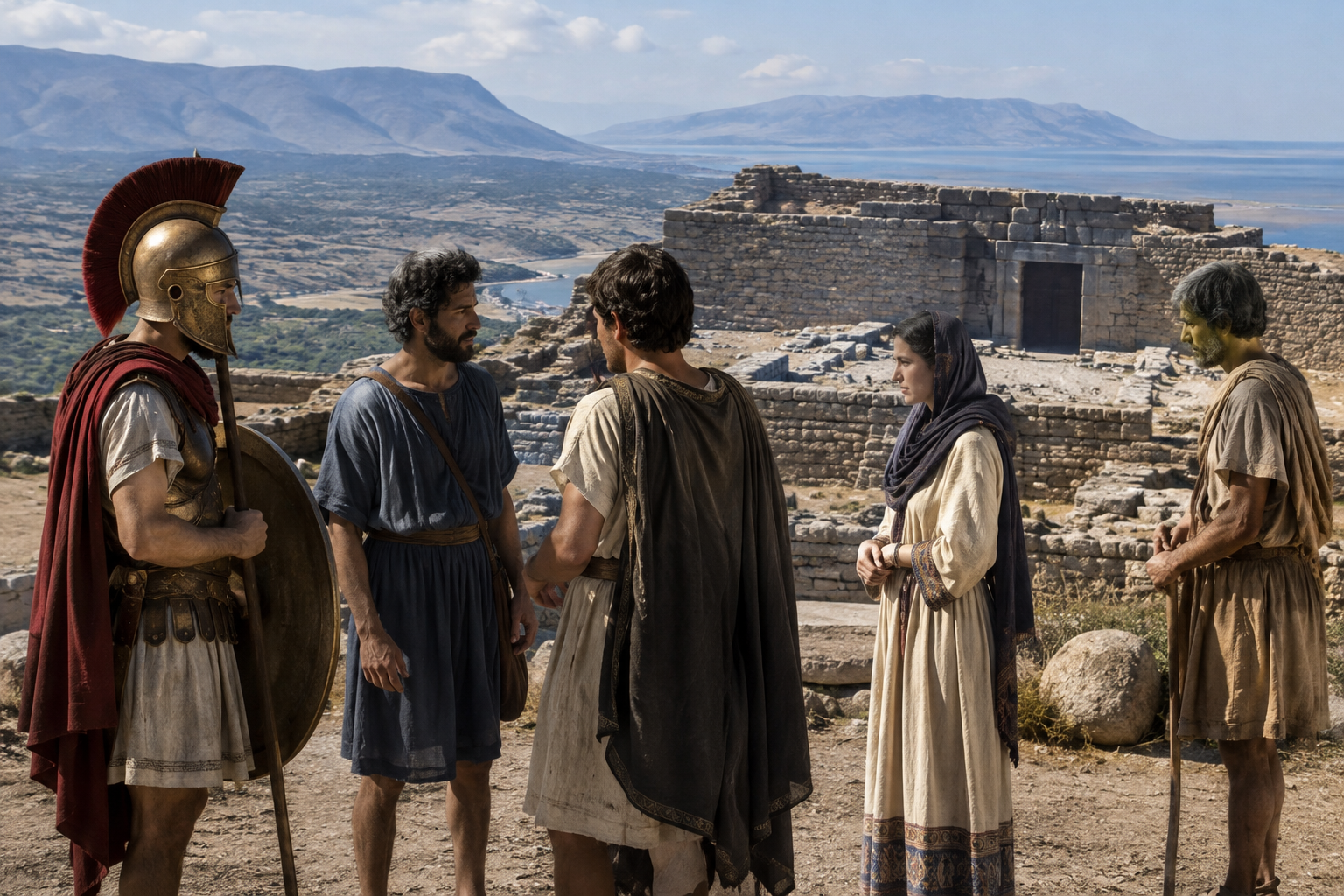
At Pylos in southwestern Greece, two men from the world of the Mycenaean palaces have been linked to the Y-DNA haplogroup R1b1a1b2a. The sample IDs are I13518 and I13506, both dated to around 1135 BC and associated with the Palace of Nestor. That is an arresting setting for any paternal lineage: not a vague prehistoric horizon, but one of the best-known centers of Late Bronze Age Greek administration, literature, and collapse.
That does not mean a Y-chromosome can tell us everything about who these men were. Y-DNA traces one direct paternal line only, not a person's whole ancestry, language, or social identity. Still, when the same branch appears at Pylos, later in Iron Age Albania, and again in post-medieval Korca, it gives us something quite valuable: a small but suggestive thread of paternal continuity across the southern Balkans and the Aegean world.
The Palace of Nestor is one of those places where archaeology feels unusually close to history. Its Linear B tablets, storerooms, and destruction horizon have made Pylos central to any discussion of the Mycenaean palatial system. So when two male individuals from this setting, I13518 and I13506, are associated with R1b1a1b2a, the interest lies not in royal glamour but in context: this haplogroup is present in the male population of a palace society at the end of the Bronze Age.
That matters because the closing centuries of Mycenaean Greece were anything but static. Populations around the Aegean had already been shaped by many earlier layers of ancestry, and the men living in palace centers were part of that complex human mixture. A major ancient DNA study on the Bronze Age eastern Mediterranean and surrounding regions helped establish just how interconnected these populations could be, while still remaining locally rooted in important ways: research on ancient Mediterranean and Balkan populations.
In other words, the appearance of R1b1a1b2a at Pylos should not be read as a label for "the Mycenaeans" as a whole. It is better seen as evidence that this paternal line was already present in the Aegean by the late 2nd millennium BC, within a society that stood at the junction of local traditions, seaborne contacts, and long-distance exchange.
The next especially useful appearance comes not from a grand palace but from inland northern Albania. Sample I14688, dated to about 500 BC, comes from Cinamak in the Kukes District and is classified to the Iron Age. Here the value of the evidence is chronological as much as geographical. We are no longer in the Bronze Age world of Linear B palaces, but in a Balkan landscape of hill communities, regional exchange, and emerging identities known to us only imperfectly through archaeology and later texts.
It would be a mistake to turn one male burial into a tribal badge. Yet I14688 shows that a paternal line associated here with R1b1a1b2a did not vanish with the end of the Mycenaean palace world. Instead, it appears again in a different political and cultural setting across the mountain corridors linking the Adriatic hinterland with the wider Balkan interior.
This is where archaeology is often more interesting than simple migration stories. The Balkans were never just a passageway. They were a long-inhabited, deeply connected zone where local continuity and outside influence met again and again. Recent discussion of Albanian population history has emphasized precisely those deep regional roots alongside later admixture and change.
The Albanian evidence becomes more intriguing because it is not confined to one period. Alongside the Iron Age sample from Cinamak, there is also I13834 from the Korca Basin in Albania, dated to around AD 1720 and classified as post-medieval. Taken together, these finds place the haplogroup in the western Balkans across a very long timespan.
Now, one must be careful. A Bronze Age man from Pylos, an Iron Age man from Kukes, and a post-medieval man from Korca are not a documented family line. They are separated by large stretches of time and by very different historical worlds: palatial Greece, pre-Roman or early classical-era inland Albania, and an Ottoman-period Balkan landscape. Still, the repeated appearance of the same reported paternal branch in this broad region suggests persistence rather than a one-off intrusion.
The Korca Basin is especially useful in that respect. By the early 18th century, this was a region shaped by centuries of Roman, Byzantine, medieval Balkan, and Ottoman history. A paternal lineage surviving into that setting reminds us that Y-chromosome lines can outlast drastic changes in language, religion, and political rule. Men carrying related paternal signatures could live through utterly different historical orders while remaining part of the same deeper biological thread.
R1b1a1b2a belongs within the broader R1b family, one of the major Y-chromosome groupings found across much of western Eurasia. But this is exactly where caution is needed. The wider history of R1b is vast, and it cannot simply be poured wholesale into every narrower branch. The article haplogroup is R1b1a1b2a, and the responsible question is not "what did all R1b men do?" but "what can these particular ancient appearances tell us about this reported branch?"
In this case, the evidence points toward a southern Balkan and Aegean story worth taking seriously. The branch appears in men connected to late Mycenaean Greece, Iron Age Albania, and later Albanian history. That pattern fits a region where continuity mattered, even as states rose and fell and populations mixed repeatedly. It also fits broader archaeogenetic work showing that the Balkans were neither an isolated refuge nor a place of total replacement, but a zone where old local ancestry could persist through new historical layers.
What makes this set of samples memorable is their contrast. I13518 and I13506 belong to a famous Late Bronze Age palace center in Greece. I14688 belongs to Iron Age northern Albania, a landscape that sat between coastal and inland spheres of contact. I13834 comes from post-medieval southeastern Albania, centuries after Rome, Byzantium, and the Ottoman expansion had all left their mark.
That is not a straight-line tale of a people marching intact through history. It is something more plausible, and in a way more human: a paternal line recurring in communities that were themselves changing all the time. Ancient DNA often works like that. It does not hand us a neat ethnic label; it shows how certain family lines can persist while the societies around them are transformed.
The Albanian dimension of this story also sits comfortably beside wider regional findings on long-term paternal shifts and survivals in the Balkans. If you are interested in how such patterns can appear over long periods without implying simple sameness, the broader regional comparisons are often more illuminating than any single sample.
For members of the MyTrueAncestry community, the most distinctive thing about R1b1a1b2a here is not scale but setting. This paternal line is linked to men from the last age of the Mycenaean palaces, appears again in Iron Age Albania, and is still visible in a post-medieval Albanian context. That makes it a lineage with a documented footprint in the southern Balkans and Aegean across more than two and a half millennia.
If this is your haplogroup, the safest historical takeaway is not a claim to one named people or dynasty, but a strong connection to the long-lived male histories of the Balkan-Aegean world: societies that endured collapse, reorganization, empire, and local survival without ever becoming simple.
Comments