Haplogroup N1

– 5 min read


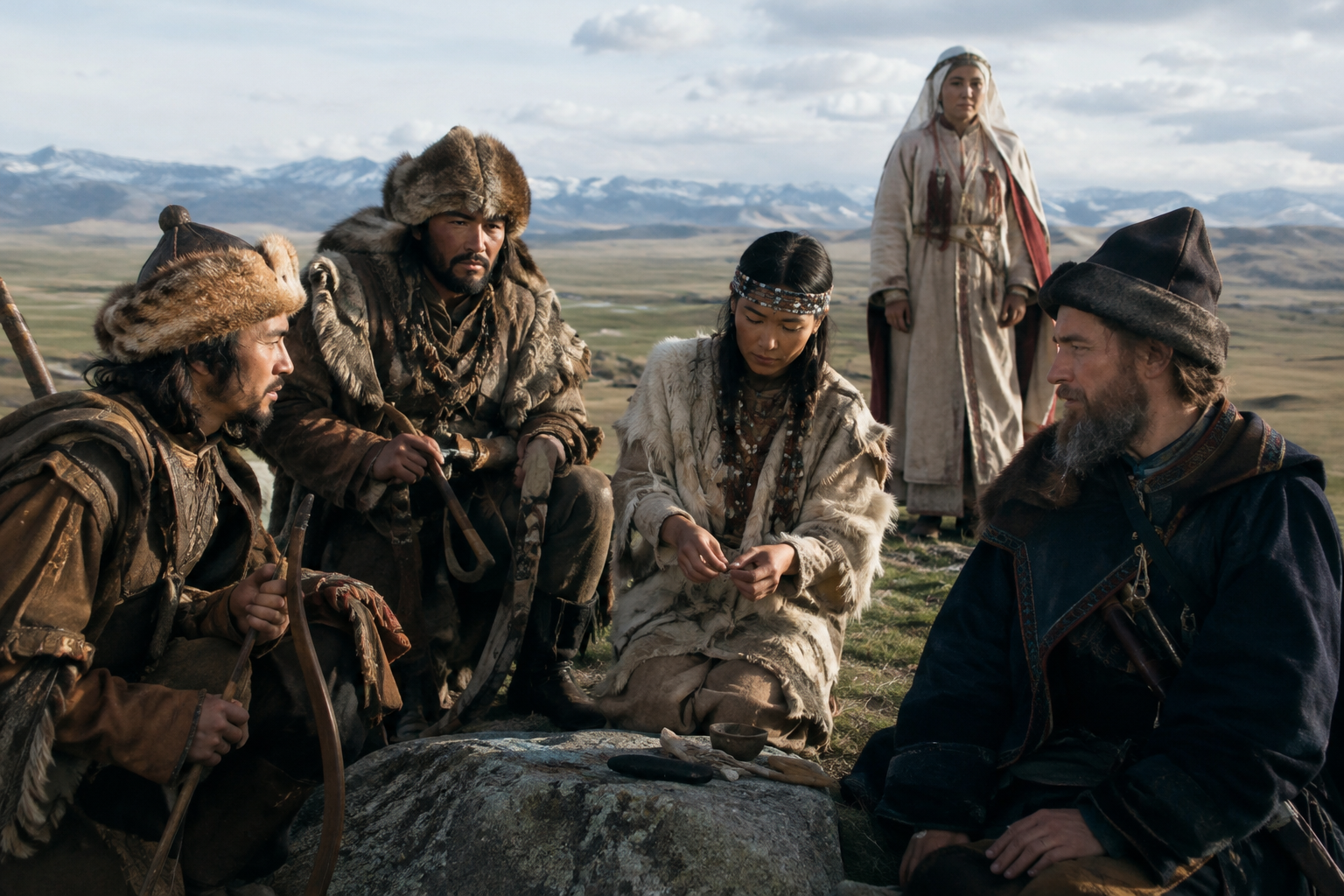
At Shamanka II on the western shore of Lake Baikal, one Early Neolithic man dated to around 5347 BC, sample DA251, carries a Y-chromosome assignment linked to haplogroup N1. That is a striking place to begin, because Baikal is one of those regions where archaeology and ancient DNA repeatedly force us to think bigger about northern Eurasia. A paternal line now best known from many Uralic-speaking and northern Eurasian populations appears here very early, in a landscape of hunter-gatherers long before the better-known Bronze Age steppe expansions.
For anyone researching N1 today, that matters. Y-DNA follows one direct paternal line only, not a person's whole ancestry, but it can still reveal where a lineage was turning up in the deep past. In the small set of ancient men associated here with N1, the pattern is not one of a single empire or one neat migration. Instead, it stretches from Neolithic Baikal to Bronze Age Kazakhstan and the Central Asian steppe, and then into medieval Russia.
Shamanka II has become an important cemetery for understanding the ancient populations of Cis-Baikal. The sample DA251, dated to the Early Neolithic, sits in a world of foragers around Lake Baikal, not in a later farming society and not in a medieval state. That alone is a useful corrective to the old habit of treating lineages like N1 as though they only arrive on the historical stage with named peoples and written chronicles.
Research on Baikal-area ancient individuals has helped show how long-lived and regionally distinctive some northern Eurasian populations were. A wider ancient DNA study of the Lake Baikal region is available here: https://www.ncbi.nlm.nih.gov/pmc/articles/PMC7817100/. Without overstating one sample, DA251 suggests that paternal branches associated with N1 were already part of the human story in this eastern zone millennia before the Bronze Age networks that later linked Siberia, the steppe, and Europe more tightly together.
It is worth lingering on that setting. Lake Baikal is not some remote footnote to European prehistory; it is one of the great crossroads for understanding how northern Eurasian populations formed and interacted. When a lineage tied to N1 appears there in the 6th millennium BC, it places this haplogroup's history firmly within the ancient forest and forest-steppe worlds to the east.
Move forward several thousand years and westward into Kazakhstan, and another ancient individual appears: NEO900 from Sjauke, dated around 1854 BC. By this period, the steppe was no quiet backwater. It was a zone of herding, mobility, exchange, and repeated population mixture. Finding an N1-linked Y-chromosome in Bronze Age Kazakhstan places this paternal line in a very different archaeological theater from Early Neolithic Baikal.
That contrast is the interesting part. N1 is not represented here by one frozen ancestral homeland, but by appearances in different societies across northern Eurasia. In a Bronze Age Kazakh context, a paternal line like this may have moved through networks of pastoral mobility, local continuity, or mixture between steppe and more northerly populations. The evidence does not allow us to choose one simple route, but it does show that N1 was present in the wider human traffic of Inner Asia.
A broader study touching ancient populations across Eurasia, including steppe-connected material relevant to this sort of question, can be found here: https://www.nature.com/articles/s41586-023-06865-0#MOESM6. What matters for this article is not a dramatic claim about one burial, but the cumulative picture: N1-associated paternal lines were participating in Bronze Age worlds far south and west of Baikal.
The sample NEO70 from Bazaiha, dated to around 802 BC, adds a later steppe example. By the early 1st millennium BC, the steppe world was changing again, with Iron Age developments, regional political formations, and ever more visible long-distance connections. An N1-associated Y lineage in this setting reminds us that paternal histories did not respect the tidy boxes later historians preferred.
Archaeologists often have to resist the temptation to make every steppe burial belong to a famous tribe from classical texts. The safer point is better anyway: N1 appears in a Central Asian steppe context during a period when populations of different ancestries and lifeways were interacting across a huge zone. That makes this sample valuable as evidence of breadth. It shows N1 not simply in northern woodland margins, but in the mobile societies that linked Siberia and Central Asia.
Put together with DA251 and NEO900, Bazaiha suggests continuity of presence across time, but not continuity of one single culture. The men carrying these Y-chromosome lines lived in very different archaeological worlds.
The latest sample in this group, SHK002 from Shekshovo in Russia, dated around AD 1200, brings N1 into the medieval period. This is a very different historical landscape again: Christian principalities, expanding political networks, trade routes through the forests and river systems of northeastern Europe, and communities shaped by centuries of interaction among Slavic, Finnic, and other northern Eurasian populations.
Here N1 begins to look more familiar to many present-day testers, because branches of haplogroup N are strongly associated in modern distributions with parts of northern Eurasia, including regions of Russia and areas historically tied to Uralic-speaking populations. But one medieval Russian sample should not be made to stand for all of Rus' or all of the north. Its importance lies in showing that an N1 paternal line is documented in the medieval Russian archaeological record, fitting the larger pattern of N lineages across the forest zone.
In historical terms, this is where the story becomes less about origins and more about persistence. The same broad paternal branch that appears in Early Neolithic Cis-Baikal and Bronze Age steppe settings is still turning up in medieval northeastern Europe, after enormous changes in language, religion, and political organization.
So what sort of haplogroup is N1, judged from these ancient appearances? Not a badge of one people, and not a shortcut to an ethnicity. Rather, it is a paternal branch with deep roots in northern Eurasia and a history that touches very different settings: Baikal foragers, Bronze Age Kazakhstan, the Central Asian steppes, and medieval Russia.
That spread also illustrates an important point about Y-DNA resolution. The article haplogroup here is N1, a broad designation. Ancient samples are often reported at different levels of certainty, and not every burial can be confidently placed into a fine modern sub-branch. It is wiser to keep the argument at the level the evidence supports: these men are associated with N1, and together they show a long and geographically wide paternal history.
The most distinctive thing about haplogroup N1 in this evidence is not grandeur but endurance. It appears first in an Early Neolithic Baikal individual, then in Bronze Age and early Iron Age steppe contexts, and later in medieval Russia. That is a remarkably wide historical arc for a single paternal branch.
If your direct paternal line belongs to N1, these ancient cases suggest a lineage with deep northern Eurasian roots and a history shaped by movement between forest, steppe, and riverine worlds over many millennia. They do not tell you that you descend from one named tribe or one famous dynasty. They do something more useful: they place your paternal line within one of Eurasia's longest-running human stories.






Comments