Haplogroup I2a1b1a2a

– 5 min read


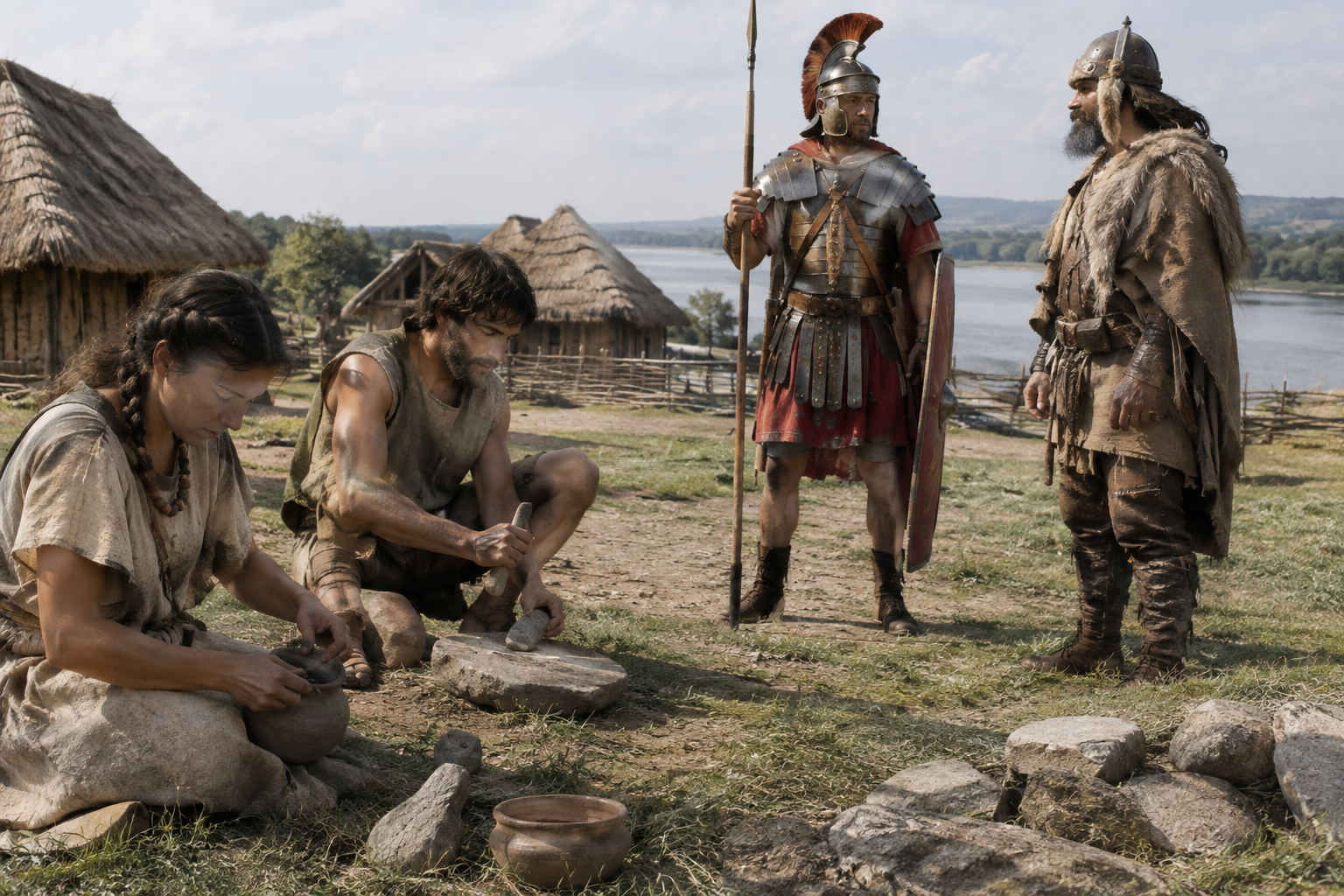
At Pietrele-Magura Gorgana on the lower Danube in modern Romania, two men dated to around 4100 BC, PIE060 and PIE061, carry a version of the paternal line reported here as I2a1b1a2a. That is a striking place to begin, because Pietrele is not some vague prehistoric dot on a map. It belongs to the world of the later Balkan Neolithic and Chalcolithic, when tells, farming villages, exchange networks, and increasingly elaborate social lives were reshaping southeastern Europe.
So this haplogroup enters the historical picture, at least in the material provided here, not with kings or conquering horsemen but with settled communities on the Danube frontier of prehistoric Europe. And that matters. Y-DNA follows one direct paternal line only, not a person's whole ancestry, yet even that single line can show remarkable endurance when it appears in very different settings over thousands of years.
Pietrele-Magura Gorgana, in Giurgiu County, lies in one of the most archaeologically important corridors in Europe. The lower Danube was a zone where early farming societies flourished, interacted, and changed long before classical antiquity. By about 4100 BC, the region had already seen millennia of farming life, but it was also a place where older southeastern European genetic lineages remained important.
That is the first useful point about I2a1b1a2a. Within the broad Y-haplogroup I, many branches are tied to long European prehistory, and southeastern Europe is especially significant for understanding that depth. The two Pietrele individuals do not prove a single unbroken local dynasty, of course, but they do place this paternal branch in a real Neolithic community on the lower Danube rather than in a merely abstract map of "ancient Europe."
A large ancient DNA study of southeastern Europe and neighboring regions has helped clarify how complex these populations were, combining early farmer ancestry with older forager-derived elements in varying proportions over time; for the wider prehistoric backdrop, see this ancient DNA research on the region. The important thing here is not to force PIE060 and PIE061 into a simplistic origin story, but to recognize that this lineage is already present in a settled Balkan landscape more than six millennia ago.
It is tempting to treat two males from the same site as evidence of a tight paternal family group. Archaeology and genetics warn us to be more careful than that. They may have been related, distantly related, or simply members of the same broader local population in which this paternal line had some presence.
Still, repetition at one site is informative. It suggests that the lineage was not an isolated accident in the lower Danube record. Pietrele gives us a small cluster, and clusters are often more revealing than single finds because they show a haplogroup embedded in a community context. In plain terms: this was not just one man passing through. The branch was part of the male population of a real Neolithic settlement world.
This also fits a broader pattern seen across parts of prehistoric Europe, where paternal lineages could be locally persistent even while overall ancestry shifted through marriage networks, movement, and cultural change. That distinction is crucial. A paternal branch can survive across major social transformations without implying that everything else stayed the same.
The next appearances in the material are much later and farther upstream in the Carpathian Basin: RKF242 from Late Roman Hungary, around AD 250, and RKF261 from the Migration Period at Rákóczifalva-Szolnok, around AD 750. That jump in time is exactly what makes this lineage interesting. We are no longer in the world of prehistoric tell settlements. We are in a region shaped by the Roman frontier, imperial withdrawal, and the reworking of society in the centuries that followed.
Rákóczifalva-Szolnok sits within the great meeting ground of the Hungarian Plain, where local continuity and incoming groups repeatedly intersected. To find the same reported haplogroup branch in both a Late Roman and a later Migration Period individual does not prove uninterrupted father-to-son descent across five centuries at that exact site. But it does show that this paternal line remained part of the human landscape through one of Europe's most turbulent eras.
That is worth lingering over. The Roman and post-Roman centuries in the Carpathian Basin are often described through peoples on the move - Sarmatians, Goths, Huns, Avars, Slavs, and others - but ancient DNA keeps reminding us that mobility did not erase local complexity. Some lineages endured, some arrived, some mixed, and many communities were made up of both older regional ancestry and newer connections.
Research published on ancient populations of the Carpathian Basin and surrounding regions has repeatedly shown that this was a zone of continuity as well as change; one broad genomic study relevant to that later prehistoric and historic setting is available here. For I2a1b1a2a, the lesson is modest but valuable: the branch appears not only in deep Balkan prehistory, but also in the lived reality of Roman and post-Roman communities to the north.
One of the easiest mistakes in genetic history is to let a historical label swallow the evidence. RKF242 lived in a Late Roman context; RKF261 lived in a Migration Period context. That does not make I2a1b1a2a inherently Roman in one century and inherently "barbarian" in another. A Y-line is older than those political labels, and it can pass through very different cultures without changing its name every time a frontier moves.
In fact, that is almost the point of this set of samples. The branch shows up in southeastern Europe before Rome existed, then appears again in the middle Danube world shaped by Rome and its aftermath. What we are seeing is not a neat ethnic badge but a durable paternal thread moving through radically different archaeological chapters.
For family historians, that is a useful corrective. If your paternal line belongs to I2a1b1a2a, the ancient evidence here does not pin you to one tribe, one language, or one medieval people. What it does suggest is a strong association with the long human history of southeastern Europe and the Danubian-Carpathian zone.
The most distinctive feature of this article's evidence is continuity of presence across enormous stretches of time. Around 4100 BC, PIE060 and PIE061 place the branch in a Neolithic lower Danube setting. By AD 250, RKF242 shows it in Late Roman Hungary. By around AD 750, RKF261 shows it again in the post-Roman world of the same broad region.
That sequence does not give us a complete map of the haplogroup, and it certainly does not capture every branch or every migration. But it does provide something better than a vague origin myth: four dated individuals, in two connected regions, spanning from prehistoric farming communities to the centuries after Rome. For a paternal lineage, that is a serious historical footprint.
I2a1b1a2a, on the evidence here, looks less like a fleeting arrival and more like a persistent southeastern European paternal line with a documented presence from Neolithic Romania into Roman and Migration Period Hungary. That is the real fascination of it. Not a glamorous dynasty, not a single conquering episode, but endurance across very different worlds along the Danube and in the Carpathian Basin.
For someone researching this haplogroup today, the responsible takeaway is that your direct paternal line may connect, at deep time depth, to some of the oldest archaeologically visible communities of southeastern Europe and to later populations who lived through the Roman and post-Roman transformations of the region.






Comments