Haplogroup R1b1a1b1a1a2b1c

– 5 min read


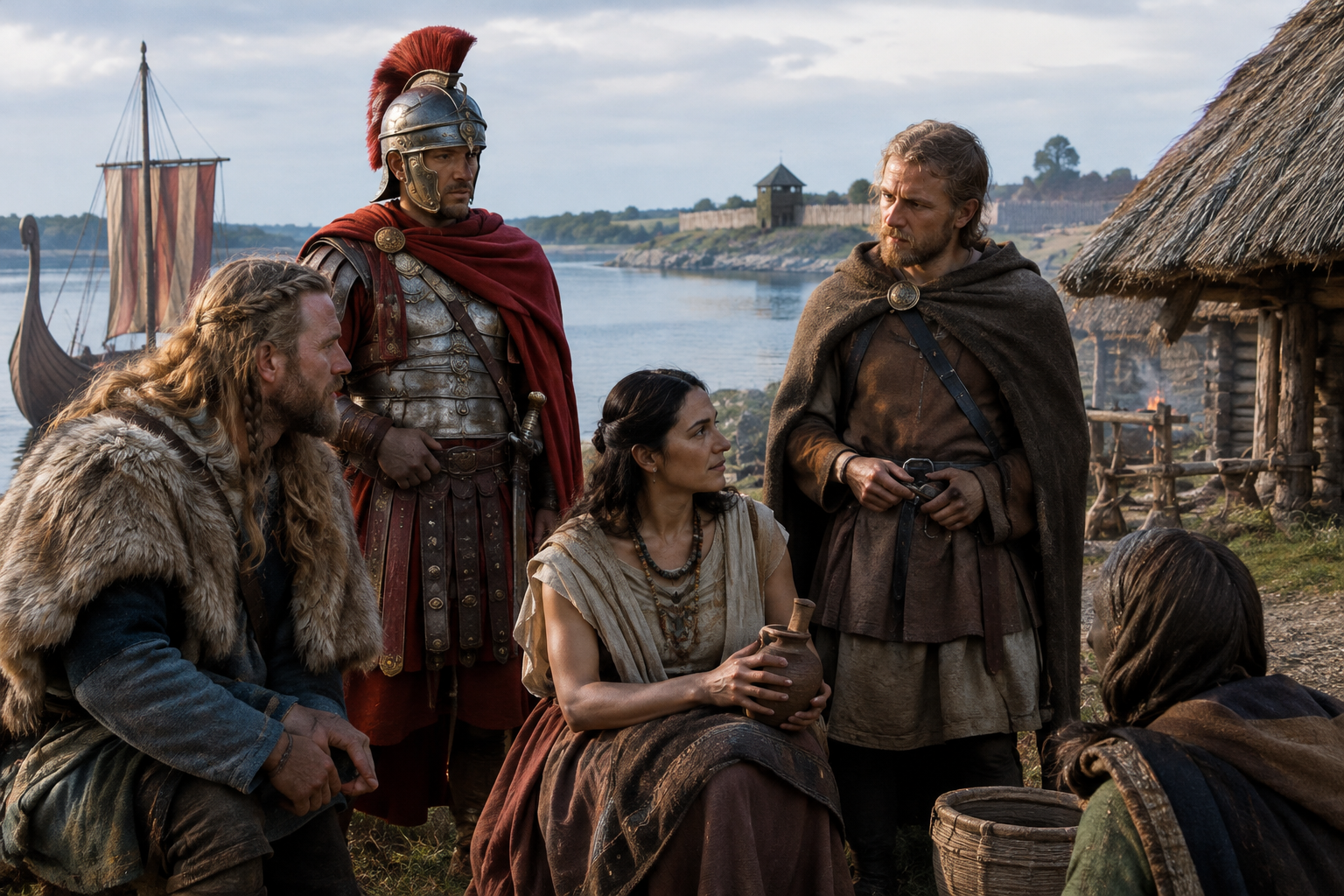
At Svilos in Krusevlje, in what is now Serbia, an Imperial Roman individual dated to around AD 332 and identified as R6701 offers a sharp way into the history of Y-DNA haplogroup R1b1a1b1a1a2b1c. This is not because one grave can explain a whole lineage, but because it places this paternal branch in a world we can recognise historically: the late Roman Balkans, a frontier zone of soldiers, farmers, traders, and families moving through an empire that was still powerful but already changing.
That matters because the same branch also appears far from late Roman Serbia: in Villanovan Bologna around 800 BC, in early medieval Moravia around AD 975, and in Viking Age Oland around AD 950. Taken together, these finds do not describe one tribe or one people. They show a paternal line turning up in very different archaeological settings across Europe over a span of nearly two millennia. As ever with Y-DNA, we are following one direct male line, not the whole ancestry or identity of the men who carried it.
The sample R6701 from Svilos, Krusevlje, sits in a period when the Balkans were one of the Roman world's great hinge regions. Armies passed through, emperors came from the wider Danubian zone, and local communities lived with both deep regional continuity and constant outside contact. A lineage such as R1b1a1b1a1a2b1c appearing here is therefore historically plausible in exactly the way the archaeology of the later empire often is: local and mobile at the same time.
Recent ancient-DNA work on southeastern Europe has made this increasingly clear, showing that Roman and post-Roman populations in the region were neither sealed off nor simply replaced. A genetic study connected with this wider landscape can be found here. The important point for this haplogroup is modest but significant: by the 4th century AD, this paternal branch was present in the central Balkans within an Imperial Roman setting.
One should resist the temptation to turn that immediately into a neat migration story. The Roman Empire is precisely the sort of place where lineages can travel without leaving tidy labels behind them. A man buried in Roman Serbia may have had family roots nearby, elsewhere in the Balkans, or farther west or north; the Y-chromosome alone cannot decide that question.
The oldest sample in this set is I46044 from Villanovan Felsina, Bologna, in the Po Valley, dated to around 800 BC. That puts the branch in northern Italy during the Villanovan period, the early Iron Age culture closely associated with the formation of the world from which the Etruscans later emerged in this region. Bologna, ancient Felsina, was already an important centre long before Rome dominated the peninsula.
This is an especially useful appearance because it widens the frame dramatically. R1b1a1b1a1a2b1c is not just showing up in Roman-period movement zones; it also appears in pre-Roman northern Italy in a well-known archaeological landscape. Research on Bologna's ancient population history has helped underline how much continuity and change overlapped there, and how cultural labels did not map neatly onto single biological lineages.
That is worth dwelling on. People often want a haplogroup to behave like a flag: Villanovan, Roman, Celtic, Etruscan, Slavic, Viking. But archaeology is much less obedient. A paternal branch can persist through language shifts, political change, and mixed communities. The Bologna sample is a good reminder that an ancient Y-line may be older and more regionally entangled than any later historical identity attached to the same landscape.
The sample POH27 from Pohansko in Moravia, dated to about AD 975, brings the story into early medieval central Europe. Pohansko is one of those sites that historians return to because it sits near the transition between the Great Moravian world and the reshaped political order of the 10th century. By this date, Moravia was part of a Christianising and increasingly connected central European sphere, linked to Bohemia, the eastern Frankish world, and neighbouring Slavic regions.
For this haplogroup, POH27 shows survival or reappearance in a setting very different from both Villanovan Bologna and Roman Serbia. The significance is not that the same family can be traced across all three places; it cannot. Rather, the branch had a geographic reach broad enough to appear in major historical zones of central Europe across long stretches of time.
The Moravian evidence is also a useful warning against simplistic ethnicity-by-haplogroup thinking. An early medieval man from Pohansko lived in a Slavic-speaking cultural environment, but that does not make the lineage itself "Slavic" in any exclusive or timeless sense. Paternal lines predate such labels and pass through many different societies.
The sample VK335 from Oland, Sweden, dated to around AD 950, adds yet another setting: the Viking Age Baltic. Oland was not some peripheral backwater. It sat in a maritime world of exchange, raiding, diplomacy, and settlement, tied into networks stretching across Scandinavia and beyond. A paternal branch found here may have arrived through older Scandinavian continuity, Baltic contact, or wider movement inside the Viking world.
That is exactly why this sample is so interesting. It reminds us that a lineage like R1b1a1b1a1a2b1c was not confined to Mediterranean or Danubian settings. By the 10th century it is also present in island Scandinavia, in a society deeply engaged with the Baltic and North Sea worlds.
Researchers working on ancient Scandinavian genomes have repeatedly shown that the Viking Age was genetically varied, with people moving in several directions at once. A broader research dataset associated with some of these ancient individuals is available here. For readers with this haplogroup, the takeaway is not "you are Viking," but that this direct paternal line could be part of Viking Age Scandinavia as well as Roman and central European contexts.
Put the four samples side by side and a pattern emerges, though not a melodramatic one. I46044 places the branch in Iron Age northern Italy; R6701 places it in the late Roman Balkans; POH27 places it in early medieval Moravia; VK335 places it in Viking Age Sweden. That is a striking spread across some of Europe's most historically dynamic corridors.
Still, the honest interpretation is a limited one. These are points of presence, not a complete map. They suggest that the paternal branch belonged within broad European population histories shaped by Iron Age transformations, Roman imperial movement, early medieval reorganisation, and Viking Age mobility. They do not prove a single uninterrupted route from Bologna to Serbia to Moravia to Oland, nor do they assign the branch to one culture above all others.
If your Y-DNA falls under R1b1a1b1a1a2b1c, the most distinctive thing these ancient finds suggest is breadth. This branch was present in several important European settings across a very long period, from early Iron Age Italy to the Roman Balkans and on into medieval central Europe and Scandinavia. That does not hand you a ready-made ethnic badge, but it does place your direct paternal line inside some of the major human movements and continuities that shaped Europe.
In other words, this is a lineage with a documented archaeological footprint in more than one historical world. That is often the most useful kind of result: not a myth of a single origin story, but evidence that your paternal line belonged to the real, mixed, mobile societies from which European history was made.






Comments