Haplogroup A1b1b2a

– 5 min read


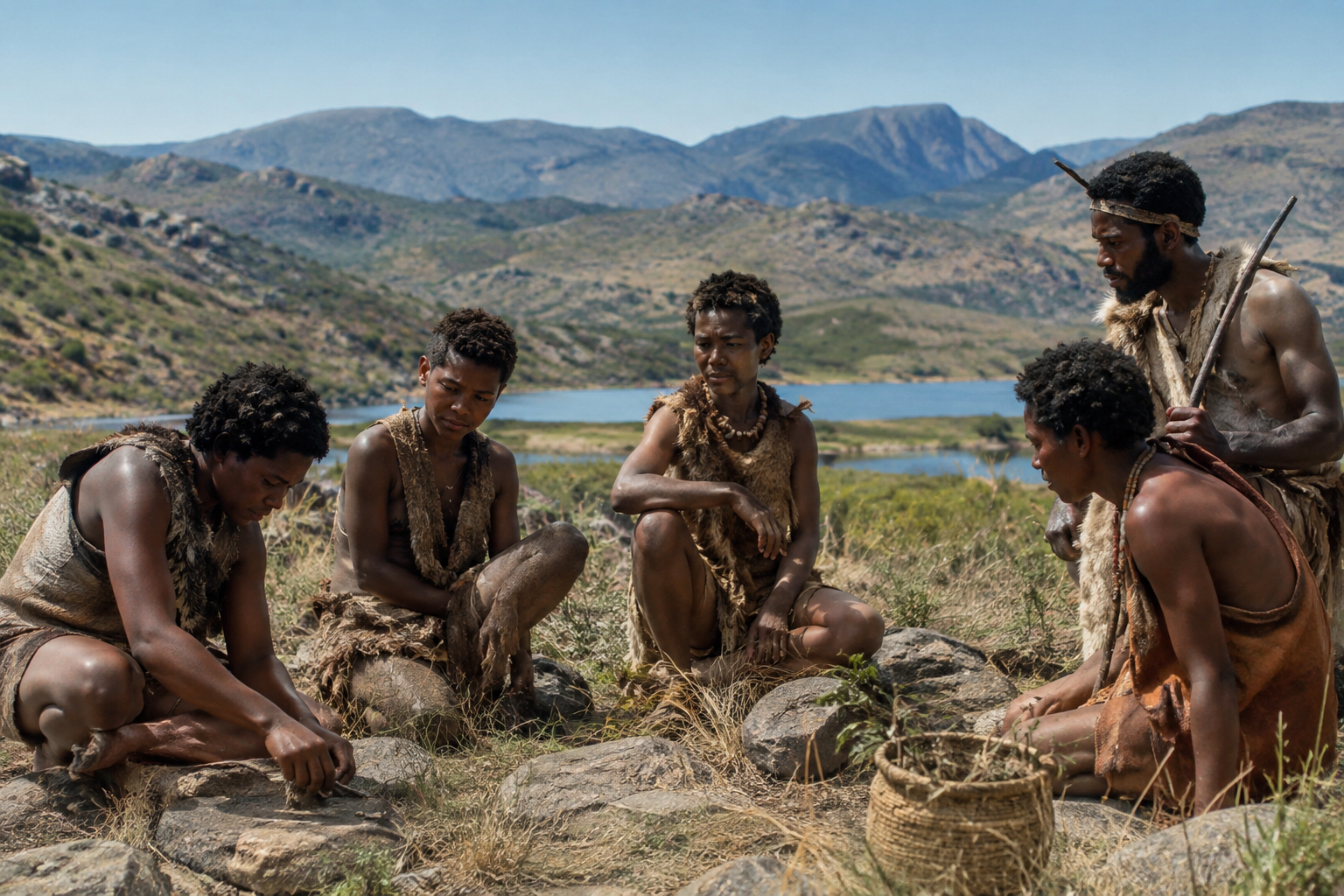
At Oakhurst in the Western Cape of South Africa, ancient DNA has put a very old paternal line into unusually clear focus. Two men dated to around 4400 BC, identified as OAK003_B0101 and OAK003_B0103, and another individual from the same region dated to about 3400 BC, OAK014_A0103, are associated here with Y-DNA haplogroup A1b1b2a. That matters because Oakhurst is not a royal cemetery or a famous empire's necropolis. It is something more fundamental: evidence for deep male-line continuity in southern Africa long before written history.
Haplogroup A1b1b2a belongs within one of the oldest major branches of the human Y-chromosome tree. Y-DNA follows a direct paternal line only, so it does not summarize a person's whole ancestry, language, or identity. Still, when the same branch appears in multiple ancient men from southern Africa across several millennia, it gives us a rare chance to talk about persistence rather than conquest, dynasty, or sudden migration.
The Oakhurst individuals are the heart of the story. Their dates, around 4400 BC and 3400 BC, place them firmly in a prehistoric southern African landscape occupied by hunter-gatherer communities. In broad historical terms, this is a world far removed from the later farming expansions associated with other parts of sub-Saharan Africa. The Oakhurst samples instead speak to populations with deep roots in the Cape region.
That three different individuals from Oakhurst, separated by roughly a thousand years, are tied here to A1b1b2a is the striking point. One sample might always be an accident of preservation or a quirk of small numbers. Three samples from the same broader region and long time span begin to suggest that this paternal lineage formed part of an enduring local population history.
A major ancient DNA study of southern African populations, published in Cell, helped establish just how important these ancient forager genomes are for understanding the deep population structure of the region. Even without overstating what can be said about one narrow Y-branch, the Oakhurst men fit into that larger picture: southern Africa preserves some of the oldest and most distinctive human genetic lineages known anywhere.
There is a temptation, with a lineage this old, to turn it into a grand slogan about the first humans. Better to be careful. A1b1b2a is a specific paternal branch within the wider and very ancient A-lineages of Africa. The wider family is deeply important in human population history, but that does not mean every detail known about the parent branch can be pasted neatly onto this exact subclade.
What the ancient samples do support is narrower and more interesting. In southern Africa, A1b1b2a appears in men from contexts identified broadly as hunter-gatherer or early local prehistoric populations. That gives the haplogroup a strong archaeological setting: not a vague map label, but real individuals from real sites, spread across thousands of years in the same general region.
It also helps explain why this lineage can feel different from the haplogroups that dominate many discussions of later Eurasian expansions. Here the historical drama is not a cavalry charge across a continent. It is survival, continuity, and the remarkable fact that ancient DNA can still detect such old paternal lines in the archaeological record.
The later samples in this set show that the story does not stop in prehistory. An individual from Nuwehoop in South Africa, dated to around AD 75 and identified as I9133, is listed as an Iron Age sample associated with this haplogroup. Another, I9028, dated to about 150 BC, is described simply as a hunter-gatherer from South Africa. Taken together, these individuals extend the observed presence of the lineage far beyond the Oakhurst horizon.
This matters because the first millennium BC and first millennium AD in southern Africa were periods of important regional change. Different lifeways, including food production in some areas, were reshaping the human landscape. If A1b1b2a appears in both earlier forager contexts and later South African individuals, that suggests local paternal lines did not simply vanish when new cultural systems appeared.
That is exactly the sort of point ancient DNA is good at making. Archaeology has long shown that cultural change need not mean total population replacement. These few male lines cannot stand in for all southern Africans, of course, but they do offer a sober corrective to simplistic tales of one people erasing another.
Southern Africa occupies a special place in archaeogenetics because it preserves evidence for extremely deep human population structure. Some of the oldest-diverging maternal and paternal lineages in living humans are found there, and ancient genomes from the region have become central to debates about long-term population history, mobility, and isolation.
More recent research has continued to refine that picture. A study published in Nature Ecology & Evolution examined ancient population history in southern Africa and added further resolution to how communities changed over time. For a haplogroup like A1b1b2a, that wider research context is crucial. It tells us that these sample labels are not isolated curiosities; they sit inside a region whose human history is exceptionally deep and genetically informative.
The Oakhurst and later South African individuals also remind us of something rather basic. Much of popular ancient DNA storytelling still revolves around Europe, the Mediterranean, or steppe migrations. Yet some of the most important evidence for the oldest surviving human paternal diversity comes from southern Africa, and it deserves to be treated as central, not peripheral.
What, then, should we picture when we read these sample IDs? Not named tribes from much later texts, and not some invented chain of descent from one excavated man to another. Better to think in archaeological terms: men living in southern African communities over a long span of prehistory and early history, whose paternal lines belonged to an ancient branch still visible in the DNA record.
OAK003_B0101, OAK003_B0103, and OAK014_A0103 anchor A1b1b2a in the prehistoric Cape. I9028 and I9133 show that the lineage, or at least reported associations with it, remained part of the South African landscape into much later periods. That is not the same thing as proving uninterrupted descent from one excavated individual to another, but it is enough to show notable time depth in one region.
The distinctive insight of haplogroup A1b1b2a is not empire, aristocracy, or medieval pedigree. It is depth. In the ancient DNA record provided here, this paternal branch appears in southern Africa from the fifth millennium BC through later prehistory and into the Iron Age-era landscape. For someone researching this Y-line today, the responsible historical takeaway is powerful enough: your direct paternal branch belongs to one of the deepest documented strands of human history, with ancient evidence rooted in South Africa itself.
Comments