Clan Tuite

– 3 min read


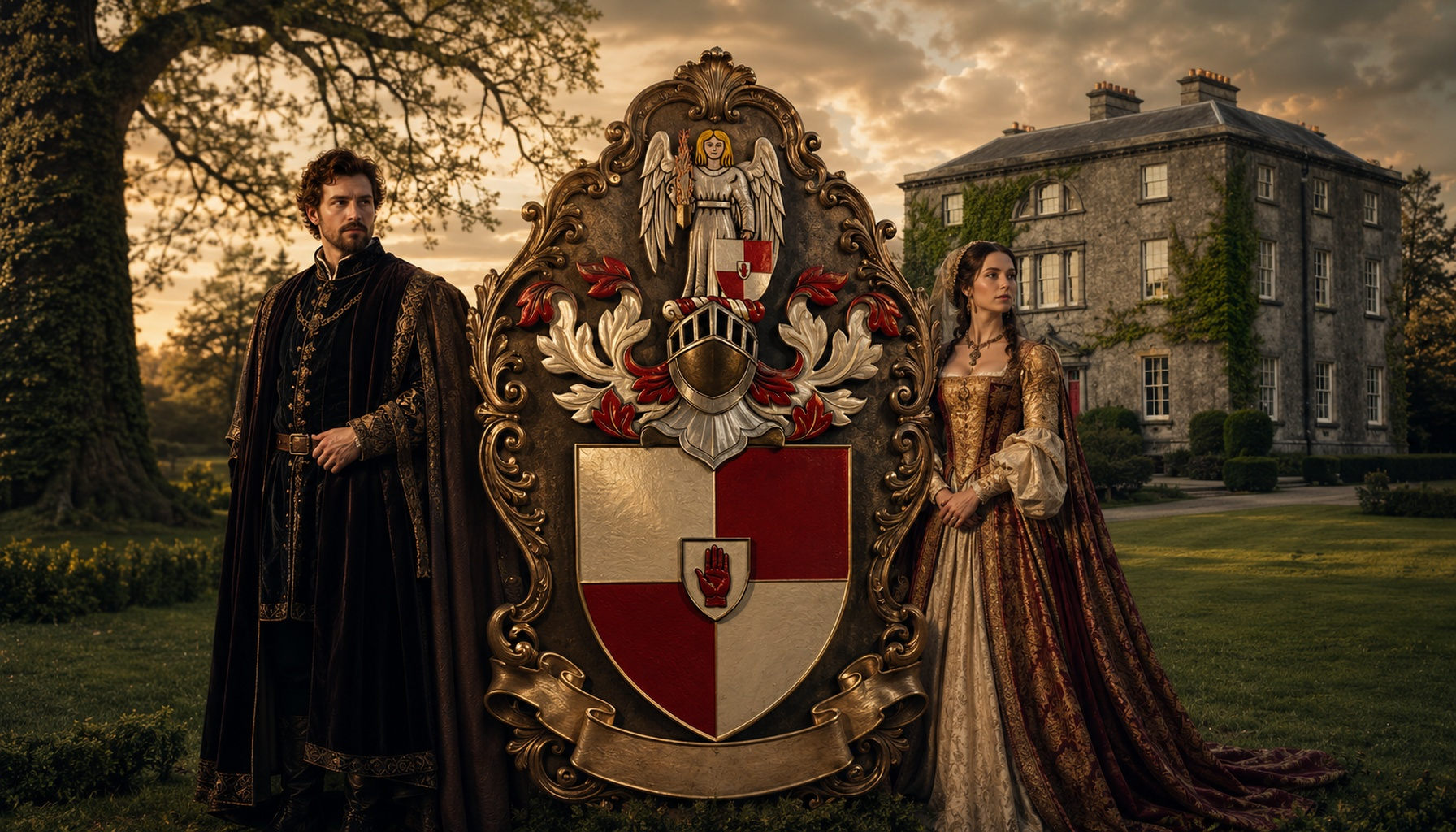
The Tuite family, or House Tuite, was one of those classic Norman-Irish noble houses that arrived in Ireland in the wake of the Anglo-Norman expansion and then, over generations, became deeply woven into the local landscape. Their roots lie in the wider world of medieval feudal settlement, where land, military service, marriage, and loyalty to powerful overlords could turn newcomers into regional dynasts. In genetic tagging terms, the primary family haplogroup linked here is R1b1a1b1a1a2c1a1d7, a branch within the great R1b lineage so common in western Europe. That does not by itself prove every Tuite line shared the same paternal story, but it offers a useful marker for thinking about deep ancestry alongside documented history.
The family became especially associated with the midlands and north midlands of Ireland, where Norman lordship was not just about conquest in the dramatic sense, but about the slower business of building castles, administering estates, collecting rents, making alliances, and surviving the constant political weather of medieval Ireland. The Tuites fit that pattern very well. They held land through feudal grants, served in military and administrative roles, and developed the sort of local authority that made a family durable. By the early 14th century we meet named figures such as John de Tuite in 1302, a reminder that this was not a shadowy legend but a family present in the records, moving within the practical machinery of lordship, law, and landholding. Like many Anglo-Norman houses in Ireland, they did not remain frozen as foreigners; they adapted, intermarried, and became part of Ireland's layered aristocratic world, carrying heraldry, memory, and estate identity across centuries.
Crover Castle is one of the best location anchors for the Tuite story, because it captures that mixture of lordship, landscape, and long memory that defines so much of Irish medieval history. Situated in County Cavan, Crover was remembered locally as an old stronghold linked with the Tuites, and folklore preserved in the Duchas tradition keeps its presence alive long after its political heyday had faded. The site was associated with a castle and estate lands near Lough Sheelin, part of a region where control of territory really mattered. Castles like Crover were not simply grand houses with battlements; they were statements in stone about possession, defence, status, and permanence. Even when later centuries altered or replaced earlier structures, the name and place continued to hold the memory of the family. The area around Crover can still be visited today, and while what survives belongs to layers of later history as well as the medieval past, it remains a meaningful stop for anyone tracing the Tuite footprint on the ground.
From an ancient DNA perspective, the haplogroup R1b1a1b1a1a2c1a1d7 links the Tuite story to a much wider tapestry of western European male-line ancestry. Related or linked samples appear across a striking spread of time and place, including Celtic Durotriges individuals from Duropolis at Winterborne Kingston in England such as WBK12, WBK20, WBK29, WBK41, WBK05, WBK30, WBK43, WBK06, WBK08, WBK18 and WBK191; Medieval England Augustinian Friars ATP_PSN_512 and ATP_PSN_520; Imperial Roman Zadar in Croatia I26776; Bronze Age Orkney KD061; Medieval Vasterhus in Sweden mbv151; Bronze Age Calabria GMO015; Early Medieval Belgium ST2025 and ST1308; Gallic France CGG023699; Post-Roman Dorset I11580; Merovingian Germany IND013; Late Roman Austria R10656; Late Roman Portugal R10488; Celtic Briton Oxfordshire I21182; Late Bronze Age North Yorkshire I16469; Iron Age Somerset I11991; Iron Age Battlesbury Bowl I21309; Bronze Age Trumpington Meadows I3256; Bronze Age Amesbury Down I2417; Bell Beaker Upavon I4950; Bronze Age Bedfordshire I7576 and I7577; Bronze Age South Lanarkshire I5473; Iron Age Hinxton HI2; Early Bronze Age Thames I5377; and Ireland Copper Age Rathlin2B. These are not claims of direct descent from any one of those individuals to the Tuites. Rather, they show that the broader paternal branch linked with the family has deep roots stretching through Bronze Age, Iron Age, Roman, and medieval populations connected with Britain, Ireland, and the wider European world from which Norman-Irish society emerged.
Read more about Clan Mac Murchada
If you are exploring Tuite heritage, this is where family legend, documentary history, and genetics can start talking to each other. Uploading your DNA to MyTrueAncestry can help you see whether you match the family haplogroup R1b1a1b1a1a2c1a1d7 or show connections to related ancient DNA samples from Iron Age Britain, Roman Europe, or early Ireland. It is a fascinating way to test whether your own story brushes against the long world of Norman settlement, Irish lordship, and the enduring memory of House Tuite.

Comments