Clan Mac Murchada
– 3 min read


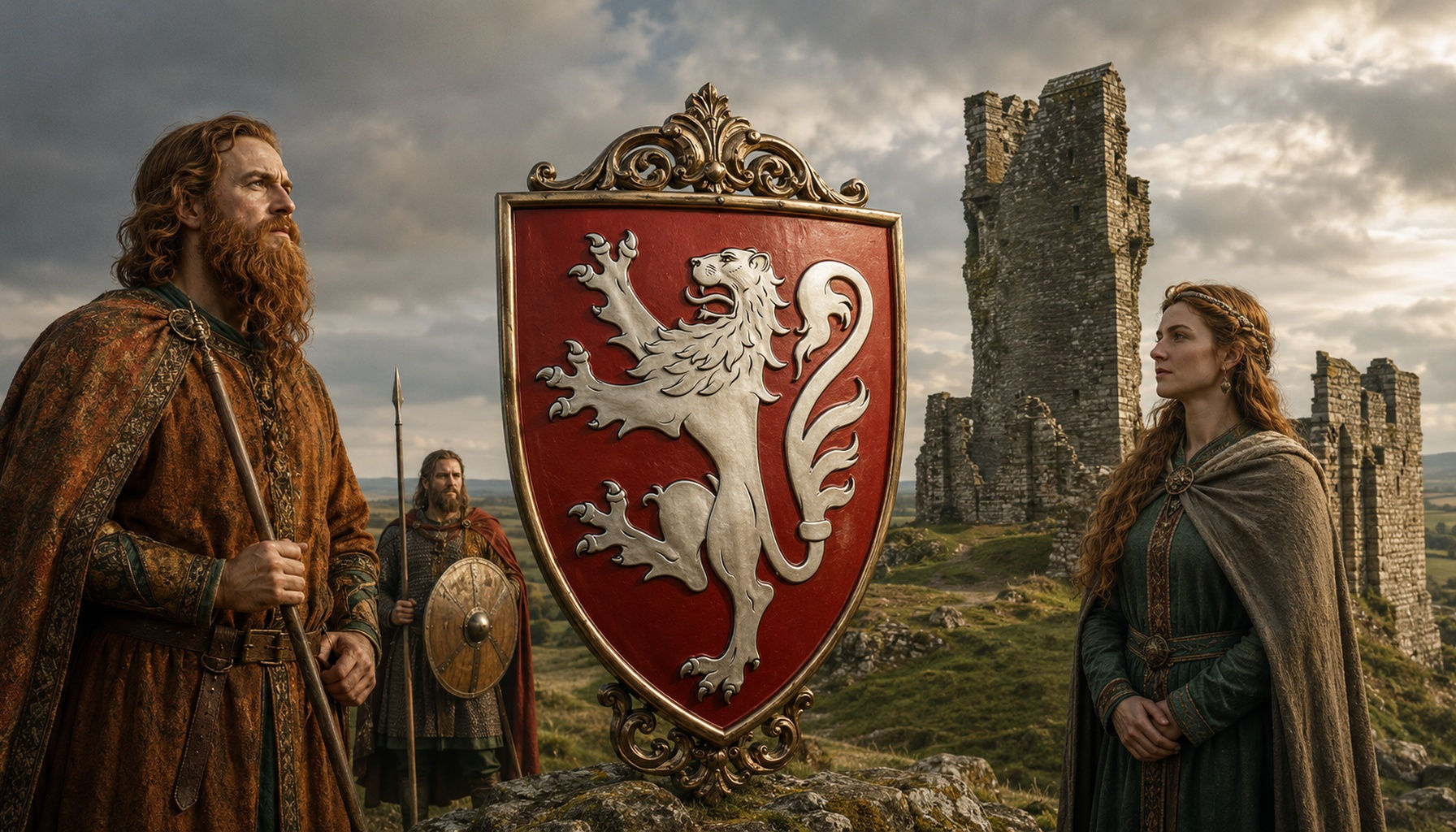
Clann Mac Murchada was one of the notable Gaelic Irish dynastic families of Leinster, rooted in the old political order of medieval Ireland, where kingship, lordship, kinship, and inherited status all mattered enormously. In plain terms, this was a royal-clan family, remembered not just because it held land and power, but because it stood inside the wider machinery of Gaelic politics: rivalries with neighboring dynasties, alliances sealed by necessity, and continual negotiation with the changing balance of power in Ireland. The haplogroup linked here with the family is R1b1a1b1a1a2c1a4a1, a lineage found in a wider Atlantic and western European context and useful as a genetic tag for exploring deep ancestral connections.
The Mac Murchada name preserves the memory of descent from Murchad and of a lineage associated above all with Leinster, especially the southeast of Ireland. Historically, Clann Mac Murchada fits the classic Gaelic dynastic pattern: genealogies guarded by learned families, political legitimacy reinforced by bardic memory, and authority tied to territory, clientship, and martial strength. Their world was not some misty romantic backdrop but a hard-edged medieval landscape of competition and survival. Among the best known figures is Diarmait Mac Murchada, King of Leinster, born around 1110 and dead in 1171, whose career has echoed through Irish history because his struggles and ambitions became entangled with the arrival of Anglo-Norman power in Ireland.
The family's historical anchor lies in Leinster, especially the region of present-day County Wexford and its surrounding sphere, where Diarmait Mac Murchada operated as a major provincial ruler. He was king of Leinster and at different moments one of the most consequential, and controversial, figures in 12th-century Ireland. Expelled from Ireland in 1166 by a coalition led by the High King Ruaidri Ua Conchobair and his rivals, Diarmait sought military help overseas and recruited forces from Wales, including the men later associated with Richard de Clare, Strongbow. That decision helped trigger the Anglo-Norman intervention in Ireland. Ferns in County Wexford is especially associated with him as an important royal and ecclesiastical center of his rule, and it remains a place that can still be visited today, with medieval remains and the wider historic landscape still giving a sense, however partial, of the old Leinster power base of the Mac Murchada line.
For those exploring the deeper genetic background linked with R1b1a1b1a1a2c1a4a1, there are related ancient DNA samples from a striking range of sites and periods across Britain and Europe. These include Celtic Durotriges England Duropolis Winterborne Kingston samples WBK12, WBK20, WBK29, WBK41, WBK05, WBK30, WBK43, WBK06, WBK08, WBK18, and WBK191; Imperial Roman Era Zadar Croatia I26776; Bronze Age Orkney Westray Links of Noltland KD061; Bronze Age Calabria Cosenza Grotta della Monaca Sant Agata di Esaro GMO015; Early Medieval Belgium Sint-Truiden Groenmarkt ST2025; Medieval Belgium Outsider Sint-Truiden Onze-Lieve-Vrouwekerk ST1308; Gallic France Parancot CGG023699; Post Roman Era Worth Matravers Dorset England I11580; Merovingian grave Alt-Inden IND013 in North Rhine-Westphalia; Late Roman Era Klosterneuburg Lower Austria R10656; Late Roman Conimbriga Portugal R10488; Iron Age Worlebury Somerset I11991; Iron Age Hillfort Battlesbury Bowl I21309; Bronze Age Trumpington Meadows Cambridge I3256; Bronze Age Amesbury Down Wiltshire I2417; Bell Beaker Upavon Wiltshire I4950; Bronze Age Bedfordshire I7576 and I7577; Bronze Age Boatbridge Quarry South Lanarkshire I5473; Celt Hinxton Iron Age HI2; Early Bronze Age England Thames I5377; and Ireland Copper Age Rathlin2B. These are not proof of direct descent from the Mac Murchada family, and should not be treated as such, but they do show the broad prehistoric and historic spread of related paternal lineages in the same wider genetic neighborhood.
If you want to see how your own DNA may connect with the deeper world behind families like Clann Mac Murchada, from Gaelic Ireland to Iron Age and Bronze Age populations, upload your DNA to MyTrueAncestry and explore the matches for yourself.
Comments