Clan Rattray
– 3 min read


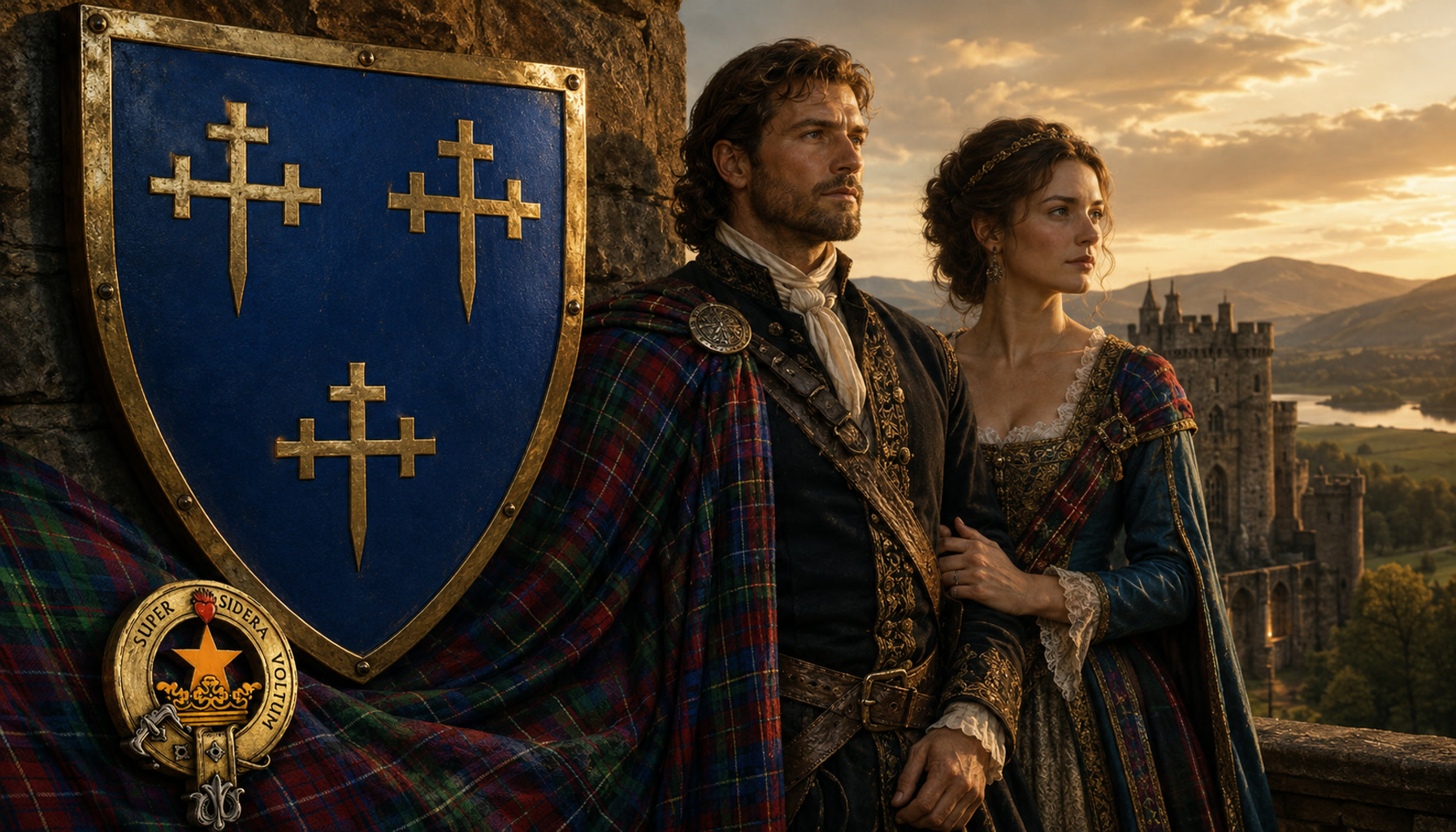
Clan Rattray was a Scottish landed family rooted in Perthshire, taking its name from the lands of Rattray themselves, and in genetic tagging terms is here associated with the primary family haplogroup R1b1a1b1a1a2c1a1a1a1a1a1a2a2. That is an important clue to the sort of family the Rattrays were. This was not a surname plucked from nowhere, but a territorial identity, the kind that grew out of medieval Scotland where land, lordship, memory, and name were tightly bound together. To be "of Rattray" was to belong to a place first and, through that place, to a durable social world of inheritance, obligation, and status.
The Rattrays sit rather neatly in that distinctively Scottish pattern where clan identity was never only about tartan romance or blood feud, but also about estates, charters, heraldry, marriage strategy, and service to crown and country. Their story bridges Highland and Lowland habits of power, which is one reason they are so interesting. The family maintained continuity through the ancestral landscape over centuries, and that continuity matters historically: it is how noble memory survived. Among the earlier named figures is Eustace de Rattray, recorded in 1297, a reminder that the family was already established during one of the most turbulent periods in Scottish history. Much later, Thomas Rattray (1684-1743), bishop and noted Jacobite-era churchman, shows the family still playing a visible role in national religious and political life.
If one wants to anchor the Rattrays on the map rather than in abstraction, Craighall Castle is the place to do it. Near Blairgowrie in Perthshire, Craighall became the historic seat of the chiefs of Clan Rattray and remains the strongest surviving symbol of the family's long hold on its territory. The castle as seen today largely reflects a 16th-century tower house later enlarged and altered, standing above the surrounding countryside in exactly the sort of commanding position one expects from a Scottish lairdly residence. It is not just a house but a statement in stone: defensible, visible, hereditary. Over time, additions turned it from a stark stronghold into a more layered residence, but it still carries that older feeling of lineage embedded in landscape. The site is well known as the traditional clan seat, and while access conditions can vary because it has been a privately owned property, Craighall Castle is a real, extant place that can still be seen and in that sense still visited, at least from the surrounding area and by arrangement where available. That survival is no small thing. So many medieval family seats are now only parchmarks or place-names; Craighall is still there, making the Rattray past unusually tangible.
On the ancient DNA side, the haplogroup R1b1a1b1a1a2c1a1a1a1a1a1a2a2 is linked with a striking cluster of medieval Irish samples, especially from Ballyhanna, County Donegal, including Sk197an, Sk197y, Sk197q, Sk197am, Sk197s, Sk197ab, Sk197u, Sk197t, Sk197r, Sk197ad, Sk197x, Sk197n, Sk197aa, Sk197z, Sk197ak, Sk197w, Sk197ai, Sk197m, Sk197ah, Sk197ag, Sk197v, Sk197ac, Sk197al, Sk197af, Sk197ae, Sk197o, Sk197aj, HAN197x, Sk197a, Sk197b, Sk197c, Sk197d, Sk197e, Sk197f, Sk197g, Sk197h, Sk197i, Sk197j, Sk197k, Sk197l, Sk197p, and HAN197, along with related medieval Irish examples from Kilteasheen in Roscommon such as KIL041, KIL044, and KIL014. These are best understood as linked or related carriers within a broader North Atlantic and Gaelic world, not as proof of direct descent from any named Rattray line. Still, they are a useful reminder that the paternal signatures associated with later Scottish families often sit within a much older web of movement and kin-connected populations across Ireland and Scotland.
The Rattrays are a fine example of how a Scottish family could endure through land, memory, heraldry, and service, with a name that kept pointing back to the same ancestral ground. If your own family story includes Rattray roots, Perthshire connections, or the haplogroup R1b1a1b1a1a2c1a1a1a1a1a1a2a2, you can upload your DNA to MyTrueAncestry and see whether you match this family story or any of the related ancient DNA samples connected with that wider medieval world.






Comments