Clan Blair
– 3 min read


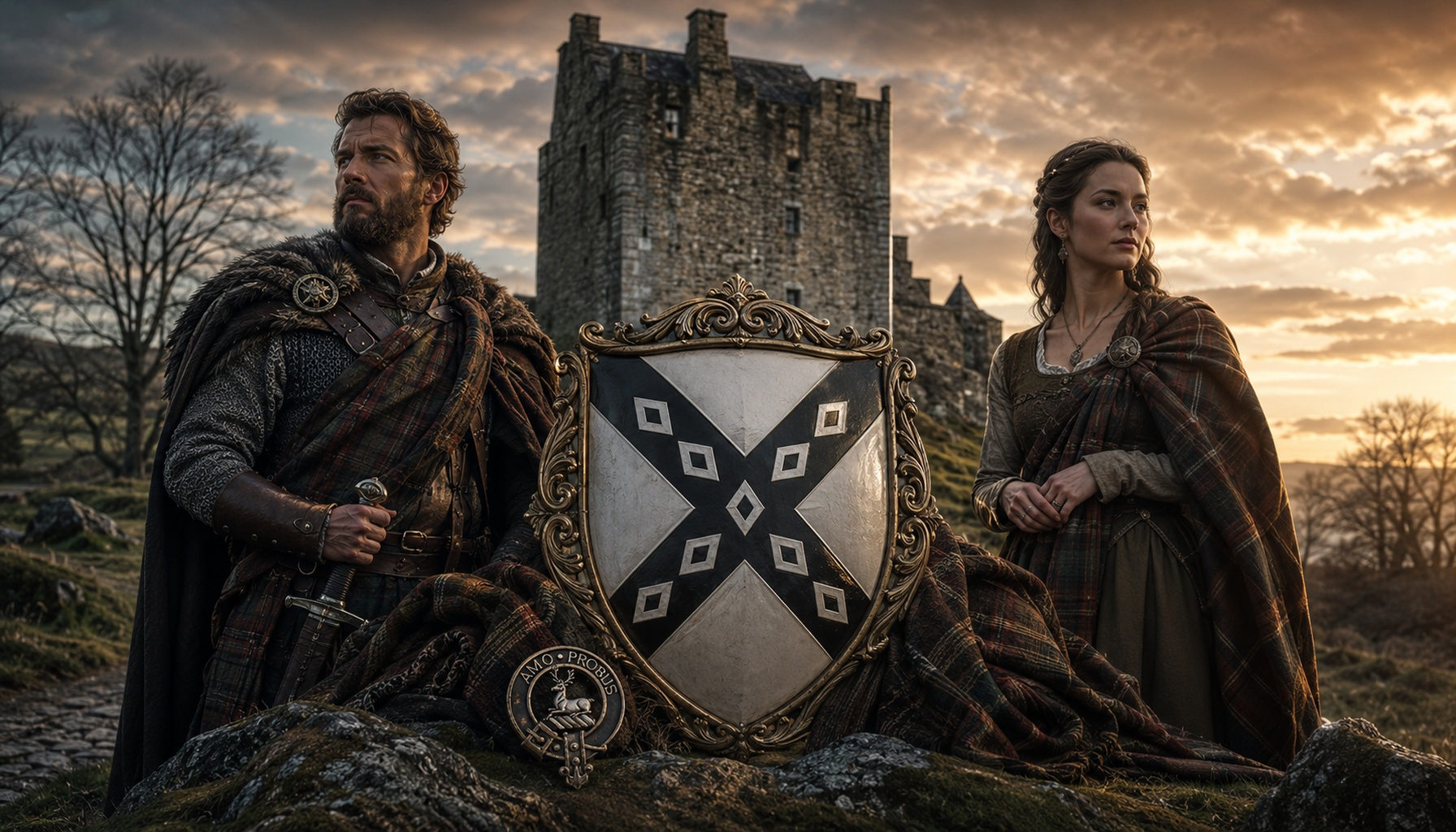
Clan Blair was a Scottish Lowland family, rooted above all in land, locality, and service rather than the later romantic image of a Highland fighting clan. The name is generally tied to territorial origins, especially the lands of Blair in Ayrshire, and from that kind of place-name beginning grew a family identity that became part of Scotland's heraldic and armorial world. The Blair story is very much a Scottish one: surname and estate reinforcing one another, local authority building over generations, and family continuity carried through charters, marriages, and public duty. In genetic tagging terms, the primary family haplogroup linked here is R1b1a1b1b3a1a1b, a branch within the great western European R1b line.
That matters because families like the Blairs were not simply names on parchment. They were participants in the machinery of Lowland Scotland: landholders, alliance-makers, and people who had to navigate crown, church, law, and neighborhood all at once. Their motto, Amo Probos, meaning I love the virtuous, suggests the kind of public ideal a landed family wished to project: honor, steadiness, and upright conduct. One early figure often associated with the name is John Francis de Blair, active in the late 12th and early 13th centuries, a reminder that the family was already visible in the documentary world of medieval Scotland when surnames were hardening into inherited identities.
Read more about Clan Cunningham
A particularly vivid Blair anchor is Ardblair Castle in Perthshire, near Blairgowrie. The building seen today is largely a 16th-century L-plan tower house, later extended and altered, but its fabric preserves the look of a fortified laird's residence rather than a fairy-tale palace. That distinction is important. Castles like Ardblair were working homes, statements of status, and practical defenses in a world where local power still had teeth. The castle has associations with the Blair family over centuries, and like many Scottish tower houses it tells a long story of adaptation: medieval defensibility giving way to post-medieval comfort, without quite losing the stern outline of its earlier life. It is known as a historic building and, as a recognized heritage site, it can be viewed and visited from the outside area reasonably supported by its public visibility, though interior access may depend on present ownership and arrangements.
From an ancient-DNA perspective, the Blair-linked primary haplogroup R1b1a1b1b3a1a1b connects the family to a much wider Eurasian story rather than to a single proven paternal line in the past. Related or linked samples assigned to this branch or close context appear across an extraordinary spread of times and places: Medieval Northern Spain at Las Gobas (ldo263), Medieval Sicily at Teatro di Segesta (SGBN22), Roman era Cambridge at Vicars Farm (VIC004), Late Imperial Roman Serbia at Timacum Kuline Ravna Village (I15552), Late Roman frontier Straubing Azlburg in Germany (STRAZ_I_11), Iron Age Pommerania at Gdansk Wielbark (PCA0475), Piast dynasty era Poland at Santok in Lubusz Province (PCA0516), Migration Period Bruecken in Saxony-Anhalt (BRC005x), Early Medieval Burgundy at Camp du Chateau (CGG023657), Dark Ages Hungary at Csongrad-Berzsenyi utca (CSB-3), Carolingian Zalavar Varsziget (AHS22), ancient Ulanci-Gradsko in North Macedonia (I7231), late medieval Albania at Bardhoc (I14687), Merovingian Alt-Inden in North Rhine-Westphalia (IND014), ancient Illyrian Albania at Cinamak (I14690), Late Roman Emona in Slovenia (R10478), Bronze Age Maros Ostojicevo in Serbia (I23209), an Avar elite burial in Early Medieval Hungary (I16759), Early Bronze Age Kikinda Mokrin in Serbia (I23207), Early Medieval Visonta Nagycsapas in North Hungary (I16752 and I16753), a post-medieval plague victim from Ellwangen in Germany (ELW028), and even a Scythian sample from southern Moldova (scy305). None of these should be read as direct ancestors of Clan Blair. Rather, they show the broad historical footprint of related paternal ancestry moving through Roman frontiers, medieval kingdoms, migration-age communities, and older Iron and Bronze Age populations.
Explore Roman and Early Medieval Britain DNA
If you carry the Blair surname, have Blair lines in your family tree, or are simply curious about how a Lowland Scottish family fits into the deeper human past, this is exactly where documentary history and DNA start talking to one another. Upload your DNA to MyTrueAncestry to see whether you match Clan Blair connections or any of the related ancient DNA samples linked to haplogroup R1b1a1b1b3a1a1b.
Comments