Clan Cunningham
– 3 min read


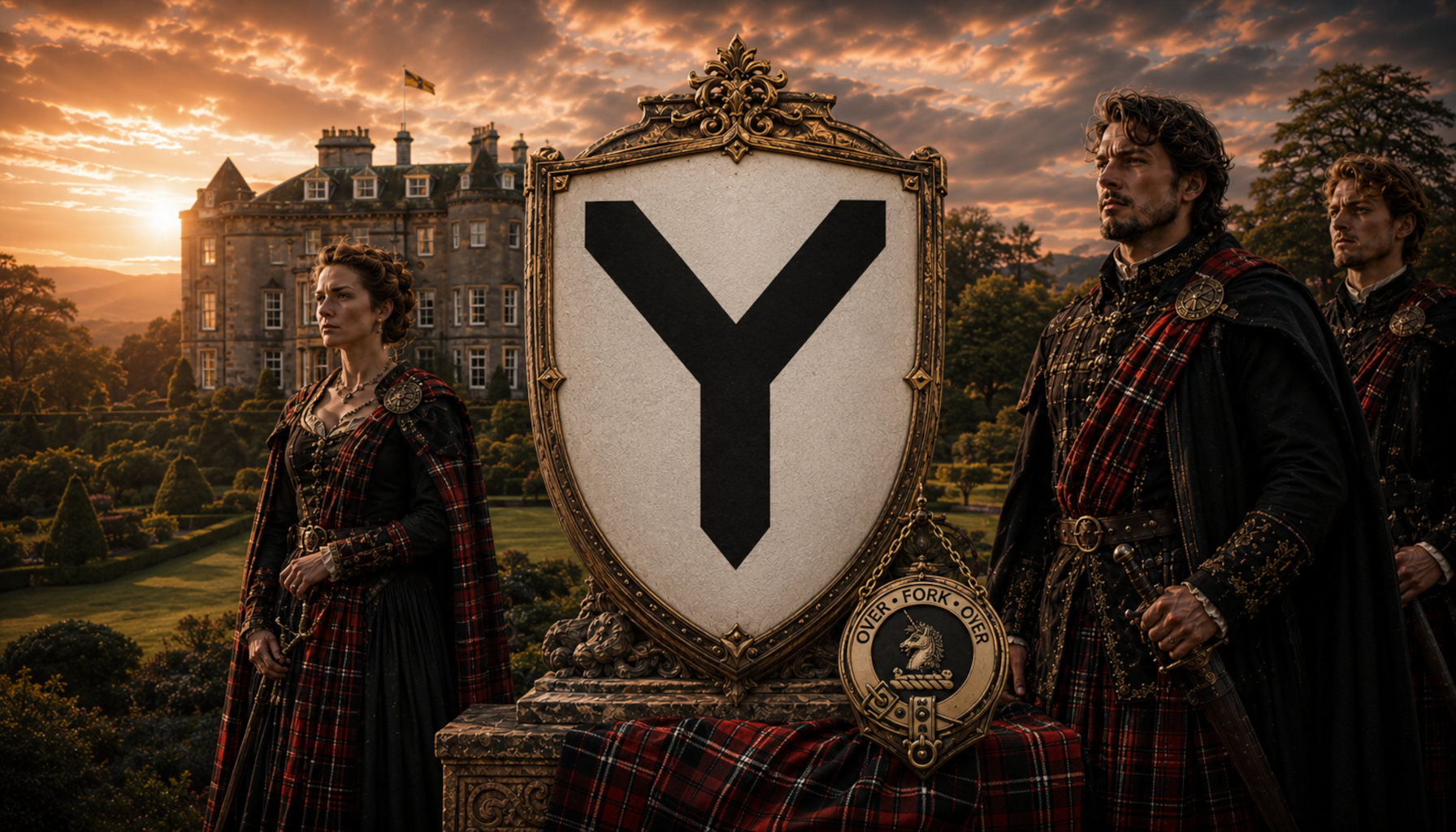
Clan Cunningham was one of the great Lowland families of western Scotland, rooted above all in Ayrshire and later strongly tied to Renfrewshire as well. In genetic tagging terms, the primary family haplogroup linked here is R1b1a1b1a1a1c2b2b1a, a branch within the broad R1b line so often associated with western Europe. Historically, the Cunninghams were not a Highland kindred of glens and chiefs in the popular tourist sense, but a hard-edged Lowland power: landholders, royal supporters, feud participants, and political survivors in a landscape where charters, marriages, castles, and sudden violence all mattered very much indeed.
The family name is generally taken from the old district of Cunningham in Ayrshire, which gave both identity and status to the lineage. By the late 13th century the clan was established around Kilmaurs, and from there its influence widened during one of the most turbulent stretches in Scottish history. The Cunninghams backed the Bruce cause in the Wars of Scottish Independence, and after Robert the Bruce prevailed, that loyalty paid political dividends in land and standing. Earlier figures flicker into view in the documentary record, including Warnebald in 1135, a reminder that noble families do not suddenly appear fully formed but emerge gradually from local lordship, service, and landholding. In later centuries the chiefs became associated with Kilmaurs and then with the Earls of Glencairn, while the clan as a whole was drawn into the fierce noble feuds of the 15th and 16th centuries, especially with Clan Montgomery. The Earls of Glencairn also carried the Cunningham name into the great national dramas of the Scottish Reformation, the age of Mary Queen of Scots, the Civil War period, and royalist resistance. Add to that the clan's heraldry, crest badge, unicorn symbolism, tartan, and motto tradition, and you have a family with a striking visual identity as well as a formidable historical one.
Read more about Clan Montgomery
Finlaystone House, near Langbank in Inverclyde, is the historic seat most strongly associated with Clan Cunningham, and in many ways it serves as the clan's emotional anchor in the landscape. The estate stands above the south bank of the River Clyde and preserves that slightly theatrical sense so many old Scottish houses possess: not merely a residence, but a statement of lineage, continuity, and territory. The present house is largely 18th century in appearance, though the site itself is much older and connected to earlier fortified occupation. It passed into Cunningham hands in the 14th century and became the seat of the Earls of Glencairn, placing it right at the heart of the clan's senior story. Later architectural changes gave it the form of a country house rather than a medieval castle, but that evolution is part of the point. Finlaystone reflects how old noble power adapted over time, from war-band lordship and feuding politics into landed prestige, estate management, and memory. Today the house remains privately owned, but the grounds and gardens are known to be open to visitors, so yes, Finlaystone can still be visited in a reasonable sense by those wanting a real geographical connection to Clan Cunningham rather than just a name on a tartan shop shelf.
From an ancient DNA perspective, the Cunningham-linked primary haplogroup R1b1a1b1a1a1c2b2b1a connects the family to a wider web of related paternal lines found across Iron Age, Migration Period, and medieval Europe. These are not claims of direct descent from named archaeological individuals, and it is important not to pretend otherwise. Rather, they are linked or related samples that help sketch the deeper world from which such later western European lineages emerged and spread. Among them are the Elite Celtic Burial from Magdalenenberg at Villingen-Schweningen in Germany, sample MBG002, the Iron Age Le Cailar sample CLR23 from southern France, and a broad cluster of Migration Period and early medieval individuals including Mln28a from Moemlingen, Btb100 from Buettelborn, NIEcap12b and NIEcap12c, BRC025x and BRC004x from Bruecken in Saxony-Anhalt, RTW017 from Rathewitz, CGG021981 from Longobard-period Holubice, and ADN004 from Hannover-Anderten. The same linked branch also appears in medieval and early medieval contexts stretching into Britain and the Low Countries, including ATP_PSN_127 and ATP_PSN_190 from Cambridge St Johns Hospital, LAK013 from Lakenheath in Suffolk, I17272 from Norton Bishops East Mill in Yorkshire, BUK010 from Buckland Dover, POH001 from Polhill in Kent, SRS004 from Schortens in Lower Saxony, and several Sint-Truiden samples in Belgium such as ST0062, ST2638, ST2326, and ST2329. There are even later northern and Scandinavian-era echoes such as VK178 from the St. Brice massacre at Oxford and VK425 from Viking Age Skara Varnhem, alongside Merovingian noble and lordly burials like NS9, NS12b, NS12c, NS1, NS6, and NS3a. In other words, the Cunningham haplogroup sits inside a very recognisable northwest European historical stream: Celtic, post-Roman, Germanic, Frankish, Anglo-Saxon, and medieval.
Explore ancient DNA and Celtic origins
If you carry the Cunningham name, have Cunningham ancestry in Ayrshire or Renfrewshire, or simply want to know whether your DNA connects with this family story or with related ancient samples from Celtic, Migration Period, and medieval Europe, you can explore that for yourself. Upload your DNA to MyTrueAncestry and see whether you match Clan Cunningham or any of the linked ancient individuals that help illuminate the deeper past behind the name.
Comments