Clan Montgomery
– 3 min read


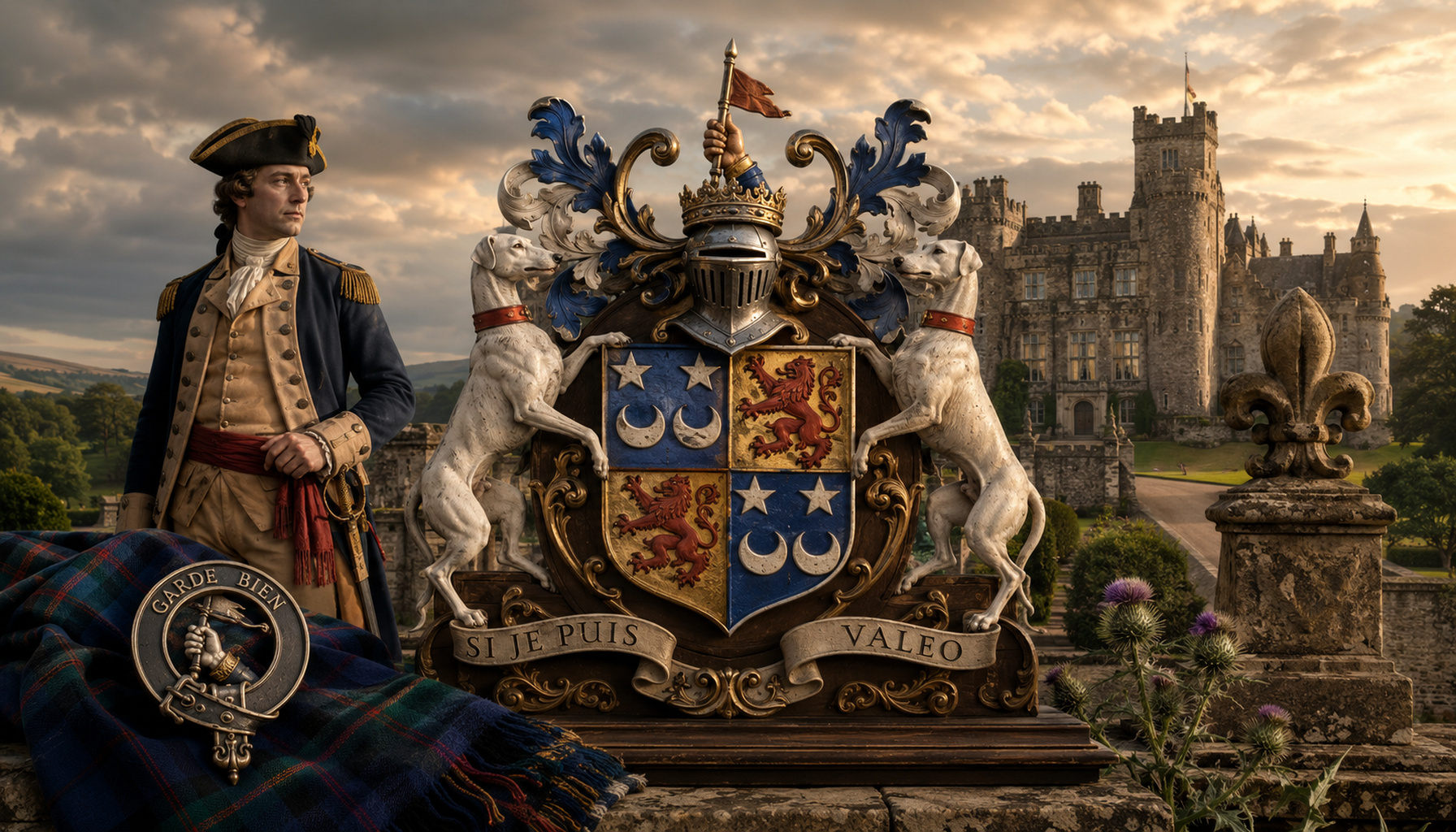
Clan Montgomery was one of the great noble families of Scotland: a house of Norman origin that took its name from Montgomery in Normandy and, over time, became thoroughly woven into Scottish history. In haplogroup terms, the primary family line here is tagged as J2a1a2b2a2b2a2b, a branch with a long and complicated story across the wider Mediterranean and Near Eastern world before any later appearance in the British Isles. Historically, the Montgomerys belonged to that broad Norman aristocratic movement which spread after the 11th century into Britain, where land, lordship, military service, and marriage alliances could turn an imported knightly family into a regional power.
In Scotland, the family became especially rooted in Renfrewshire and Ayrshire, with Eaglesham and then Eglinton emerging as key centers of Montgomery influence. Their rise was not sudden, nor was it merely decorative. This was a family that advanced by serving kings, managing estates, building alliances, and surviving the rough business of medieval and early modern politics. Alexander Montgomerie, 1st Lord Montgomerie, created in 1470, stands as one of the pivotal figures in that ascent, while the Earls of Eglinton, from 1508 to the present, carried the family into the front rank of Scottish nobility. The later Earls of Winton, restored from 1859 to the present in the Montgomery line, added yet another layer to the family's aristocratic story. Around them gathered all the familiar ingredients of noble power in Scotland: armed rivalry with neighboring families, royal favor, heraldry, castles, and a strong hold over local life in the west of the country.
Read more about Clan Cunningham
The Montgomery story also stretches well beyond feudal titles. They were involved in the unstable world of late medieval warfare, in the shifting loyalties of the Reformation, and in the fierce political and religious struggles of the Covenanting age. That matters because it reminds us that a clan like this was not just a tartan badge attached to a surname. It was a living network of land, kin, influence, and ambition. The Montgomerys are a very good example of how Norman lineage could be transformed, over centuries, into something unmistakably Scottish: a family whose local strongholds and noble authority helped shape the history of Ayrshire and left a lasting mark on the aristocratic map of Britain.
Eglinton Castle became the great symbolic seat of the Montgomery family, standing near Kilwinning in Ayrshire within what is now Eglinton Country Park. What visitors see today is not a fully intact medieval fortress but the remains of a grand later country house built in castellated style, shaped and reshaped across the 18th and 19th centuries to express the prestige of the Earls of Eglinton. It was closely associated with one of the most theatrical episodes in aristocratic Scotland, the famous Eglinton Tournament of 1839, a deliberately medievalizing spectacle staged by the 13th Earl that tried, with considerable flair and a touch of absurdity, to revive the age of chivalry in the modern world. Fire and later decline badly damaged the building, but surviving ruins, bridges, landscape features, and parkland still preserve the atmosphere of the estate. Yes, it can still be visited: the castle remains and surrounding country park are accessible to the public, making it one of the best places to feel the Montgomery imprint on the land rather than just read about it in a pedigree.
For those interested in deeper paternal origins, the Montgomery haplogroup tag J2a1a2b2a2b2a2b links the family to a much older and wider genetic landscape than medieval Scotland alone. Related or linked ancient samples carrying nearby branches include Phoenician Era Italy Sicily Selinunte Manuzza sample I21853, Hellenic-Carthago Tunisia Kerkouane sample I24047, an Ancient Greek warrior from the Second Sicilian War at Himera in Sicily sample I17866, a Mycenaean from Kolikrepi-Spata in Attica sample I16709, and an Ancient Mycenaean from Phokis near Delphi sample I13579. These are not evidence of direct descent from any one excavated individual, and it would be wrong to pretend otherwise. But they do show that this haplogroup family has a deep history in the eastern and central Mediterranean world, a useful reminder that noble houses of Norman and later Scottish identity often sit atop far older human journeys than their surnames suggest.
If you carry Montgomery ancestry, or simply want to see how your own DNA fits into this larger story of Norman migration, Scottish nobility, and deep ancient connections, you can upload your DNA to MyTrueAncestry and explore whether you match the family line or related ancient DNA samples.
Comments